Why didn't the US dollar weaken in tandem with oil prices falling below $100?
2026-09-23 18:00:11
On Wednesday, September 23, the US dollar index fluctuated around 100.80, while Brent crude oil fell back to around $99 per barrel, and risk sentiment did not deteriorate significantly. According to traditional forex logic, a decline in energy prices coupled with improved risk appetite would weaken the relative attractiveness of the dollar. However, this round of market movements has not followed this path. The market has once again placed pricing power in the Federal Reserve's policy narrative: after last week's 25 basis point increase in the federal funds rate, bringing the target range to 3.75%-4.00%, officials still prioritized inflation risks over employment risks. ING points out that the dollar remains resilient to lower energy prices and a risk-friendly environment, indicating that the Fed's narrative still dominates. 
How can policy statements override oil prices and risk appetite?
The real focus of the foreign exchange market in recent days hasn't been the decline in crude oil prices themselves, but rather whether the interest rate path has been rewritten. Richmond Fed President Thomas Barkin's speech in Baltimore on September 22nd articulated this logic directly. He stated that inflation risks outweigh employment risks, which was the reason for last week's rate hike; last week's rate hike helped lower prices, but whether further rate hikes are necessary, and how many, depends on subsequent data. He used the analogy of raising a child, saying that one conversation might not be enough. Barkin also provided constraints: the job market is neither overheated nor particularly tight, consumer balance sheets haven't shown significant strain, and if employment remains stable, spending is unlikely to contract proactively. He mentioned that the personal consumption expenditure price index was still at 3.7% in July, with a significant portion of core components growing above 3%, meaning price pressures cannot be simply attributed to energy or tariffs. For the foreign exchange market, this kind of statement has a concrete meaning: before employment shows a clearer slowdown, officials are unlikely to shift their stance to easing, and the dollar's interest rate support won't automatically dismantle due to a single day's drop in oil prices.How can high-frequency employment data constrain policy paths?
High-frequency employment indicators serve as an anchor for current expectations, not background noise. For the week ending September 12, initial jobless claims in the US fell to 196,000, lower than the market forecast of 208,000 and the previous week's 206,000, returning below the 200,000 mark; the four-week moving average was approximately 203,000. Continuing claims fell back to around 1.73 million during the same period. Seasonal adjustments during the Labor Day week can easily distort weekly readings, but the overall direction remains the same: the pace of layoffs has not accelerated. High-frequency hiring in the US private sector also shows no significant reversal. Institutional monitoring shows that weekly hiring briefly rebounded to around 20,000 in early September. August non-farm payrolls were 162,000, with an unemployment rate of 4.1%. Market expectations for the official September jobs report are converging towards 80,000 to 100,000. This range is neither overheated nor stalled. What's more crucial for traders is the transmission sequence. Stable employment makes it difficult for consumption to contract proactively; with consumption present, the rate of decline in service sector prices is limited; and a slow decline in prices narrows the repricing space for interest rates. The recent sluggish response of the US dollar index to improved risk appetite stems from this chain of factors, not from sentimental slogans.The decline in energy prices has not rewritten the logic of interest rate pricing.
Geopolitical disturbances have a limited immediate impact on the foreign exchange market. The UN General Assembly statements did not provide clear signals for the currency market; contacts with Iran and expectations of the resumption of Saudi Arabia's east-west pipeline pushed Brent crude below $100 per barrel. Currently, Brent is around $99 per barrel, and West Texas Intermediate crude is around $90 per barrel. Whether pipeline repairs and diplomatic contacts can translate into sustained supply improvement remains to be seen. From an interest rate pricing perspective, if oil prices continue to fluctuate between $90 and $100 per barrel, the downward pressure on inflation expectations will be limited, and the market will not rewrite the probability of the Fed's October policy based solely on this pullback. Energy is a variable, not an on/off switch. As long as employment and core price components do not weaken simultaneously, the center of gravity of interest rate expectations will not automatically shift downward simply because crude oil prices fell below psychological levels. The Fed officials' schedule was light that day, with the main data being the preliminary S&P Global Purchasing Managers' Index (PMI). Manufacturing was expected to be around 53.5 and services around 56.0, both still in expansion territory, but their weight is usually lower than the ISM survey and is more often used as a sentiment check.Daily chart structure
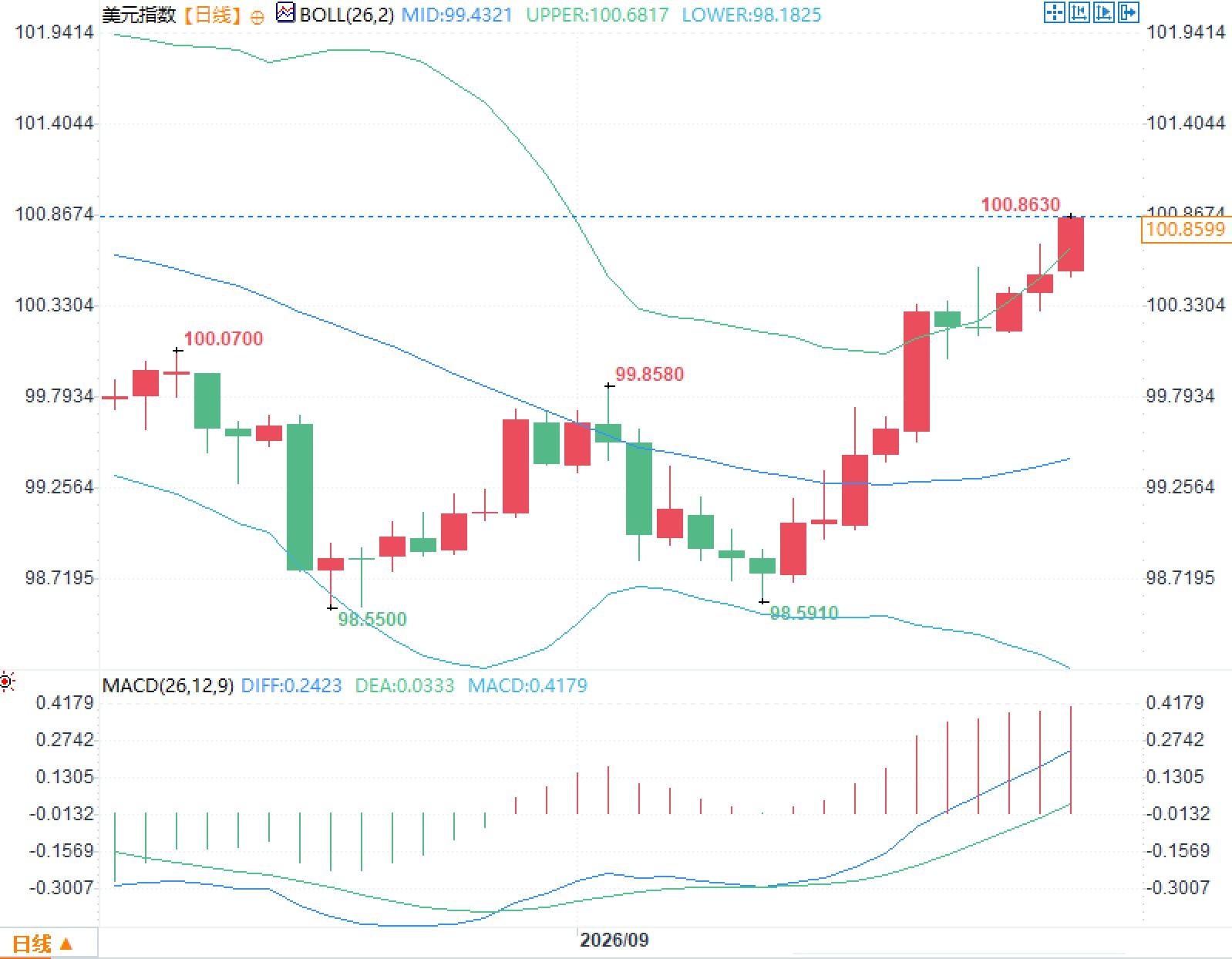
The US Dollar Index daily Bollinger Bands show a middle band at 99.4321, an upper band at 100.6817, and a lower band at 98.1825. The price is trading outside the upper band, with an intraday high of 100.8630. The MACD parameters are DIFF at 0.2423, DEA at 0.0333, and the histogram at 0.4179, with the histogram above the zero line. Recent lows were around 98.5500 and 98.5910, after which the price returned from below the middle band to near the upper band.Frequently Asked Questions
Question 1: Oil prices fell below $100 per barrel, why didn't the US dollar weaken in tandem? Answer: Forex trading is driven by relative interest rate paths. Brent crude has fallen back to around $99 per barrel. If it remains within the $90-$100 range, its downward pressure on core price expectations will be limited, and the market will not rewrite the Fed's path. Question 2: What does the 196,000 initial jobless claims mean for policy discussions? Answer: It indicates that the pace of layoffs has not accelerated. Barkin emphasized that the narrative is unlikely to shift until there is a clearer slowdown in employment. August's non-farm payrolls of 162,000 and unemployment rate of 4.1% point to the same constraint as high-frequency data.- Risk Warning and Disclaimer
- The market involves risk, and trading may not be suitable for all investors. This article is for reference only and does not constitute personal investment advice, nor does it take into account certain users’ specific investment objectives, financial situation, or other needs. Any investment decisions made based on this information are at your own risk.