Wall Street is worried that the Federal Reserve may raise interest rates further, and US Treasury yields have hit multi-year highs.
2026-09-24 00:42:12
On Wednesday (September 23), the US stock and bond markets experienced a period of synchronized adjustment, with the overall market exhibiting characteristics of mild repricing. Driven by multiple factors, including better-than-expected economic fundamentals, a recovery in energy prices, and minor adjustments to policy expectations, US Treasury yields rose to new multi-year highs.  I. Key Market Performance The overall sentiment in the US Treasury market was weak on the day, with yields generally rising. The 10-year Treasury yield rose 13 basis points to close at 5.08%, having reached a high of 5.07% during the session, hitting a high since July 2007. The 30-year Treasury yield also rose 9 basis points to 5.39%. The rise in long-term interest rates reflects a renewed market perception of long-term economic resilience and inflation sustainability, rather than a single negative impact, indicating a moderate upward shift in the long-term risk-free rate in the US. Meanwhile, the 2-year Treasury yield, more sensitive to monetary policy, rose 14 basis points to 4.88%, a new high in over two years. Fluctuations in short-term interest rates reflect the market's keen response to short-term policy changes, demonstrating rational behavior of cautious observation and advance positioning by fund providers. As risk-free rates rose, equity market valuations passively corrected. By midday Eastern Time, the Dow Jones Industrial Average was down 0.61%, the S&P 500 was down 0.66%, and the Nasdaq Composite was down 1.06%. Given that US stocks were previously at historically high levels and valuations were relatively priced in, rising interest rates naturally brought moderate downward pressure, which is a normal market self-regulation. Growth stocks, due to their greater valuation elasticity, experienced relatively more pronounced adjustments. II. Core Drivers of the Current Yield Rise
 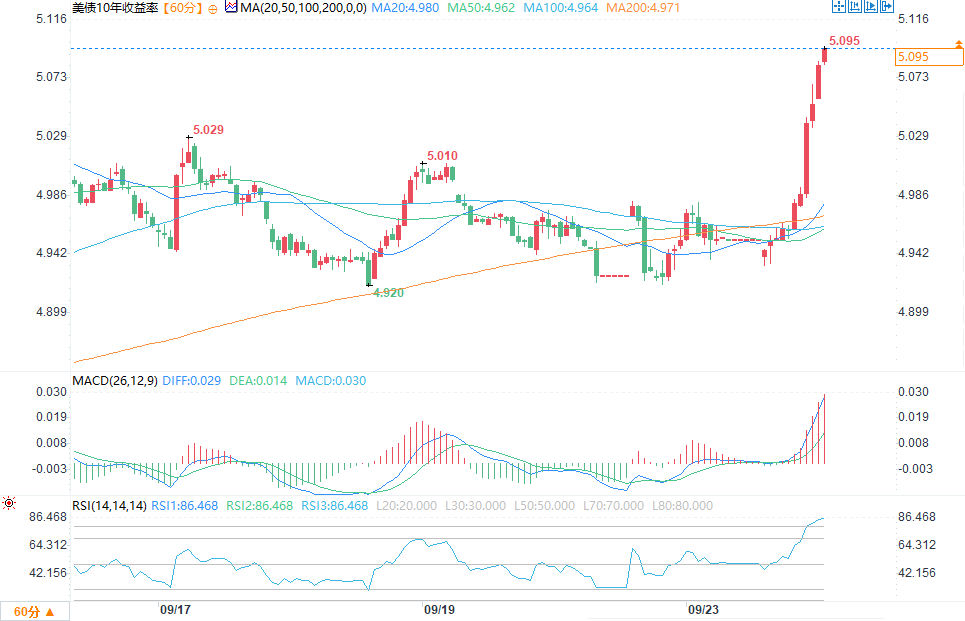 (US Treasury Yield 1-Hour Chart) The recent rise in US Treasury yields is the result of a confluence of multiple market signals. These factors have overlapped and collectively driven the recovery of market expectations, with no single dominant negative factor. First, the US manufacturing sector has demonstrated strong resilience. S&P Global data shows that the US manufacturing PMI for September was 57, significantly higher than the market expectation of 53.6. Manufacturing activity has expanded for four consecutive months, reaching a new high since July 2021. This steady recovery in the real economy reflects the positive trend of US industrial recovery and also allows the market to view the pace of inflation decline more rationally, weakening previous optimistic expectations of excessively rapid easing. Second, the phased recovery in energy prices has brought mild inflationary pressure. Brent crude futures rose 3.60% and WTI crude futures rose 2.45% on the day, with the November Brent crude contract price approaching $100 per barrel. Coupled with the policy expectations of a US diesel export ban, the market is more cautious in its assessment of the stability of the energy supply chain, reasonably predicting that energy inflation may remain resilient, which helps the policy side maintain a steady pace of regulation. Secondly, Federal Reserve officials released a prudent policy signal. Federal Reserve Governor Michael Barr stated that inflation remains somewhat sticky, and there is still a possibility of policy fine-tuning to steadily push inflation back to the 2% target range. This statement leans towards forward-looking risk control, helping to stabilize long-term inflation expectations and allowing monetary policy to maintain a flexible and gradual adjustment pace. Finally, the interconnectedness of global capital markets has increased. The European sovereign bond market experienced a period of volatility, with cross-border capital rebalancing leading to a synchronized adjustment in US Treasury bonds. The synchronized changes in the global fixed-income market reflect the unified pricing logic of international capital in the global macroeconomic environment, which is a normal phenomenon of cross-border market linkage. III. Market Interest Rate Hike Expectations and Institutional Views With the continued release of economic, inflation, and policy signals, market predictions of the Federal Reserve's policy path have become more detailed. According to data from the CME FedWatch Tool, the probability of an October rate hike rose from 55% the previous day to 71%, and the probability of at least one rate hike before December is close to 95%. The rising expectation of a rate hike is not panic pricing, but rather a gradual correction of expectations based on the latest data. Several mainstream institutions have also offered cautious and rational assessments of the market outlook. Gregory Daco, Chief Economist of Ernst & Young Parthenon, believes the Federal Reserve may implement a 25-basis-point rate hike in December. Moderate policy tightening would help smooth inflation fluctuations and stabilize long-term economic expectations, but it could also lead to a period of stock market valuation adjustments. Keith Leiner, Chief Investment Officer of Truss Consulting, noted that the current pace of interest rate increases is relatively fast, which could easily trigger market volatility in the short term. Mackenzie Investments' fixed income team stated that the previous period of stability in the bond market has temporarily ended, and the market is actively adapting to a more stable and cautious monetary policy environment. IV. Structural Reasons for the Continued Rise in Long-Term Bond Yields This Year The steady rise in long-term US Treasury yields this year stems from long-term structural supply and demand changes and a gradual adjustment in market pricing logic, rather than a short-term emotional shock. First, the risk premium of US Treasury bonds has been reasonably corrected. With the steady expansion of US fiscal scale, the market rationally demands higher long-term risk compensation, which is a normal pricing correction process in mature capital markets, driving a gradual increase in long-term bond yields. Second, the demand for real economy financing has led to an expansion of bond supply. The continued development of the AI industry has driven growth in corporate capital expenditure, leading to a steady increase in the issuance of corporate bonds. Dynamic changes in the market's investment and financing structure and the diversification of fixed-income product supply have prompted an adaptive adjustment in the overall yield center. Third, the effectiveness of policy stabilization tools is relatively limited. The US Treasury launched a Treasury repurchase operation lasting until early November, aiming to stabilize long-term interest rate fluctuations. While this policy has a positive intention to stabilize the market, it is difficult to completely offset long-term changes in macroeconomic fundamentals and market structure, thus its effect is relatively mild. V. Macroeconomic and Market Impacts of a High-Interest-Rate Environment Bond prices and yields fluctuate inversely. This round of interest rate increases has led to a reasonable return of overall social financing prices. Adaptive increases in household credit, corporate financing, and government interest payments help curb overheated demand and smooth the pace of inflation, which is positive for long-term economic stability. At the capital market level, rising risk-free interest rates have led to a correction in the valuation system. Growth equities are more sensitive to interest rates, thus their short-term adjustments are more pronounced. This type of valuation fluctuation is a benign market self-correction that can squeeze out irrational premiums and make asset pricing more aligned with fundamentals. Overall, the Federal Reserve's 25-basis-point rate hike earlier this month, given the persistently sticky inflation and resilient economy, justifies a cautious pace of policy tightening. Going forward, the market will continue to seek a balance between economic resilience, declining inflation, and policy adjustments, and the overall market environment will evolve towards a more stable, rational, and orderly direction.
I. Key Market Performance The overall sentiment in the US Treasury market was weak on the day, with yields generally rising. The 10-year Treasury yield rose 13 basis points to close at 5.08%, having reached a high of 5.07% during the session, hitting a high since July 2007. The 30-year Treasury yield also rose 9 basis points to 5.39%. The rise in long-term interest rates reflects a renewed market perception of long-term economic resilience and inflation sustainability, rather than a single negative impact, indicating a moderate upward shift in the long-term risk-free rate in the US. Meanwhile, the 2-year Treasury yield, more sensitive to monetary policy, rose 14 basis points to 4.88%, a new high in over two years. Fluctuations in short-term interest rates reflect the market's keen response to short-term policy changes, demonstrating rational behavior of cautious observation and advance positioning by fund providers. As risk-free rates rose, equity market valuations passively corrected. By midday Eastern Time, the Dow Jones Industrial Average was down 0.61%, the S&P 500 was down 0.66%, and the Nasdaq Composite was down 1.06%. Given that US stocks were previously at historically high levels and valuations were relatively priced in, rising interest rates naturally brought moderate downward pressure, which is a normal market self-regulation. Growth stocks, due to their greater valuation elasticity, experienced relatively more pronounced adjustments. II. Core Drivers of the Current Yield Rise (US Treasury Yield 1-Hour Chart) The recent rise in US Treasury yields is the result of a confluence of multiple market signals. These factors have overlapped and collectively driven the recovery of market expectations, with no single dominant negative factor. First, the US manufacturing sector has demonstrated strong resilience. S&P Global data shows that the US manufacturing PMI for September was 57, significantly higher than the market expectation of 53.6. Manufacturing activity has expanded for four consecutive months, reaching a new high since July 2021. This steady recovery in the real economy reflects the positive trend of US industrial recovery and also allows the market to view the pace of inflation decline more rationally, weakening previous optimistic expectations of excessively rapid easing. Second, the phased recovery in energy prices has brought mild inflationary pressure. Brent crude futures rose 3.60% and WTI crude futures rose 2.45% on the day, with the November Brent crude contract price approaching $100 per barrel. Coupled with the policy expectations of a US diesel export ban, the market is more cautious in its assessment of the stability of the energy supply chain, reasonably predicting that energy inflation may remain resilient, which helps the policy side maintain a steady pace of regulation. Secondly, Federal Reserve officials released a prudent policy signal. Federal Reserve Governor Michael Barr stated that inflation remains somewhat sticky, and there is still a possibility of policy fine-tuning to steadily push inflation back to the 2% target range. This statement leans towards forward-looking risk control, helping to stabilize long-term inflation expectations and allowing monetary policy to maintain a flexible and gradual adjustment pace. Finally, the interconnectedness of global capital markets has increased. The European sovereign bond market experienced a period of volatility, with cross-border capital rebalancing leading to a synchronized adjustment in US Treasury bonds. The synchronized changes in the global fixed-income market reflect the unified pricing logic of international capital in the global macroeconomic environment, which is a normal phenomenon of cross-border market linkage. III. Market Interest Rate Hike Expectations and Institutional Views With the continued release of economic, inflation, and policy signals, market predictions of the Federal Reserve's policy path have become more detailed. According to data from the CME FedWatch Tool, the probability of an October rate hike rose from 55% the previous day to 71%, and the probability of at least one rate hike before December is close to 95%. The rising expectation of a rate hike is not panic pricing, but rather a gradual correction of expectations based on the latest data. Several mainstream institutions have also offered cautious and rational assessments of the market outlook. Gregory Daco, Chief Economist of Ernst & Young Parthenon, believes the Federal Reserve may implement a 25-basis-point rate hike in December. Moderate policy tightening would help smooth inflation fluctuations and stabilize long-term economic expectations, but it could also lead to a period of stock market valuation adjustments. Keith Leiner, Chief Investment Officer of Truss Consulting, noted that the current pace of interest rate increases is relatively fast, which could easily trigger market volatility in the short term. Mackenzie Investments' fixed income team stated that the previous period of stability in the bond market has temporarily ended, and the market is actively adapting to a more stable and cautious monetary policy environment. IV. Structural Reasons for the Continued Rise in Long-Term Bond Yields This Year The steady rise in long-term US Treasury yields this year stems from long-term structural supply and demand changes and a gradual adjustment in market pricing logic, rather than a short-term emotional shock. First, the risk premium of US Treasury bonds has been reasonably corrected. With the steady expansion of US fiscal scale, the market rationally demands higher long-term risk compensation, which is a normal pricing correction process in mature capital markets, driving a gradual increase in long-term bond yields. Second, the demand for real economy financing has led to an expansion of bond supply. The continued development of the AI industry has driven growth in corporate capital expenditure, leading to a steady increase in the issuance of corporate bonds. Dynamic changes in the market's investment and financing structure and the diversification of fixed-income product supply have prompted an adaptive adjustment in the overall yield center. Third, the effectiveness of policy stabilization tools is relatively limited. The US Treasury launched a Treasury repurchase operation lasting until early November, aiming to stabilize long-term interest rate fluctuations. While this policy has a positive intention to stabilize the market, it is difficult to completely offset long-term changes in macroeconomic fundamentals and market structure, thus its effect is relatively mild. V. Macroeconomic and Market Impacts of a High-Interest-Rate Environment Bond prices and yields fluctuate inversely. This round of interest rate increases has led to a reasonable return of overall social financing prices. Adaptive increases in household credit, corporate financing, and government interest payments help curb overheated demand and smooth the pace of inflation, which is positive for long-term economic stability. At the capital market level, rising risk-free interest rates have led to a correction in the valuation system. Growth equities are more sensitive to interest rates, thus their short-term adjustments are more pronounced. This type of valuation fluctuation is a benign market self-correction that can squeeze out irrational premiums and make asset pricing more aligned with fundamentals. Overall, the Federal Reserve's 25-basis-point rate hike earlier this month, given the persistently sticky inflation and resilient economy, justifies a cautious pace of policy tightening. Going forward, the market will continue to seek a balance between economic resilience, declining inflation, and policy adjustments, and the overall market environment will evolve towards a more stable, rational, and orderly direction.
- Risk Warning and Disclaimer
- The market involves risk, and trading may not be suitable for all investors. This article is for reference only and does not constitute personal investment advice, nor does it take into account certain users’ specific investment objectives, financial situation, or other needs. Any investment decisions made based on this information are at your own risk.