A chart shows the Baltic Dry Index has slightly declined, with significant divergence in market conditions across different ship types.
2026-09-23 22:44:12
The latest data shows that on September 23, 2026, the Baltic Dry Index (BDI) was 3430 points, a decrease of 0.06% compared to the previous week, marking the largest drop since September 16, 2026. Looking at the short-term charts, the BDI has seen positive growth 5 times, negative growth 6 times, and zero growth 0 times in the last 11 BDI data points. Specifically, the Panamax Freight Index (BPI) was 2333 points, up 1.48% from the previous week; the Capesize Freight Index (BCI) was 5861 points, down 0.53%; and the Supramax Freight Index (BSI) was 1778 points, up 0.11%. For detailed charts of the latest 720-day and 10-year trends of the Baltic Dry Index and its three main sub-indices, please refer to the charts specially created by FX678. 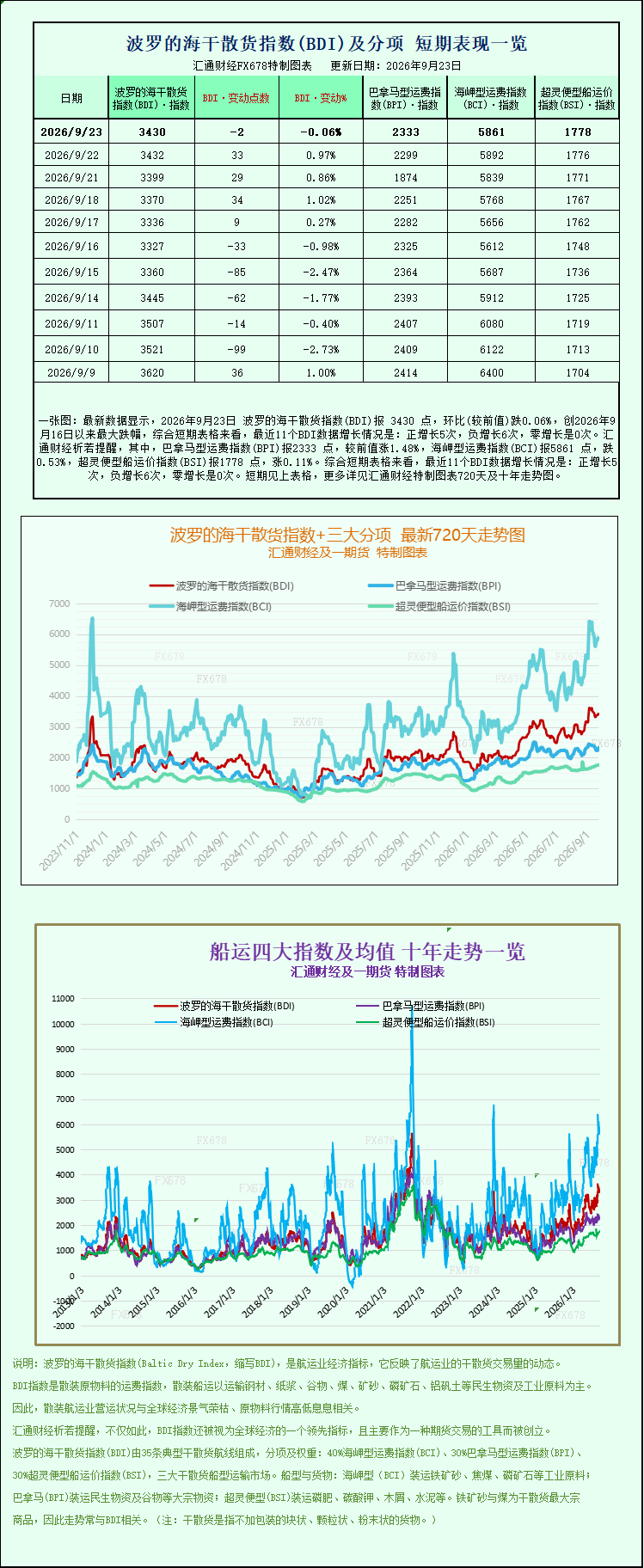 Global shipping benchmark indices saw a slight pullback due to both weakening international crude oil prices and cooling demand for Capesize vessels. Weak crude oil prices dragged down overall sentiment in commodity shipping, coupled with a short-term easing of the supply-demand balance for large dry bulk carriers, resulting in a clear structural divergence in the global dry bulk shipping market on September 23. Overall, the Baltic Dry Index reversed its previous day's upward trend and declined slightly, with large vessel freight rates under pressure and falling, while medium and small bulk carrier rates rose against the trend, showing significant differences in market segmentation. The latest data released by the Baltic Exchange on September 23 showed that the Baltic Dry Index fell slightly on Wednesday, ending the week-long high reached in the previous trading day. Previously, on September 22nd, the index surged, climbing to its highest point in nearly a week, indicating a slight improvement in short-term market sentiment. However, the upward momentum failed to continue, primarily due to a significant weakening in Capesize vessel freight rates, which offset the gains in smaller vessel sizes, ultimately leading to a slight pullback in the overall index. As the vessel type with the largest market weighting, the Capesize vessel market was the core trigger for this index correction. Data shows that the Capesize vessel index fell 31 points that day, a decrease of 0.5%, closing at 5861 points, making it the only mainstream vessel type to experience a significant decline. In terms of specific operating revenue, Capesize vessels, which mainly carry 150,000-ton iron ore, coal, and other bulk industrial raw materials, saw their average daily earnings decrease by $286 compared to the previous trading day, with the latest average daily revenue at $49,652. Capesize vessels primarily serve the long-haul transportation of global commodities. Their freight rates are highly correlated with industrial raw material demand and energy market sentiment. The recent decline in freight rates is mainly due to the impact of weak international crude oil prices, leading to a more cautious market outlook on the pace of global industrial recovery and a temporary cooling in demand for commodity shipping bookings. Notably, iron ore, a core cargo transported by Capesize vessels, has seen its market fundamentals stabilize and recover, offsetting some of the downward pressure on the shipping market. Recently, iron ore futures prices have continued to rise slightly. After last week's sharp drop, market sentiment has gradually recovered, and prices have stabilized. This recovery in iron ore prices is mainly attributed to short-term supply support from weather factors. Affected by El Niño, major iron ore producing regions in Brazil experienced logistical disruptions and reduced shipments, resulting in a short-term global iron ore supply gap and providing strong support for prices. Meanwhile, the current profitability of the domestic steel industry is weak, and the recovery of downstream steel demand is slower than expected, which to some extent has suppressed the upward space of iron ore prices. Amidst the interplay of bullish and bearish factors, the iron ore market has maintained a generally stable and volatile pattern, providing a floor for Capesize freight rates and preventing a sharp decline. In stark contrast to the sluggish performance of Capesize vessels, the medium-sized Panamax vessels have performed exceptionally well, becoming the core force supporting the resilience of the market. Data shows that the Panamax index rose sharply by 34 points that day, an increase of 1.5%, closing at 2333 points, the most significant increase among the three major vessel types. Revenue has also rebounded simultaneously. Panamax vessels, which mainly carry 60,000 to 70,000 tons of coal, grain, and other commodities, saw an increase of $309 in daily revenue, reaching a latest daily average of $20,996. Panamax vessels are mainly suitable for regional food and energy transport. Recently, the accelerated global food trade and increased demand for coal replenishment in Asia have driven a continuous increase in bookings for this vessel type, leading to a corresponding rise in freight rates. The small vessel market also continued its steady upward trend, further highlighting the overall resilience of the market. The Supramax vessel index rose slightly by 2 points, or 0.1%, to close at 1778 points, maintaining a steady upward trend. Supramax vessels are flexible in hull size and adaptable to a wide range of routes, mainly handling small and medium-sized bulk cargo transportation. Benefiting from stable demand in global trade of scattered industrial materials, building materials, and minor agricultural products, freight rates have remained stable with minimal fluctuations, becoming a cornerstone of the shipping market's stability. In summary, the slight decline in the Baltic Dry Index is essentially a reflection of structural differentiation in the shipping market, not an overall downturn in prosperity. Currently, the global dry bulk shipping market presents a pattern of "large vessels under pressure, medium and small vessels strengthening," the core logic being the differentiated impact of energy market sentiment and regional trade demand. In the short term, the weak trend in international crude oil prices will continue to suppress the market for large bulk carriers, while disruptions in Brazilian iron ore supply, active global food trade, and regional energy restocking demand will continue to support freight rates for medium and small vessels. The subsequent market trend will depend heavily on the pace of global industrial recovery, the supply and demand pattern of commodities, and the fluctuations in international oil prices. Overall, the market is expected to maintain a structural oscillating trend, and the divergence is likely to continue.
Global shipping benchmark indices saw a slight pullback due to both weakening international crude oil prices and cooling demand for Capesize vessels. Weak crude oil prices dragged down overall sentiment in commodity shipping, coupled with a short-term easing of the supply-demand balance for large dry bulk carriers, resulting in a clear structural divergence in the global dry bulk shipping market on September 23. Overall, the Baltic Dry Index reversed its previous day's upward trend and declined slightly, with large vessel freight rates under pressure and falling, while medium and small bulk carrier rates rose against the trend, showing significant differences in market segmentation. The latest data released by the Baltic Exchange on September 23 showed that the Baltic Dry Index fell slightly on Wednesday, ending the week-long high reached in the previous trading day. Previously, on September 22nd, the index surged, climbing to its highest point in nearly a week, indicating a slight improvement in short-term market sentiment. However, the upward momentum failed to continue, primarily due to a significant weakening in Capesize vessel freight rates, which offset the gains in smaller vessel sizes, ultimately leading to a slight pullback in the overall index. As the vessel type with the largest market weighting, the Capesize vessel market was the core trigger for this index correction. Data shows that the Capesize vessel index fell 31 points that day, a decrease of 0.5%, closing at 5861 points, making it the only mainstream vessel type to experience a significant decline. In terms of specific operating revenue, Capesize vessels, which mainly carry 150,000-ton iron ore, coal, and other bulk industrial raw materials, saw their average daily earnings decrease by $286 compared to the previous trading day, with the latest average daily revenue at $49,652. Capesize vessels primarily serve the long-haul transportation of global commodities. Their freight rates are highly correlated with industrial raw material demand and energy market sentiment. The recent decline in freight rates is mainly due to the impact of weak international crude oil prices, leading to a more cautious market outlook on the pace of global industrial recovery and a temporary cooling in demand for commodity shipping bookings. Notably, iron ore, a core cargo transported by Capesize vessels, has seen its market fundamentals stabilize and recover, offsetting some of the downward pressure on the shipping market. Recently, iron ore futures prices have continued to rise slightly. After last week's sharp drop, market sentiment has gradually recovered, and prices have stabilized. This recovery in iron ore prices is mainly attributed to short-term supply support from weather factors. Affected by El Niño, major iron ore producing regions in Brazil experienced logistical disruptions and reduced shipments, resulting in a short-term global iron ore supply gap and providing strong support for prices. Meanwhile, the current profitability of the domestic steel industry is weak, and the recovery of downstream steel demand is slower than expected, which to some extent has suppressed the upward space of iron ore prices. Amidst the interplay of bullish and bearish factors, the iron ore market has maintained a generally stable and volatile pattern, providing a floor for Capesize freight rates and preventing a sharp decline. In stark contrast to the sluggish performance of Capesize vessels, the medium-sized Panamax vessels have performed exceptionally well, becoming the core force supporting the resilience of the market. Data shows that the Panamax index rose sharply by 34 points that day, an increase of 1.5%, closing at 2333 points, the most significant increase among the three major vessel types. Revenue has also rebounded simultaneously. Panamax vessels, which mainly carry 60,000 to 70,000 tons of coal, grain, and other commodities, saw an increase of $309 in daily revenue, reaching a latest daily average of $20,996. Panamax vessels are mainly suitable for regional food and energy transport. Recently, the accelerated global food trade and increased demand for coal replenishment in Asia have driven a continuous increase in bookings for this vessel type, leading to a corresponding rise in freight rates. The small vessel market also continued its steady upward trend, further highlighting the overall resilience of the market. The Supramax vessel index rose slightly by 2 points, or 0.1%, to close at 1778 points, maintaining a steady upward trend. Supramax vessels are flexible in hull size and adaptable to a wide range of routes, mainly handling small and medium-sized bulk cargo transportation. Benefiting from stable demand in global trade of scattered industrial materials, building materials, and minor agricultural products, freight rates have remained stable with minimal fluctuations, becoming a cornerstone of the shipping market's stability. In summary, the slight decline in the Baltic Dry Index is essentially a reflection of structural differentiation in the shipping market, not an overall downturn in prosperity. Currently, the global dry bulk shipping market presents a pattern of "large vessels under pressure, medium and small vessels strengthening," the core logic being the differentiated impact of energy market sentiment and regional trade demand. In the short term, the weak trend in international crude oil prices will continue to suppress the market for large bulk carriers, while disruptions in Brazilian iron ore supply, active global food trade, and regional energy restocking demand will continue to support freight rates for medium and small vessels. The subsequent market trend will depend heavily on the pace of global industrial recovery, the supply and demand pattern of commodities, and the fluctuations in international oil prices. Overall, the market is expected to maintain a structural oscillating trend, and the divergence is likely to continue.
- Risk Warning and Disclaimer
- The market involves risk, and trading may not be suitable for all investors. This article is for reference only and does not constitute personal investment advice, nor does it take into account certain users’ specific investment objectives, financial situation, or other needs. Any investment decisions made based on this information are at your own risk.