The Bank of Japan's meeting minutes were hawkish but the path forward was gradual. How much support can the yen get?
2026-09-28 10:22:15
On Monday (September 28) during Asian trading hours, the US dollar rose against the Japanese yen, currently trading around 157.80. The latest minutes of the Bank of Japan's July meeting provided key clues for the market to assess the pace of future interest rate hikes. The minutes of the Bank of Japan's policy meeting held on July 30-31, released Monday, showed that the board voted 8-1 to keep the key interest rate unchanged at around 1.0%, but debated the pace of further rate hikes, with one member dissenting in support of immediate action. Board member Hajime Takada was the only dissenter, arguing that the global shift towards tighter monetary policy meant the Bank of Japan needed to adopt a more flexible approach, discussing the magnitude of rate hikes rather than adhering to a fixed pace. He proposed raising the interest rate to around 1.25% at the meeting, but this was rejected by the remaining board members, with most preferring to first assess how the June rate hike would be transmitted to the economy. 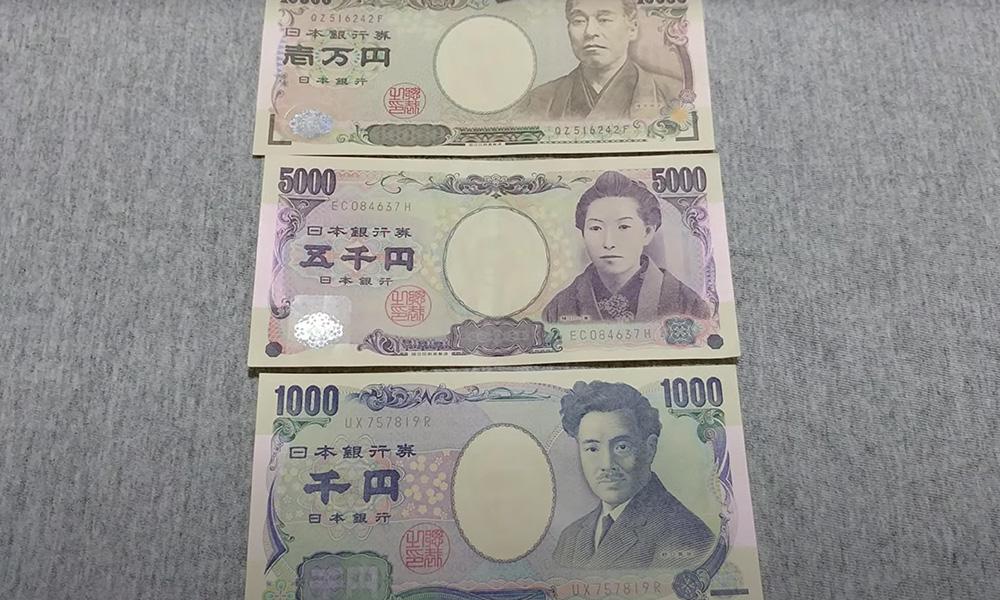
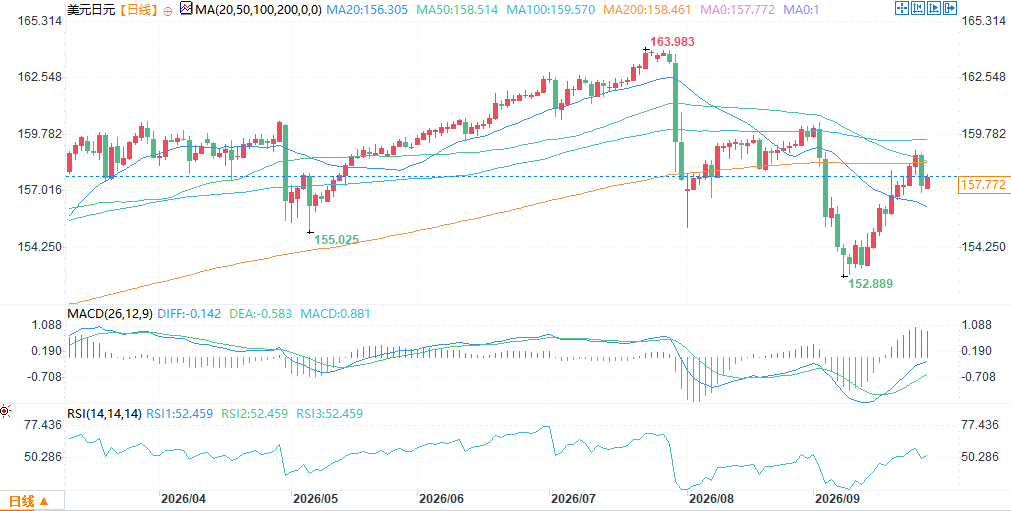 (USD/JPY daily chart, source: EasyForex) At 10:20 Beijing time, USD/JPY was trading at 157.74/75.
The vote was 8 to 1 to maintain the interest rate, with the sole dissenter advocating for an immediate rate hike to 1.25%.
The policy board voted 8-1 to maintain its guidance on the unsecured overnight call rate at around 1.0%, unchanged since the June rate hike. Hajime Takata was the sole dissenter, arguing that the global shift towards tighter monetary policy meant the Bank of Japan needed to be more flexible, discussing the magnitude of rate hikes rather than adhering to a fixed pace. He proposed raising the rate to around 1.25% at the meeting, but this was rejected by the rest of the board. Most members preferred to first assess how the June rate hike would transmit to the economy, as rising interest rates typically have a lag of about one to one and a half years before affecting inflation and activity. This dissent was not an isolated incident—Takata's proposal in July became a reality at the September meeting, when the Bank of Japan raised the policy rate to 1.25% on September 17-18, the highest level since 1995.Inflation risks are tilted to the upside, with core inflation approaching 2%, and some indicators already reaching 2.5% to 3%.
Despite maintaining interest rates, the discussion leaned towards caution rather than definitive conclusions. Members agreed that underlying consumer price inflation, excluding fresh food, was hovering around 1.5% at the time of the meeting, but was approaching the central bank's 2% target. They assessed that the risks to the price outlook were skewed to the upside, while growth risks were roughly balanced. The Board expects overall inflation to rise significantly above 2% from the second half of the fiscal year, driven by the transmission from previous oil price increases and yen depreciation, before falling back to around 2% the following year. Some members went further, noting that inflation measures excluding one-off government subsidies were already hovering between 2.5% and 3%, suggesting that the 2% norm might be more entrenched than the overall data indicated.Middle Eastern oil prices and AI demand have become two major sources of risk.
Two forces dominated the risk discussions: developments in the Middle East and the pace of global AI-related demand. Oil prices fluctuated significantly between the two meetings, falling due to the now-defunct US-Iran memorandum of understanding and subsequently rising as tensions resurfaced; AI-related exports and investment continued to support Japanese corporate profits and business confidence, even as terms of trade were squeezed by higher energy costs. Members also flagged the yen's depreciation as a potential price driver, particularly given the broader shift in corporate behavior towards passing costs onto wages and selling prices, a shift they said makes exchange rate movements more likely to transmit to inflation than in the past.Market expectations that a six-month interval between rate hikes may be too slow.
Regarding the future pace of tightening, several members stated that given the upside risks, the market-priced approximately six-month interval for rate hikes might prove too slow. However, the Board did not commit to any fixed timetable, indicating that decisions will continue to be made on a meeting-by-meeting basis based on upcoming data. This statement implies that if inflationary pressures accumulate, the pace of rate hikes could be faster than the market expects, and the yen and Japanese government bond markets will remain sensitive to upcoming inflation data. Fluctuations in Middle Eastern oil prices and AI-related demand were repeatedly cited as the two most likely forces driving the Bank of Japan's actions.The interest rate differential between USD/JPY has not yet reversed.
The minutes clearly correlated with the USD/JPY exchange rate, but the impact was complex. On one hand, the minutes reinforced the Bank of Japan's narrative of continued normalization: the only dissenter advocated an immediate rate hike to 1.25%, a proposal that materialized in September; members unanimously agreed that inflation risks were tilted to the upside, with some indicators reaching 2.5% to 3%; several members explicitly pointed out that the market's pricing of a six-month rate hike interval might be too slow. These signals are theoretically bullish for the yen, as faster rate hikes would narrow the USD/JPY interest rate differential, reducing the attractiveness of carry trades. On the other hand, the minutes reinforced a "gradual but continuous" path, rather than accelerating tightening. The board did not commit to a fixed timetable, emphasizing data-driven decisions at each meeting, meaning the Bank of Japan is unlikely to provide more hawkish guidance than the market expects in the short term. In contrast, the Federal Reserve maintained interest rates at 3.75% to 4.00% and retained the option for further rate hikes, keeping the USD/JPY interest rate differential wide. After the release of the minutes, the USD/JPY pair remained near recent highs, reflecting the market's focus on the current interest rate differential rather than the Bank of Japan's long-term intentions. For USD/JPY, the impact of the minutes is more reflected in increased sensitivity: if upcoming inflation data supports a faster rate hike, the yen may receive some support; if the data is moderate, the Bank of Japan's gradual stance will be confirmed, the interest rate differential logic will continue to dominate, and the downside for USD/JPY will be limited. Middle East oil prices and AI demand were repeatedly mentioned as two major variables, which will also indirectly affect Japanese inflation and the pace of the central bank's policy decisions.Summarize
The minutes of the Bank of Japan's July meeting revealed that, despite maintaining interest rates, the board's debate shifted from "whether to raise rates again" to "how quickly to raise rates." The sole dissenter, Hajime Takada, advocated for an immediate rate hike to 1.25%, a proposal that materialized in September. Members unanimously agreed that inflation risks were skewed to the upside, with core inflation nearing 2% and some indicators reaching 2.5% to 3%, citing Middle East oil prices and AI demand as two major sources of risk. Several members suggested that the market-priced six-month interval for rate hikes might be too slow, but the board did not commit to a fixed timetable. For the yen and Japanese government bond markets, the minutes reinforced the Bank of Japan's narrative of gradual but continuous normalization; upcoming inflation data will determine whether the pace of rate hikes is faster than market expectations. Going forward, attention should be paid to Middle East oil price movements, changes in AI-related demand, the yen exchange rate, and the Bank of Japan's decisions at each meeting. (USD/JPY daily chart, source: EasyForex) At 10:20 Beijing time, USD/JPY was trading at 157.74/75.
- Risk Warning and Disclaimer
- The market involves risk, and trading may not be suitable for all investors. This article is for reference only and does not constitute personal investment advice, nor does it take into account certain users’ specific investment objectives, financial situation, or other needs. Any investment decisions made based on this information are at your own risk.