The 10-year US Treasury yield broke 5%, prompting strategists to warn of US fiscal risks and argue that gold remains the core asset allocation during periods of stagflation.
2026-09-28 11:22:13
With the 10-year US Treasury yield rising above 5%, many investors are attracted by the high yields and want to enter the market to invest in US Treasuries. Kristina Hooper, chief market strategist at MF Global, warns that persistently high borrowing costs are posing an increasing threat to financial markets and the overall macroeconomy. In this environment of uncertainty, investors should diversify their asset allocation, including gold and other commodities in their portfolios to hedge against multiple macroeconomic risks. Hooper points out that the sustainability of US fiscal policy is currently questionable, inflation risks have not yet peaked, and supply-side price pressures are a problem that the Federal Reserve cannot easily resolve through monetary policy alone.

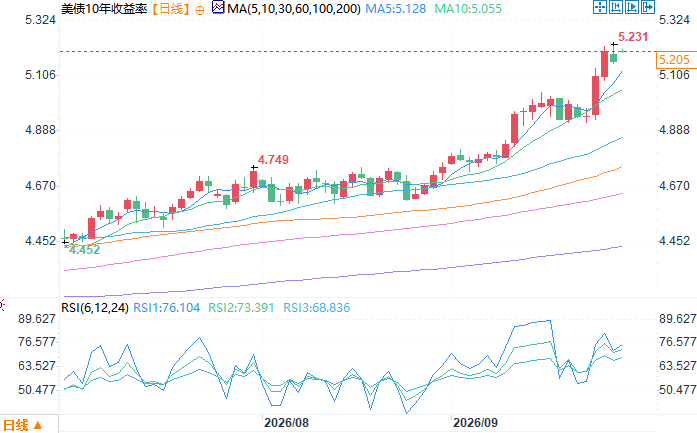 10-year US Treasury yield daily chart. Source: EasyTrade. At 11:20 AM Beijing time on September 28th, the 10-year US Treasury yield was 5.197%.
The high yields of US Treasury bonds conceal underlying fiscal risks, increasing the risk of long-term US Treasury investment.
Many investors see the 10-year US Treasury yield breaking through 5% as an attractive entry opportunity. However, Kristina Hooper cautions the market against focusing solely on the impressive coupon rates, emphasizing the deeper risks lurking behind rising yields, particularly the ripple effects of the US government's massive debt. Hooper states that rising long-term bond yields will suppress the stock market, particularly impacting long-duration sectors like technology, and the risks extend far beyond equity. When a significant portion of the federal budget is used to pay debt interest, the negative impact gradually spreads throughout the economy. She says, "When a large portion of the federal budget is used to pay debt, this spending is not productive." This phenomenon warrants attention from multiple perspectives. Even if the rise in yields is partly due to strong economic growth, high interest rates will still significantly impact the market and economy, and coupled with an increasingly challenging fiscal environment, the overall negative impact cannot be ignored. She said, "Overall, I think this is a negative signal; it's essentially a fiscal sustainability crisis." She further explained that rising bond yields expose a core problem facing the US: there is currently no clear and feasible path to reduce the deficit-to-GDP ratio . For investors looking to invest in US Treasuries, Hooper advised against blindly allocating to long-term Treasuries, as yields still have room to rise. She stated, "The risks of investing in US Treasuries today are significantly higher than a few years ago." While she didn't give a specific target price, she judged that the 10-year Treasury yield still has the potential to continue rising. Faced with such uncertainty, investors should not bet on a single economic scenario; broad diversification is the preferred approach.Inflationary pressures have complex origins, and the risk of stagflation cannot be ignored.
According to Hooper, inflationary pressures in the United States have not subsided but may even intensify. The Federal Reserve faces a significant challenge in successfully suppressing inflation, as policymakers must address multiple sources of price increases simultaneously. She stated, "The sources of inflation are currently very diverse, with various factors pushing up prices intertwined." She listed several key drivers: the situation in the Middle East, the Russia-Ukraine conflict, tariff policies, immigration policies, and the massive capital investment in artificial intelligence infrastructure. Hooper added that the tariff shock is not a one-off event; newly introduced tariffs will continue to generate a series of smaller inflationary disturbances. Currently, most price pressures are supply-side issues, and monetary policy has limited effectiveness in controlling this type of inflation. She continued, " Monetary policy is more effective at dealing with demand-pull inflation; it is naturally at a disadvantage when facing supply-side inflation. " This means the Federal Reserve faces a huge challenge from the outset. The superposition of multiple supply shocks increases the likelihood of the US economy falling into stagflation , meaning weak economic growth but persistently high inflation. The energy sector is another major inflationary threat, with pressure on refining capacity continuing to push up energy prices. Rising diesel prices will spread to transportation and commodity distribution, creating a secondary and tertiary chain reaction, transmitting overall inflationary pressure to core inflation. She said, "This is the process by which overall inflation transforms into core inflation." Many in the market believe inflation is about to peak, but Hooper disagrees, reminding the market not to be complacent. She said, "I don't think inflation has peaked; it's probably still some distance from its peak."A new approach to asset allocation: diversification, with an emphasis on gold and commodities.
Faced with multiple uncertainties surrounding inflation, interest rates, government finances, and economic growth, Hooper advises investors to build a more balanced portfolio, relying on the differentiated performance of various assets under different macroeconomic environments to mitigate risk. Diversification should cover both traditional asset classes and cross-class assets, including overseas equities and fixed-income products. At the same time, commodities and alternative investments should also be important components of the portfolio; their value will become more apparent if inflation remains high and the economy moves towards stagflation. Hooper stated that commodities have historically performed well in inflationary environments, and trend-following alternative strategies can also generate returns during sustained price movements, with gold playing a key role in the portfolio. She said, "Gold tends to perform well in stagflationary environments." She acknowledged that rising interest rates increase the opportunity cost of holding gold, putting downward pressure on prices. However, historically, gold has shown remarkable performance during periods of widespread inflation, especially during the extreme stagflation of the late 1960s and early 1980s.Conclusion
While the high yields of over 5% on US Treasury bonds may seem attractive, they mask deep-seated contradictions such as the US fiscal deficit and high debt interest payments. Under multiple supply shocks, inflation is unlikely to peak, the risk of stagflation persists, and the Federal Reserve's monetary policy maneuvering space is limited. Hooper does not recommend investors heavily invest in long-term US Treasury bonds, but instead advocates building a highly diversified portfolio that includes commodities and gold to address various future economic and market possibilities. In a complex and volatile macroeconomic environment, recognizing the potential risks of different asset classes and adhering to diversified allocation is the core strategy for ordinary investors to cope with market volatility. 10-year US Treasury yield daily chart. Source: EasyTrade. At 11:20 AM Beijing time on September 28th, the 10-year US Treasury yield was 5.197%.- Risk Warning and Disclaimer
- The market involves risk, and trading may not be suitable for all investors. This article is for reference only and does not constitute personal investment advice, nor does it take into account certain users’ specific investment objectives, financial situation, or other needs. Any investment decisions made based on this information are at your own risk.