Despite the Fed's hawkish stance and Trump's rejection of Iran, the pound is poised to rise for two consecutive days.
2026-09-28 11:38:14
Despite hawkish signals from Federal Reserve officials, the pound is poised for a second straight day of gains against the dollar, trading around 1.3245 in Asian trading on Monday (September 28). Traders are turning their attention to key economic indicators this week, including key U.S. jobs data and the Fed's preferred inflation gauge. The market is currently pricing in a 65.9% probability of a Fed rate hike in October, up from 57.6% a week ago and 9.4% a month ago. 
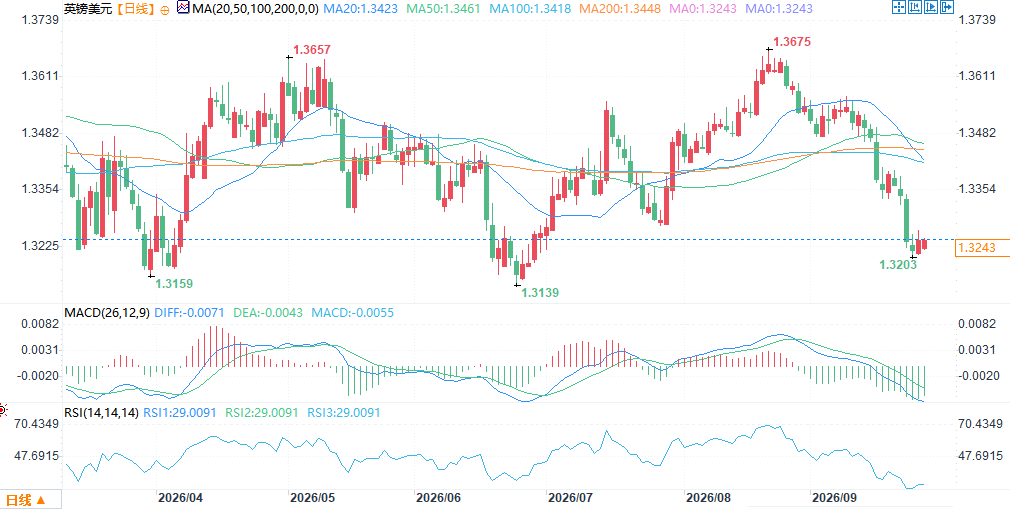 (GBP/USD daily chart, source: FX678) At 11:36 Beijing time, GBP/USD was trading at 1.3240/41.
The dollar weakened, but downside was limited; Federal Reserve officials expressed concern about sticky inflation.
The dollar's downside may be limited as several central bank officials expressed concerns about persistent inflation. Several Federal Reserve officials have continued to express concerns about sticky inflation, providing a floor for the dollar. Cleveland Fed President Hammark warned last week that the public cannot be allowed to take persistently high prices for granted, emphasizing that the central bank must take restrictive policies to prevent inflation expectations from becoming unanchored. She pointed out that inflation has been above target for several years, and if this becomes a habitual mindset, the cost of subsequent adjustments will increase significantly. Philadelphia Fed President Paulson also expressed a similar stance, believing that moderately further tightening of policy may be necessary. Market pricing in a Fed rate hike in October has risen to 65.9%, significantly higher than 57.6% a week ago and 9.4% a month ago. This change in expectations directly enhances the dollar's attractiveness in terms of interest rates, limiting its further weakness. For the pound against the dollar, the dollar's floor support means that upside potential is limited. Investors need to closely monitor subsequent speeches by Fed officials and inflation data; any signals reinforcing the "higher and longer" scenario will continue to support the dollar, thereby suppressing the pound's appreciation potential. Overall, the hawkish shift in monetary policy expectations has become a key stabilizing factor for the dollar's short-term trend.Geopolitical uncertainty persists; Trump rejects Iran proposal.
Besides monetary policy, geopolitical developments in the Middle East remain a market focus. Trump recently explicitly rejected Iran's proposal to reopen the Strait of Hormuz, stating that Tehran overestimated its leverage, but also indicated that negotiations are expected to resume this week. Trump expressed confidence that the conflict with Iran will end soon, while reserving the possibility of further military action before the midterm elections. As a crucial global oil shipping route, the Strait of Hormuz's navigation status directly impacts energy supply security. Trump's rejection has exacerbated short-term uncertainty, leading to increased risk aversion in the market. However, the US dollar has not received significant additional support, indicating that the current exchange rate is more driven by interest rate expectations than simply risk aversion. Investors are closely monitoring the progress of negotiations; if the conflict escalates or negotiations break down, energy prices may come under renewed pressure, indirectly affecting global inflation expectations; conversely, signs of easing tensions could alleviate safe-haven buying. Geopolitical uncertainty adds volatility to the market, but its support for the US dollar in the short term is limited, manifesting more as periodic fluctuations in risk premiums.Hawkish comments from Bank of England officials support pound.
The pound sterling has recently been supported by increasingly hawkish comments from Bank of England policymakers. Bank of England Governor Bailey warned that persistently high energy prices will make it difficult for the central bank to maintain current interest rates. He emphasized that while the transmission of energy shocks is currently subdued, the longer it lasts, the more difficult it will be to maintain a no-rate-hike stance. Monetary Policy Committee members Braden and Lombardy also indicated they are close to supporting a rate hike, arguing that rising energy costs could cause inflation to remain above target. These statements have reinforced market expectations that the Bank of England may follow suit with tightening, providing interest rate support for the pound. In contrast, while the dollar has its own rate hike expectations, the pound's interest rate advantage has strengthened, partially offsetting the pressure from a stronger dollar. Against the backdrop of high energy prices, the risk of inflation in the UK remains, and the cautiously hawkish stance of central bank officials helps stabilize the pound's exchange rate. Investors will closely watch subsequent UK inflation and energy data; any signals reinforcing the necessity of a rate hike could further support the pound. Overall, relative changes in policy expectations are becoming an important driver of the pound's short-term performance.Bailey's speech had two supporting logics: a short-term tightening bias coupled with a medium-term AI narrative, both supporting the pound.
Bailey's warning that persistently high energy prices make maintaining a no-interest-rate stance more difficult, along with his concern about rising mortgage rates, clearly points to a cautious bias towards future policy tightening, directly supporting the pound. Meanwhile, Bailey views artificial intelligence as a potential positive shock in an era of negative supply shocks, introducing a constructive narrative for UK productivity and medium-term growth. He acknowledges that the transmission of current energy prices to broader inflation remains subdued, but emphasizes that it is still in its early stages and vigilance is necessary. This stance makes the pound highly sensitive to upcoming inflation and energy data. Comments on AI provide a medium- to long-term optimistic perspective, helping to alleviate concerns about the UK's growth prospects. In summary, Bailey's statements both reinforced the upside risks to short-term interest rates and injected positive expectations for economic transformation, a dual logic supporting the pound's exchange rate. Investors need to closely monitor subsequent data to determine whether the policy path will further tilt towards tightening.Summarize
The market is pricing in a 65.9% probability of a Fed rate hike in October, providing a floor for the dollar. Regarding the Bank of England, Bailey warned that high energy prices make maintaining interest rates more difficult, while Braden and Lombardy are close to supporting a rate hike, providing interest rate support for the pound. Going forward, attention should be paid to US employment data and the Fed's preferred inflation indicators, developments in the Middle East, UK inflation and energy data, and further statements from Bank of England officials. If US data supports a hawkish stance, the upside potential for the pound against the dollar may be limited; if the Bank of England shifts to a more hawkish stance, the pound may receive further support. (GBP/USD daily chart, source: FX678) At 11:36 Beijing time, GBP/USD was trading at 1.3240/41.
- Risk Warning and Disclaimer
- The market involves risk, and trading may not be suitable for all investors. This article is for reference only and does not constitute personal investment advice, nor does it take into account certain users’ specific investment objectives, financial situation, or other needs. Any investment decisions made based on this information are at your own risk.