Gulf crude oil exports surge, Hormuz risk premium supports oil price resilience
2026-09-29 19:34:18
Middle Eastern crude oil exports hit a record high in September since the outbreak of the conflict, but overall supply has not yet returned to normal levels. Currently, crude oil exports are relying on route changes and ship-to-ship transshipment near Oman, and the market does not recognize this export recovery as a supply chain repair. Affected by the negative impact of the supply recovery, crude oil prices weakened slightly during the day, with both WTI and Brent prices closing lower. However, the ongoing geopolitical uncertainty in the Strait of Hormuz kept the risk premium for crude oil in place, limiting the downside potential and resulting in a volatile pattern of "data recovery suppressing the market, geopolitical support preventing a sharp drop."  As of the intraday close, WTI crude oil futures were trading at $91.67, down $0.93, or 1%; Brent crude oil futures were trading at $96.79, down $1.77, or 1.79%. Technical Analysis On Tuesday morning, November WTI crude oil futures were generally weak and trending downwards, with significant short-term pressure. The overall daily trend remains upward and has not been broken by the short-term decline. The core trend dividing line is clear: a decisive break above $101.69 is needed to restart a new round of upward movement; conversely, if the key support level of $78.55 is breached, the overall daily trend will turn completely bearish. Currently, the secondary trend is clearly downward, dominating the short-term downward momentum and being the core technical reason for this pullback. To reverse the weak trend in the short term, prices need to strongly rise above $98.01 to push the secondary trend upwards and relieve the current downward pressure. Short-term retracement resistance is concentrated in the $95.18-$96.72 range, which is also a strong resistance area for intraday rebounds. The core support range is $90.12-$87.39, with last week's low of $88.67 within this support zone, providing temporary support for oil prices. In addition, the 50% retracement levels at $86.87 and $84.39 provide further defensive support for subsequent declines. Meanwhile, the 50-day moving average is firmly established at $88.32, serving as a core support level for the daily trend. A break below this level would significantly weaken the current bullish structure, opening up further downside potential. Gulf exports hit a new high since the conflict, but still fall short of pre-war levels. Data from energy data analysis agency Kpler shows that crude oil exports from major Middle Eastern oil-producing countries reached 16.328 million barrels per day in September, the highest since the outbreak of the conflict in February. However, the strong export data did not boost oil prices; instead, it became a short-term bearish factor suppressing prices. The core reason lies in the insufficient supply recovery. Current regional crude oil exports are still about 3.2 million barrels per day less than pre-war levels in February, recovering to only 80% of pre-conflict levels. Currently, the crude oil flow through the Strait of Hormuz is approximately 9.719 million barrels per day, with Saudi Arabia and the UAE accounting for the vast majority of the export increase. The market's lack of bullish sentiment and subsequent downward pressure stems from the fact that this round of export growth relies on ship-to-ship transshipment in the Gulf of Oman and shipments from non-Strait ports to fill the gap. This represents temporary emergency supply with extremely poor supply chain stability. Geopolitical risks have not been resolved, and the risk premium continues to lock in the downside potential of oil prices, preventing a market collapse. Saudi Arabia relies on Rastanura port to drive export recovery Saudi crude oil exports rebounded significantly in September, with average daily exports expected to reach 5.4 million barrels per day, more than double the 2.446 million barrels per day in August. This export increase almost entirely relied on a single port. Rastanura port alone saw an average daily output of approximately 3.25 million barrels, far exceeding the 929,000 barrels per day output in August. Damage to the East-West oil pipeline caused by the attack has severely limited exports from Saudi Arabia's Yanbu port, forcing it to rely heavily on Rastanura port on the Gulf coast for supplies. Even with a significant rebound in export data, the port's current throughput is only about half of the pre-war level of 6.411 million barrels per day, indicating that its capacity is far from normal. The sharp decline in shipping efficiency also underscores the fragility of the supply chain. Last week, only 19 Very Large Crude Carriers (VLCCs) carrying Saudi crude oil sailed out of the Strait of Hormuz; this figure does not include tankers that sailed with their transponders off. Before the conflict, approximately 125 large commercial vessels passed through the strait daily. The market now needs to consume more shipping capacity and bear higher shipping risks to export less crude oil. This is the core logic behind the persistent risk premium in crude oil and the difficulty in a deep price drop. Meanwhile, short-term supply increases continue to suppress the strength of any bullish rebound. Trump's statements have diminished the substantial positive impact of peace expectations . Recently, US and Iranian officials have continued to hold joint mediation talks. The market had previously speculated on the positive impact of a de-escalation in the Middle East, supporting a slight rebound in oil prices. However, Trump's public denial of offering Iran a core solution of "lifting sanctions and unfreezing assets in exchange for concessions on the Iranian nuclear issue" directly negated the most valuable substantive benefit of this round of talks. Market expectations for easing tensions cooled, and earlier safe-haven long positions took profits, contributing to a decline in oil prices during the day. After multiple rounds of ceasefire news, traders' sentiment has become more rational, clearly recognizing that the current mediation and dialogue between the various parties cannot restore normal shipping in the Strait of Hormuz. Even if talks continue, without a formal cooperation agreement to be implemented and incorporated into pricing, the positive effects of easing tensions have been largely priced in, making it difficult to support a sustained rise in oil prices. The US's actions regarding diesel and strategic reserves confirm the continued tight supply. To stabilize domestic refined oil prices and alleviate supply pressure, the US government is considering expanding the sales permits for red-dyed diesel as an alternative to the diesel export ban. The US's continued fine-tuning of diesel-related policies sufficiently demonstrates that the government is not optimistic about a short-term recovery in the Middle East refined oil supply chain, and the tight global refined oil supply situation continues. Reserve data also confirms the supply shortage. The US Strategic Petroleum Reserve fell to 283.8 million barrels last week, a new low since 1982. This reserve release is part of a planned 172 million barrel release. The International Energy Agency also stated that if a supply crisis occurs in the refined oil market, member countries may further release oil reserves. It is important to note that reserve releases can only alleviate spot supply tensions in the short term and cannot eliminate the maritime geopolitical risks in the Strait of Hormuz. Maritime risks are the core factor supporting the risk premium for crude oil. Therefore, despite the dual negative impacts of reserve releases and increased exports, oil prices only fell slightly and did not experience a one-sided downward trend. Inventory data had less impact than sudden news from the Gulf region . The market generally expected a decrease in US crude oil and gasoline inventories last week, while distillate fuel inventories remained largely unchanged. If crude oil and gasoline inventories decrease as expected, it will confirm that the current Gulf crude oil supply can be effectively absorbed by the market, further strengthening the logic of a short-term loose supply and putting sustained downward pressure on oil prices. Since the current Middle East conflict, diesel has consistently been the core focus of the market's supply and demand imbalance, which is the core reason for the frequent rumors of diesel export bans. From a market impact perspective, weekly inventory reports can only cause short-term fluctuations in oil prices on a single day, and cannot change the overall oscillating pattern. However, sudden developments in the Gulf, such as those involving Iran, the Houthis, and attacks on Saudi infrastructure, are the core factors determining the short-term strength or weakness of oil prices and the volatility of risk premiums. Market Focus
 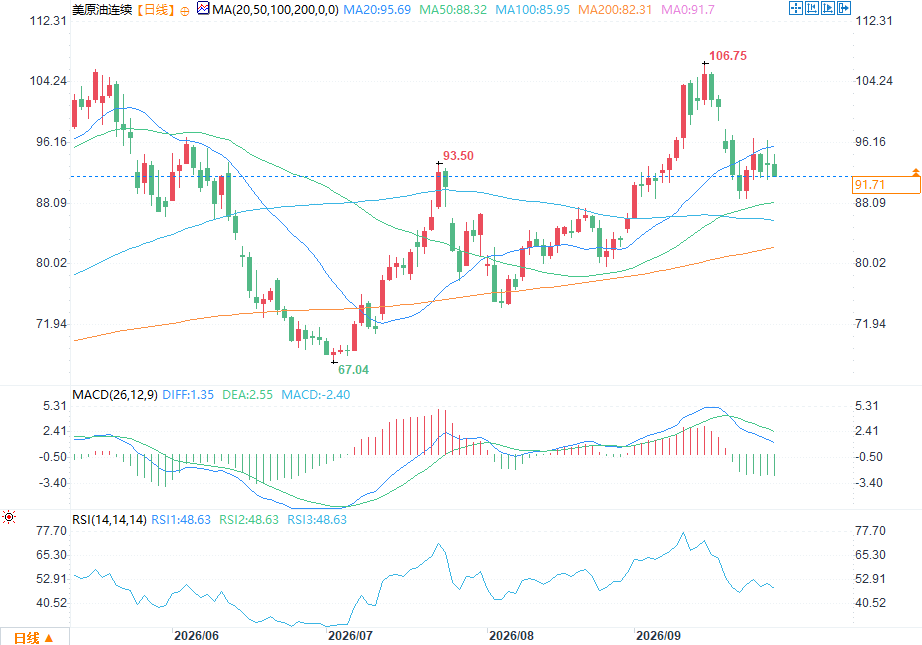 Crude oil is currently in a two-way oscillation pattern, with the intraday price action slightly weaker and trending downwards. The secondary downward trend is dominating short-term price action, while the overall trend remains bullish. Rapidly escalating geopolitical tensions could stimulate safe-haven buying, supporting oil prices; conversely, de-escalating news and increased supply could weaken safe-haven demand, suppressing any rebound. Neither bulls nor bears currently have sufficient strength to break out of the current range. In the short term, if oil prices can hold above the upper resistance level of $96.72, it would indicate a return of bullish funds and alleviate the current weakness. A decisive break above $98.01 is necessary to reverse the downward secondary trend and retest the previous high of $101.69. The key support level is the 50-day moving average at $88.32, a crucial line of defense for the overall bullish trend. A breach of this level would weaken the market further, with downside targets shifting to the 50% Fibonacci retracement level at $84.39 and the key support level at $78.55.
As of the intraday close, WTI crude oil futures were trading at $91.67, down $0.93, or 1%; Brent crude oil futures were trading at $96.79, down $1.77, or 1.79%. Technical Analysis On Tuesday morning, November WTI crude oil futures were generally weak and trending downwards, with significant short-term pressure. The overall daily trend remains upward and has not been broken by the short-term decline. The core trend dividing line is clear: a decisive break above $101.69 is needed to restart a new round of upward movement; conversely, if the key support level of $78.55 is breached, the overall daily trend will turn completely bearish. Currently, the secondary trend is clearly downward, dominating the short-term downward momentum and being the core technical reason for this pullback. To reverse the weak trend in the short term, prices need to strongly rise above $98.01 to push the secondary trend upwards and relieve the current downward pressure. Short-term retracement resistance is concentrated in the $95.18-$96.72 range, which is also a strong resistance area for intraday rebounds. The core support range is $90.12-$87.39, with last week's low of $88.67 within this support zone, providing temporary support for oil prices. In addition, the 50% retracement levels at $86.87 and $84.39 provide further defensive support for subsequent declines. Meanwhile, the 50-day moving average is firmly established at $88.32, serving as a core support level for the daily trend. A break below this level would significantly weaken the current bullish structure, opening up further downside potential. Gulf exports hit a new high since the conflict, but still fall short of pre-war levels. Data from energy data analysis agency Kpler shows that crude oil exports from major Middle Eastern oil-producing countries reached 16.328 million barrels per day in September, the highest since the outbreak of the conflict in February. However, the strong export data did not boost oil prices; instead, it became a short-term bearish factor suppressing prices. The core reason lies in the insufficient supply recovery. Current regional crude oil exports are still about 3.2 million barrels per day less than pre-war levels in February, recovering to only 80% of pre-conflict levels. Currently, the crude oil flow through the Strait of Hormuz is approximately 9.719 million barrels per day, with Saudi Arabia and the UAE accounting for the vast majority of the export increase. The market's lack of bullish sentiment and subsequent downward pressure stems from the fact that this round of export growth relies on ship-to-ship transshipment in the Gulf of Oman and shipments from non-Strait ports to fill the gap. This represents temporary emergency supply with extremely poor supply chain stability. Geopolitical risks have not been resolved, and the risk premium continues to lock in the downside potential of oil prices, preventing a market collapse. Saudi Arabia relies on Rastanura port to drive export recovery Saudi crude oil exports rebounded significantly in September, with average daily exports expected to reach 5.4 million barrels per day, more than double the 2.446 million barrels per day in August. This export increase almost entirely relied on a single port. Rastanura port alone saw an average daily output of approximately 3.25 million barrels, far exceeding the 929,000 barrels per day output in August. Damage to the East-West oil pipeline caused by the attack has severely limited exports from Saudi Arabia's Yanbu port, forcing it to rely heavily on Rastanura port on the Gulf coast for supplies. Even with a significant rebound in export data, the port's current throughput is only about half of the pre-war level of 6.411 million barrels per day, indicating that its capacity is far from normal. The sharp decline in shipping efficiency also underscores the fragility of the supply chain. Last week, only 19 Very Large Crude Carriers (VLCCs) carrying Saudi crude oil sailed out of the Strait of Hormuz; this figure does not include tankers that sailed with their transponders off. Before the conflict, approximately 125 large commercial vessels passed through the strait daily. The market now needs to consume more shipping capacity and bear higher shipping risks to export less crude oil. This is the core logic behind the persistent risk premium in crude oil and the difficulty in a deep price drop. Meanwhile, short-term supply increases continue to suppress the strength of any bullish rebound. Trump's statements have diminished the substantial positive impact of peace expectations . Recently, US and Iranian officials have continued to hold joint mediation talks. The market had previously speculated on the positive impact of a de-escalation in the Middle East, supporting a slight rebound in oil prices. However, Trump's public denial of offering Iran a core solution of "lifting sanctions and unfreezing assets in exchange for concessions on the Iranian nuclear issue" directly negated the most valuable substantive benefit of this round of talks. Market expectations for easing tensions cooled, and earlier safe-haven long positions took profits, contributing to a decline in oil prices during the day. After multiple rounds of ceasefire news, traders' sentiment has become more rational, clearly recognizing that the current mediation and dialogue between the various parties cannot restore normal shipping in the Strait of Hormuz. Even if talks continue, without a formal cooperation agreement to be implemented and incorporated into pricing, the positive effects of easing tensions have been largely priced in, making it difficult to support a sustained rise in oil prices. The US's actions regarding diesel and strategic reserves confirm the continued tight supply. To stabilize domestic refined oil prices and alleviate supply pressure, the US government is considering expanding the sales permits for red-dyed diesel as an alternative to the diesel export ban. The US's continued fine-tuning of diesel-related policies sufficiently demonstrates that the government is not optimistic about a short-term recovery in the Middle East refined oil supply chain, and the tight global refined oil supply situation continues. Reserve data also confirms the supply shortage. The US Strategic Petroleum Reserve fell to 283.8 million barrels last week, a new low since 1982. This reserve release is part of a planned 172 million barrel release. The International Energy Agency also stated that if a supply crisis occurs in the refined oil market, member countries may further release oil reserves. It is important to note that reserve releases can only alleviate spot supply tensions in the short term and cannot eliminate the maritime geopolitical risks in the Strait of Hormuz. Maritime risks are the core factor supporting the risk premium for crude oil. Therefore, despite the dual negative impacts of reserve releases and increased exports, oil prices only fell slightly and did not experience a one-sided downward trend. Inventory data had less impact than sudden news from the Gulf region . The market generally expected a decrease in US crude oil and gasoline inventories last week, while distillate fuel inventories remained largely unchanged. If crude oil and gasoline inventories decrease as expected, it will confirm that the current Gulf crude oil supply can be effectively absorbed by the market, further strengthening the logic of a short-term loose supply and putting sustained downward pressure on oil prices. Since the current Middle East conflict, diesel has consistently been the core focus of the market's supply and demand imbalance, which is the core reason for the frequent rumors of diesel export bans. From a market impact perspective, weekly inventory reports can only cause short-term fluctuations in oil prices on a single day, and cannot change the overall oscillating pattern. However, sudden developments in the Gulf, such as those involving Iran, the Houthis, and attacks on Saudi infrastructure, are the core factors determining the short-term strength or weakness of oil prices and the volatility of risk premiums. Market Focus Crude oil is currently in a two-way oscillation pattern, with the intraday price action slightly weaker and trending downwards. The secondary downward trend is dominating short-term price action, while the overall trend remains bullish. Rapidly escalating geopolitical tensions could stimulate safe-haven buying, supporting oil prices; conversely, de-escalating news and increased supply could weaken safe-haven demand, suppressing any rebound. Neither bulls nor bears currently have sufficient strength to break out of the current range. In the short term, if oil prices can hold above the upper resistance level of $96.72, it would indicate a return of bullish funds and alleviate the current weakness. A decisive break above $98.01 is necessary to reverse the downward secondary trend and retest the previous high of $101.69. The key support level is the 50-day moving average at $88.32, a crucial line of defense for the overall bullish trend. A breach of this level would weaken the market further, with downside targets shifting to the 50% Fibonacci retracement level at $84.39 and the key support level at $78.55.
- Risk Warning and Disclaimer
- The market involves risk, and trading may not be suitable for all investors. This article is for reference only and does not constitute personal investment advice, nor does it take into account certain users’ specific investment objectives, financial situation, or other needs. Any investment decisions made based on this information are at your own risk.