Cooling interest rate hike expectations may help gold prices continue their rebound.
2026-09-30 18:04:15
On Wednesday (September 30th) during the Asian and European sessions, spot gold fluctuated and consolidated, holding onto all the gains from Tuesday evening, currently trading around 4187. A moderate cooling in the US labor market, a sharp drop in consumer confidence, and dovish signals from New York Fed President Williams led to a downward revision of market expectations for an October rate hike, marginally easing real interest rate expectations that had been suppressing gold prices. Meanwhile, the recent sharp correction in oil prices eased inflation concerns, providing gold with a chance for a phased rebound. Multiple recent US macroeconomic data and speeches by Fed officials have created a combination of positive signals, reversing the previous market's one-sided bet on continued aggressive rate hikes by the Fed, driving gold prices to rebound from their lows. As a non-interest-bearing asset, gold's core pricing anchor is the US dollar's real interest rate. Once market expectations for aggressive rate hikes by the Fed cool, the opportunity cost of holding gold decreases, and gold prices gain direct upward momentum. Currently, the triple resonance of economic fundamentals, consumer sentiment, and monetary policy expectations has created a favorable environment for a gold rebound. 
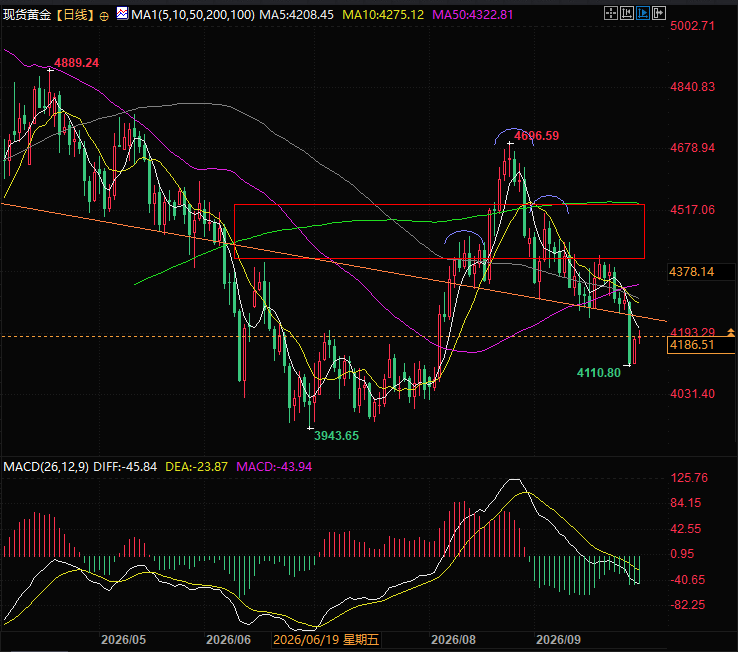 (Spot gold daily chart, source: EasyTrade) At 17:50 Beijing time, spot gold is currently trading at $4187 per ounce.
Labor demand continues to cool, weakening the core support for interest rate hikes.
The JOLTS job openings data released by the U.S. Department of Labor in August confirms the continued mild rebalancing of the U.S. labor market, significantly weakening the core employment logic that previously supported the Federal Reserve's tightening policy. Data shows that the number of job openings in the U.S. fell to 7.079 million in August, a significant drop from the revised 7.335 million in July, with the job vacancy rate falling from 4.4% to 4.3%, indicating a continued cooling of the labor market. Looking at the detailed data, the job market exhibits a mild cooling characteristic of "declining demand and no large-scale layoffs." Hiring in August rebounded slightly to 5.192 million, with the hiring rate rising slightly to 3.3%; the number of voluntary resignations and the resignation rate remained relatively stable, indicating no significant fluctuations in residents' employment sentiment. Meanwhile, the pace of layoffs continued to slow, with layoffs and dismissals falling to 1.641 million in August, and the layoff rate falling from 1.1% to 1.0%. Overall, the U.S. job market is gradually returning to equilibrium, and the strong employment situation has significantly weakened its support for the Federal Reserve's interest rate hikes, laying a fundamental foundation for a rebound in gold prices.Consumer confidence has plummeted, and economic pressures are highlighting constraints on interest rate hikes.
Amid a cooling labor market, US consumer sentiment has deteriorated significantly, further limiting the Federal Reserve's room for aggressive interest rate hikes and benefiting gold's valuation recovery. Data from the Conference Board shows that the US consumer confidence index fell sharply to 81.9 in September from 88.6 in August, the lowest level since 2014 and significantly lower than market expectations, with the decline far exceeding market predictions.The Federal Reserve has signaled a dovish stance, significantly cooling expectations for interest rate hikes.
Compared to the marginal weakening of economic data, the latest speech by New York Fed President Williams became the core catalyst for this round of gold price rebound, directly correcting the market's aggressive expectations for interest rate hikes. As a core member of the FOMC's interest rate decision-making committee, Williams' remarks are highly significant as a policy indicator. Williams clearly stated that although current inflation is still above the 2% policy target, and there is still a possibility of another rate hike later this year, the September rate hike has already been completed, and there is no need for further policy tightening at present. The Fed can wait for more economic data before assessing subsequent monetary policy. After this speech, market expectations were quickly restructured. CME data showed that the probability of a Fed rate hike in October fell sharply from 70% to around 50%, and the market's pessimistic expectations of "continuous rate hikes" cooled down completely. Although the current 10-year US Treasury yield is still at a 19-year high, and inflation stickiness has not completely subsided, the Fed's clear release of a "wait and see" policy signal ended the previous market narrative of continuous tightening and significantly alleviated the core negative factors suppressing gold prices.Market Outlook: A recovery and rebound are expected, but the trend still needs data confirmation.
Previously, near the lowest point after a sharp drop in gold prices, the article suggested that the opportunities outweighed the risks, and there was no need for excessive panic. Gold prices subsequently rebounded. The current market exhibits a typical pattern of "high inflation, weak economy, and gradual interest rate hikes," with a triple positive factor of cooling labor market, weakening consumption, and rising expectations of policy easing driving a phase of rebound in gold prices. However, this round of market movement is characterized as a corrective rebound based on expectations, not a trend reversal, and the subsequent trend remains uncertain. In the short term, the market is focused on two key data points: the upcoming September non-farm payroll data and tonight's September inflation data. If employment and inflation data continue to weaken, expectations of a Fed rate hike will further cool, and the upside potential for gold prices will continue to open up; if the data is stronger than expected, inflation stickiness will continue to strengthen, and the market may restart pricing in rate hikes, likely putting downward pressure on the current gold price rebound. Technical Analysis: Spot gold rebounded after falling to near the previous low-level densely traded area. 4200 is the recent watershed between bulls and bears. The next resistance level is the neckline of the head and shoulders pattern. Currently, the gold price is suppressed by the moving average and the neckline, and the overall trend is biased towards a downward oscillation. It is highly likely that it will need to wait for the moving average to consolidate and flatten before it can start to rise again. (Spot gold daily chart, source: EasyTrade) At 17:50 Beijing time, spot gold is currently trading at $4187 per ounce.
- Risk Warning and Disclaimer
- The market involves risk, and trading may not be suitable for all investors. This article is for reference only and does not constitute personal investment advice, nor does it take into account certain users’ specific investment objectives, financial situation, or other needs. Any investment decisions made based on this information are at your own risk.