Despite negative news and increased pressure from the US dollar, gold prices remained resilient.
2026-10-05 17:48:19
This week, gold prices exhibited a typical weak and volatile trend during the Asian and European sessions, with positive news failing to drive prices higher while negative news continued to escalate. Gold prices rose slightly before quickly retreating, remaining within a range. Behind this seemingly contradictory market movement lies a complex interplay of factors: structural divergence in the US economy, marginal cooling of inflation, repricing of expectations for Fed rate hikes, and the divergence in monetary policies between Europe and the US, coupled with a confluence of external risks. This explains the recent unusual trend of gold failing to rise despite positive non-farm payroll data and facing pressure from a strengthening dollar. 
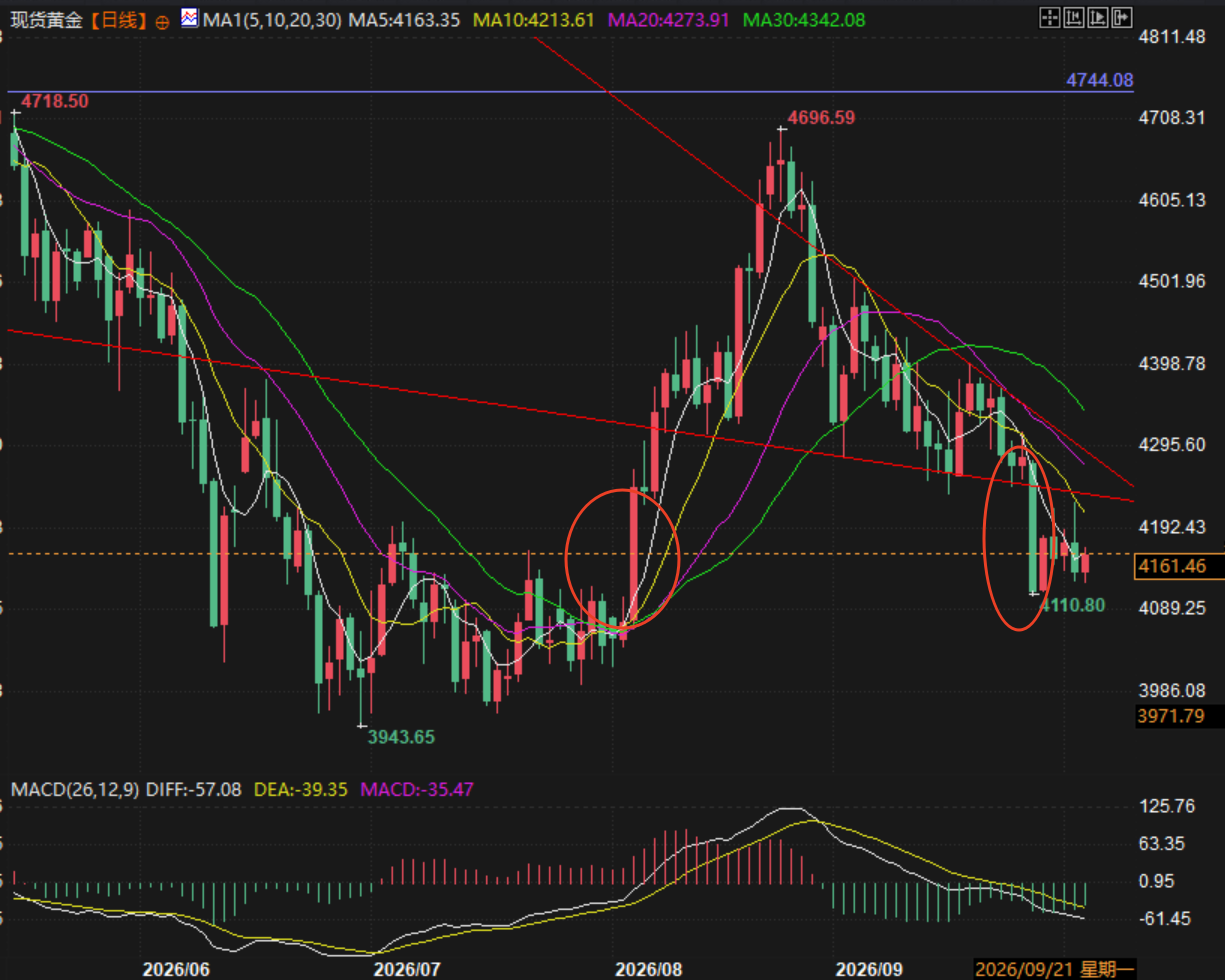 (Spot gold daily chart, source: EasyTrade) At 17:45 Beijing time, spot gold is currently trading at $4156 per ounce.
Structural divergence in the ISM Manufacturing PMI: Hinting at core contradictions in Fed policy, limiting gold's upside potential.
The previously released US September ISM Manufacturing PMI showed a decline, with the main drags being a decrease in raw material inventories and a slight improvement in supplier deliveries, rather than a contraction in market demand. Key sub-indices all improved: new orders, order backlogs, manufacturing employment, and input prices all strengthened, sufficiently demonstrating the resilience of US real economic demand. Currently, US companies are not experiencing a shortage of orders, but rather are proactively reducing inventory and adopting a light-inventory order-taking model to deliberately avoid the risks of large-scale stockpiling due to high loan interest rates, high diesel prices, and cost uncertainties brought about by Middle East geopolitical conflicts. This data structure directly shatters the market's one-sided expectation of "weakening economy and expected Fed easing," highlighting the Fed's policy dilemma: on the one hand, high interest rates continue to suppress market financing costs, aiming to cool inflation; therefore, once external geopolitical risks ease and financing pressures subside, companies with sufficient orders on hand can easily initiate inventory replenishment and recruitment, leading to a rapid rebound in aggregate demand and a rapid release of corporate momentum. Coupled with the fading inflation expectations shown in the non-farm payrolls, this reinforces the resilient economic situation, making it difficult for gold to experience a sustained upward trend.Non-farm payroll data reveals hidden clues: wage inflation is mainly cooling, and economic resilience supports real interest rates.
The highly anticipated September non-farm payroll data also showed a clear divergence, which was the core reason for the recent surge and subsequent decline in gold prices. Data showed that the US added only 26,000 non-farm jobs in September, significantly lower than the market expectation of 90,000. Meanwhile, the August non-farm payroll figure was revised down from 162,000 to 133,000. The decline in monthly job growth and the cooling of previous job market activity directly reflected a temporary slowdown in corporate hiring intentions. However, the market's over-interpretation of weakening employment expectations was quickly corrected. The core highlight of this non-farm payroll report was not the decline in employment, but rather the substantial easing of wage inflation. September wage growth fell to 3.0%, the lowest level since May 2021. Since wages are a core anchor of US service inflation, the cooling of wages means that the persistent endogenous inflationary pressures that have long plagued the Federal Reserve are continuing to subside. Overall, the US labor market has not experienced a recession-like weakening and remains relatively resilient. The combination of a slight decline in employment and continued cooling inflation further strengthened market expectations for a soft landing for the US economy, pushing US Treasury real interest rates upward. For gold, a non-interest-bearing asset, rising real interest rates directly suppress valuations. This is the core logic behind the market's previous prediction that "the positive impact of non-farm payrolls on gold prices will be limited," which ultimately resulted in gold prices rising and then falling back.Differences in monetary policy between the US and Europe, coupled with risks in the Eurozone, have kept the strong dollar under pressure on gold prices.
If the divergence in US economic data limited the upside potential for gold, then the strong rebound of the US dollar index directly shattered the short-term bullish trend for gold. ING analysts clearly point out that the current strong support for the dollar is driven by the significant divergence in monetary policy expectations between the US and European central banks, coupled with the impact of French fiscal risks on the euro. The market has already fully priced in the Fed's monetary policy path: maintaining interest rates unchanged in October, a high probability of another rate hike in December, and an 85% probability of a rate hike this year. In contrast, since the end of September, the market has erased 30bp of its rate hike expectations for the European Central Bank, while the Fed has only lowered its rate hike expectations by 13bp, demonstrating far greater policy resilience than the ECB. Coupled with the continued escalation of French fiscal risks, the euro continues to weaken, and given that the euro accounts for 58% of the dollar index's currency basket, the euro's depreciation directly pushes the dollar index to a new high for the year. Meanwhile, geopolitical risks in the Middle East and between Russia and Ukraine continued to escalate. The Yemeni government launched a military operation to retake Houthi-controlled territory, Iran announced its intention to block the Strait of Hormuz, and the Russia-Ukraine conflict continued to intensify. As a result, geopolitical safe-haven funds did not flow into gold significantly; instead, they continued to strengthen the US dollar, a stronger safe-haven asset, further pressuring gold prices. Even weaker-than-expected US non-farm payroll and inflation data in September failed to shake the dollar's strength, and gold only managed a brief, slight rebound before quickly falling back.Core trading logic for the future: Closely monitor three key variables
Considering the current fundamentals and market trends, gold is unlikely to experience a one-sided trend in the short term, maintaining an overall weak and volatile pattern. Its future movement will be entirely anchored to three core variables: First, the US dollar index and the real interest rate of US Treasury bonds. This is the core driver of gold's medium- to long-term price movement. As long as the Fed's high interest rates and strong dollar do not reverse, gold's upside potential will remain limited. Second, subsequent US inflation and employment data need to continuously verify the sustainability of the cooling wage inflation and whether the economy's resilience has weakened. If the data strengthens again, it will further reinforce expectations of a Fed rate hike, putting downward pressure on gold prices. Third, the difference in monetary policy expectations between Europe and the US, and risks in the Eurozone. If the ECB's easing expectations and the French fiscal problems continue to escalate, the strong dollar will persist, and the downward pressure on gold prices will be difficult to reverse. In the short term, gold is constrained by the triple pressure of economic resilience, high real interest rates, and a strong dollar, and the weak and volatile pattern will continue. The market needs to focus on the US ISM Services PMI, the FOMC meeting minutes, and speeches by Fed officials to capture opportunities arising from changes in policy expectations. Technical Analysis: Gold prices are in a zone of significant divergence between bulls and bears. There is clear support from the previous large bullish candlestick, but also bearish momentum from the recent large bearish candlestick. At the same time, the moving averages are in a bearish alignment, and a bullish counterattack will require the moving averages to consolidate. In addition, the recent double bottom pattern on the daily chart also indicates that the bearish momentum is weakening. (Spot gold daily chart, source: EasyTrade) At 17:45 Beijing time, spot gold is currently trading at $4156 per ounce.- Risk Warning and Disclaimer
- The market involves risk, and trading may not be suitable for all investors. This article is for reference only and does not constitute personal investment advice, nor does it take into account certain users’ specific investment objectives, financial situation, or other needs. Any investment decisions made based on this information are at your own risk.