USD/JPY stuck below 158: Why was the Bank of Japan's October rate hike pricing halved?
2026-10-05 18:18:18
On Monday, October 5th, the USD/JPY pair was trading below 158 with little intraday movement. Meanwhile, pricing in whether the Bank of Japan would raise interest rates again in October was reduced by about half in the meeting summary. 
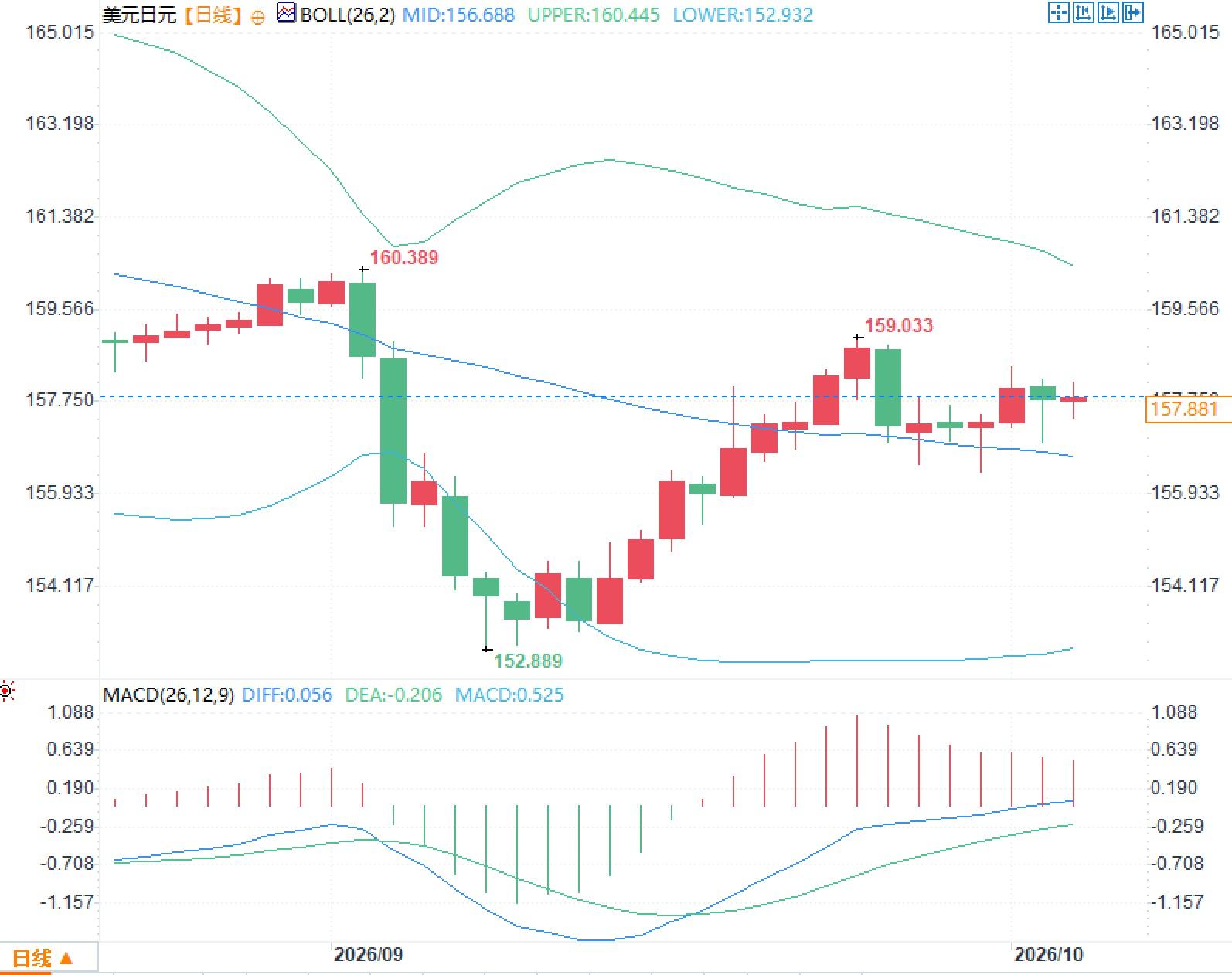 Intervention alters the position structure, not the medium-term equilibrium. The marginal cost of adding to short positions above 158 increases, while long positions lack the support of interest rate differential closure, resulting in lighter positions and narrower price fluctuations. What truly determines the medium-term path is the pace of adjustments in policy rates on both sides, and whether Japanese wages and core inflation can sustainably approach 2%. Fiscal expansion and the deficits in services trade and digital items represent domestic constraints in Japan that prevent the yen from achieving a revaluation through a single interest rate hike.
The Bank of Japan's path and interest rate differential are not closed.
On September 18, the Bank of Japan raised its unsecured overnight call rate guidance from 1% to 1.25%, a level approximately 31 years high, by a 7-2 vote. The dissenting votes came from board members appointed by Prime Minister Sanae Takaichi, Toichiro Asada and Ayano Sato. Governor Kazuo Ueda stated after the meeting that the stage of policy-making has changed, with the focus shifting from pushing inflation towards the target to preventing inflation from deviating too far from the 2% target. When asked whether further adjustments or a faster pace were possible, he stated that no specific option was ruled out in advance. The statement also indicated that even with this increase, financial conditions are expected to remain accommodative, and policy rates will continue to rise. After the meeting summary was released, the interest rate market roughly halved the implied probability of another rate hike in October, shifting the baseline scenario to December, making the pace closer to quarterly increases. The October window is not closed, but it has been downgraded from the primary scenario to a secondary scenario. Tokyo inflation and August wages remain key indicators to watch; nominal wages in August were around 4.7% year-on-year. As long as domestic prices and wages in Japan do not deviate significantly from the baseline, the internal disagreement within the policy committee regarding the pace of appreciation will continue to suppress the yen's upward movement. On September 16th, the Federal Reserve raised the target range for the federal funds rate by 25 basis points to 3.75% to 4% by a 12-0 vote. The spread between the upper limit and the Bank of Japan's policy rate remains around 2.75 percentage points, and the lower limit is approximately 2.5 percentage points. The financing cost of carry trades is rising, but the absolute spread has not closed. This is the core reason why the USD/JPY pair weakened on the day of the Bank of Japan's rate hike and subsequently failed to effectively move away from the 158 level.US employment is weak.
U.S. nonfarm payrolls increased by 29,000 in September, with a monthly average increase of about 45,000 over the previous 12 months, exceeding market expectations of around 90,000. July and August figures were revised down by approximately 60,000 combined, with July's figure being revised back to negative. The unemployment rate was 4.2%, slightly higher than the previous month. Total private nonfarm hourly earnings rose 0.1% month-over-month to $37.81, and 3.0% year-over-year, a slower reading in recent years. Healthcare contributed approximately 17,000 jobs, construction approximately 11,000, with most sectors showing little change. Household employment increased by approximately 406,000, and the labor force increased by approximately 485,000, with the participation rate rising to 61.8%, inconsistent with weaker institutional surveys. The Federal Reserve's statement was subdued, stating that economic activity expanded at a solid pace, inflation remained high, and this action aimed to bring prices back to the 2% target more promptly. The statement did not commit to further rate hikes. Interest rate futures are pricing in a rate hike at the October 28 meeting at around one-third of the way down. After hitting its highest level since April 2025, the US dollar index retreated, putting downward pressure on the USD/JPY pair. Meanwhile, uncertainty stemming from geopolitical conflicts will continue to drive safe-haven demand for the dollar in stages, making the retreat more of a gradual, albeit less pronounced, decline.How Intervention in Memory Rewrites Positions
In late July, US and Japanese authorities jointly purchased yen. Subsequently, when the exchange rate approaches the 160 level again, the historical memory of verbal warnings and actual actions will increase short-term volatility premiums. Mitsubishi UFJ Research's October monthly report listed the undervaluation of the yen as a high-level agenda item, and pointed out that if the USD/JPY exchange rate breaks through 160, the intensity of warnings from both sides may increase, and the possibility of coordinated operations will be re-evaluated. Intervention alters the position structure, not the medium-term equilibrium. The marginal cost of adding to short positions above 158 increases, while long positions lack the support of interest rate differential closure, resulting in lighter positions and narrower price fluctuations. What truly determines the medium-term path is the pace of adjustments in policy rates on both sides, and whether Japanese wages and core inflation can sustainably approach 2%. Fiscal expansion and the deficits in services trade and digital items represent domestic constraints in Japan that prevent the yen from achieving a revaluation through a single interest rate hike.Frequently Asked Questions
Question 1: US non-farm payrolls increased by only 29,000, why didn't the USD/JPY exchange rate weaken unilaterally? Answer: September's job growth of 29,000 was lower than the expected 90,000, with the unemployment rate at 4.2% and hourly wages up 3.0% year-on-year. The weaker-than-expected data limited the dollar's momentum, but the Federal Reserve just raised the target range for the federal funds rate to 3.75% to 4% in September, still about 2.5 to 2.75 percentage points behind the Bank of Japan's 1.25%. The interest rate differential hasn't closed, and there's a coexistence of demand for both short covering and safe-haven assets, resulting in a narrow range-bound exchange rate movement. Question 2: Japan raised interest rates in September, why is October still being repeatedly priced in? Answer: On September 18th, the policy rate rose from 1% to 1.25%, a roughly 31-year high, with a 7-2 vote. Kazuo Ueda stated that the policy phase has shifted to preventing excessive inflation, and did not pre-exclude further adjustments. The dissenting votes came from newly appointed members. After the meeting summary, the implied probability of another rate hike in October was roughly halved, and the baseline scenario shifted to December. The window of opportunity in October is not closed, but it has been downgraded from the main scenario to the tail scenario.- Risk Warning and Disclaimer
- The market involves risk, and trading may not be suitable for all investors. This article is for reference only and does not constitute personal investment advice, nor does it take into account certain users’ specific investment objectives, financial situation, or other needs. Any investment decisions made based on this information are at your own risk.