Gold signals are mixed, and market sentiment remains cautious.
2026-10-05 19:58:17
Over the past month, gold has experienced a significant downward trend. Recent trading has seen a tug-of-war between gold's short-term speculative nature and its solid intrinsic value, resulting in volatile price movements. For speculative traders, this asset remains worthy of continued attention and participation. Global market sentiment characterized by widespread risk aversion and caution, coupled with a strengthening US dollar, has directly driven a clear reversal in gold's price action. Given the mixed signals in gold's recent price movements, speculators must be prepared for rapid shifts in market momentum.  Gold's Short-Term Direction Remains Uncertain While the US dollar has remained strong for the past few weeks, leading to a slight sell-off in gold, the short-term price trend of this precious metal remains difficult to predict. Admittedly, gold prices have been declining since the third week of August, and interpreting sudden and sharp fluctuations in gold prices is often very challenging for ordinary retail traders. Many market participants believe that gold's long-term value is unshakeable, but speculative factors always accompany this commodity. The significant fluctuations in gold prices not only provide opportunities to bet on gold's intrinsic value but also reflect the overall risk sentiment in global markets. While this is true for all assets, gold's long historical status makes it a focal point of debate among various market viewpoints. Rising US Treasury yields continue to test gold's resilience. Gold prices are approaching $4150 per ounce. At the same time last week, gold was around $4130 per ounce. This price comparison is worth considering for speculative traders. Even though the US dollar continues to strengthen significantly in the foreign exchange market, gold prices are higher than at the same time last week. This raises the question: are gold speculators anticipating global market risks and sentiment, or are they lagging behind? For all short-term trading, gold trading undoubtedly possesses speculative attributes, and shifts in market momentum are crucial for traders. Gold prices touched $4685/ounce on August 25th, and it's likely that prices will eventually reach that level again, though the timing remains uncertain. Recent pressure on the US bond market and rising yields have weighed on gold prices. When will the large number of bullish gold supporters decide that gold is oversold and re-enter the market in large numbers? This is a key point to watch. Gold price movements reflect short-term market sentiment shifts. Recently, gold price fluctuations have been relatively mild, but the market can shift at any time, suddenly entering a period of sharp volatility. Even with a stronger dollar, gold still showed some upward momentum in the early morning session. For retail gold traders, the choice of trading time frame is crucial; patience is essential to capitalize on frequently shifting market momentum. Gold will inevitably demonstrate its appeal as a safe-haven asset again, but as long as US Treasury yields remain high, its upward path will be bumpy. Technical traders can certainly try to position themselves, but they must clearly understand the key indicators to watch: US interest rates and US Treasury yields. Market expectations regarding these two factors dominate short-term gold price movements. Long-term buying demand may prevent further price declines. Some traders believe that they can continue to be bearish on gold prices until global market fundamentals change. However, gold has a large number of long-term bullish investors who may enter the market at any time, posing a risk to short-term bearish traders. Gold prices may test around $4000/ounce, but once they fall to that level, a large influx of buyers believing gold is oversold could enter the market. Gold traders should remain cautious in volatile markets . This morning, gold dipped to around $4110/ounce before rebounding, with buying power emerging. This is not unexpected for experienced traders, as gold prices often directly reflect current market sentiment. The overall market sentiment is currently cautious, and gold is expected to continue this trend in the short term. Gold: A key price level determining future market direction.
 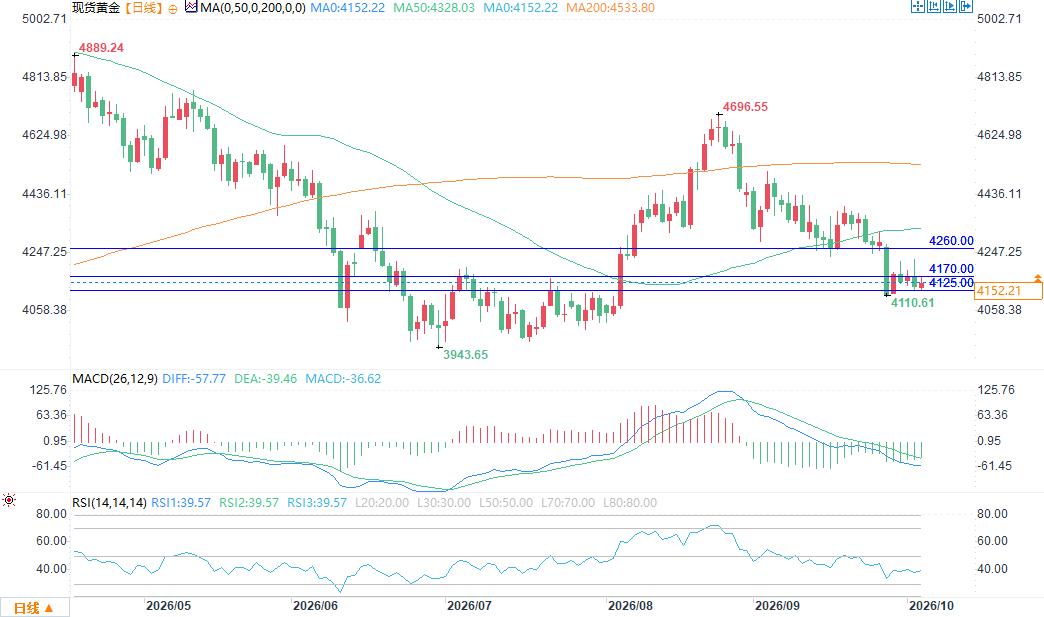 After this round of correction, gold is attempting to stabilize, but the market remains highly sensitive to fluctuations in the US dollar and US Treasury yields. This means that gold prices may continue to fluctuate within a range or experience a sudden momentum shift. $4170 is the primary resistance level to watch. If gold prices can hold above this level, it indicates that buying power is continuously strengthening; conversely, if gold prices fail to break through this level effectively multiple times, the market will still favor a correction. On the downside, $4125 is the nearest support level. If this level is broken, the market focus will shift to $4050. Conversely, if gold prices rebound and hold above $4170, the $4260 range will re-enter the market's attention. Currently, compared to short-term intraday fluctuations, gold's performance near these key price levels is more indicative. The core question is: given the continued diversion of gold's appeal by high yields, can buyers hold these key support levels?
Gold's Short-Term Direction Remains Uncertain While the US dollar has remained strong for the past few weeks, leading to a slight sell-off in gold, the short-term price trend of this precious metal remains difficult to predict. Admittedly, gold prices have been declining since the third week of August, and interpreting sudden and sharp fluctuations in gold prices is often very challenging for ordinary retail traders. Many market participants believe that gold's long-term value is unshakeable, but speculative factors always accompany this commodity. The significant fluctuations in gold prices not only provide opportunities to bet on gold's intrinsic value but also reflect the overall risk sentiment in global markets. While this is true for all assets, gold's long historical status makes it a focal point of debate among various market viewpoints. Rising US Treasury yields continue to test gold's resilience. Gold prices are approaching $4150 per ounce. At the same time last week, gold was around $4130 per ounce. This price comparison is worth considering for speculative traders. Even though the US dollar continues to strengthen significantly in the foreign exchange market, gold prices are higher than at the same time last week. This raises the question: are gold speculators anticipating global market risks and sentiment, or are they lagging behind? For all short-term trading, gold trading undoubtedly possesses speculative attributes, and shifts in market momentum are crucial for traders. Gold prices touched $4685/ounce on August 25th, and it's likely that prices will eventually reach that level again, though the timing remains uncertain. Recent pressure on the US bond market and rising yields have weighed on gold prices. When will the large number of bullish gold supporters decide that gold is oversold and re-enter the market in large numbers? This is a key point to watch. Gold price movements reflect short-term market sentiment shifts. Recently, gold price fluctuations have been relatively mild, but the market can shift at any time, suddenly entering a period of sharp volatility. Even with a stronger dollar, gold still showed some upward momentum in the early morning session. For retail gold traders, the choice of trading time frame is crucial; patience is essential to capitalize on frequently shifting market momentum. Gold will inevitably demonstrate its appeal as a safe-haven asset again, but as long as US Treasury yields remain high, its upward path will be bumpy. Technical traders can certainly try to position themselves, but they must clearly understand the key indicators to watch: US interest rates and US Treasury yields. Market expectations regarding these two factors dominate short-term gold price movements. Long-term buying demand may prevent further price declines. Some traders believe that they can continue to be bearish on gold prices until global market fundamentals change. However, gold has a large number of long-term bullish investors who may enter the market at any time, posing a risk to short-term bearish traders. Gold prices may test around $4000/ounce, but once they fall to that level, a large influx of buyers believing gold is oversold could enter the market. Gold traders should remain cautious in volatile markets . This morning, gold dipped to around $4110/ounce before rebounding, with buying power emerging. This is not unexpected for experienced traders, as gold prices often directly reflect current market sentiment. The overall market sentiment is currently cautious, and gold is expected to continue this trend in the short term. Gold: A key price level determining future market direction. After this round of correction, gold is attempting to stabilize, but the market remains highly sensitive to fluctuations in the US dollar and US Treasury yields. This means that gold prices may continue to fluctuate within a range or experience a sudden momentum shift. $4170 is the primary resistance level to watch. If gold prices can hold above this level, it indicates that buying power is continuously strengthening; conversely, if gold prices fail to break through this level effectively multiple times, the market will still favor a correction. On the downside, $4125 is the nearest support level. If this level is broken, the market focus will shift to $4050. Conversely, if gold prices rebound and hold above $4170, the $4260 range will re-enter the market's attention. Currently, compared to short-term intraday fluctuations, gold's performance near these key price levels is more indicative. The core question is: given the continued diversion of gold's appeal by high yields, can buyers hold these key support levels?
- Risk Warning and Disclaimer
- The market involves risk, and trading may not be suitable for all investors. This article is for reference only and does not constitute personal investment advice, nor does it take into account certain users’ specific investment objectives, financial situation, or other needs. Any investment decisions made based on this information are at your own risk.