Tax cuts in Kaohsiung shake up the source of revenue; the yen faces another directional decision.
2026-10-06 11:16:17
In her policy speech on October 5th, Sanae Takaichi formally unveiled her long-planned tax adjustment scheme—a proposed reduction of the food and beverage consumption tax from 8% to 1% for two years, effective from April next year. Simultaneously, cash subsidies will be provided to low- and middle-income groups, aiming to create some financial flexibility for households amidst high prices. Addressing market concerns about fiscal deterioration, she explicitly stated that to gain market trust, revenue would not rely on issuing deficit bonds, adding, "Please rest assured." However, whether this promise can be fulfilled has become the core suspense in the current pricing of the yen and Japanese government bonds. Japan's fiscal situation is already among the worst in the G7, and the consumption tax is its single largest source of revenue. This tax cut is tantamount to stripping away a stable and substantial portion of fiscal revenue. Although Takaichi claims she will use expenditure reviews and non-tax revenue to "make room" for the shortfall, independent institutions' calculations are not optimistic—estimates suggest that at most half of the lost revenue can be recovered, with the remainder essentially requiring borrowing to fill the gap. The market has always only valued arithmetic and not readily believed intentions. As long as this loophole remains unresolved, the credibility of public finances will remain uncertain. 
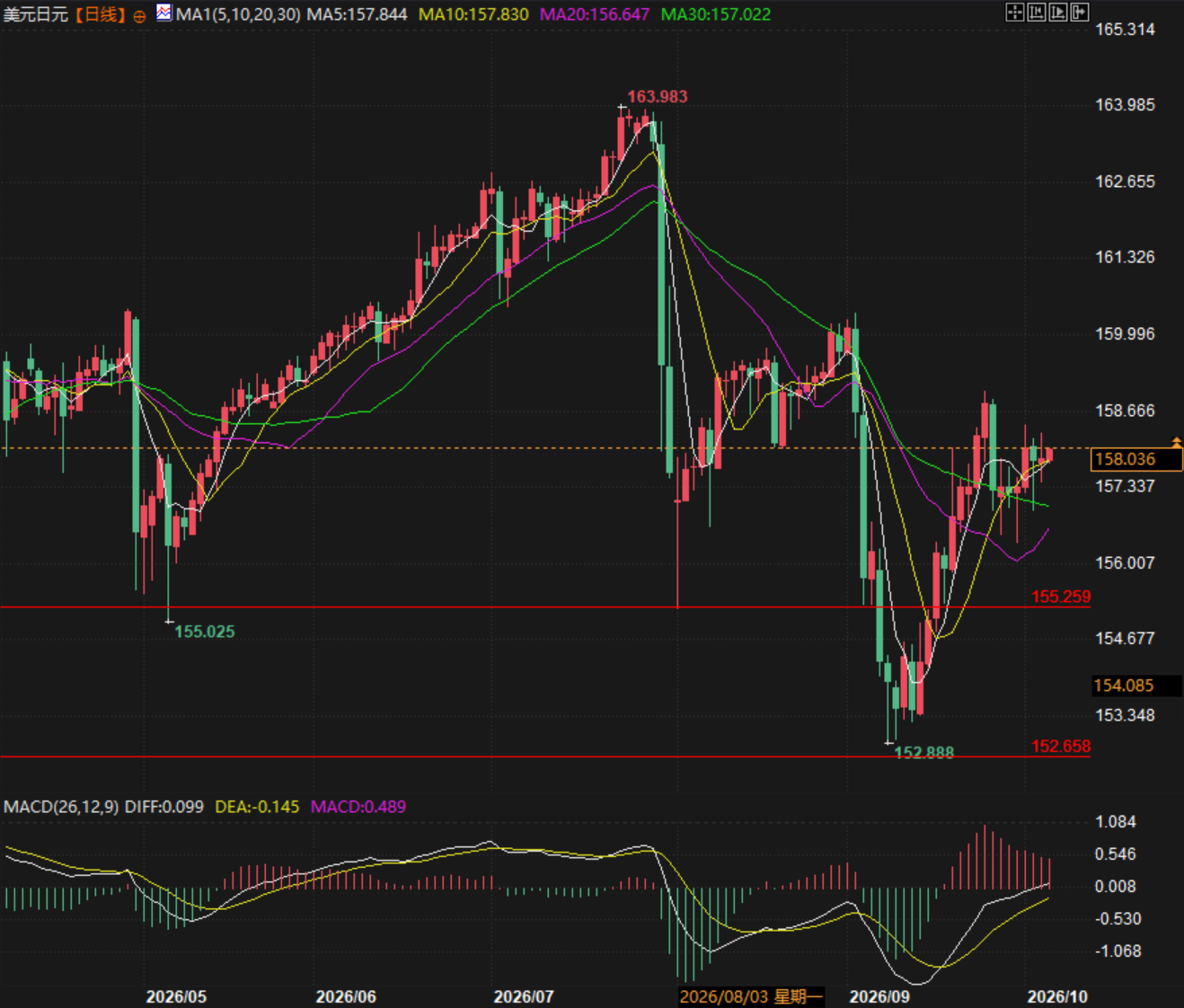 (USD/JPY daily chart, source: FX678) At 11:11 Beijing time, USD/JPY is currently trading at 158.03/04.
From the perspective of national income, let's examine the cycle of debt, the yen, and inflation.
Sovereign debt at a 30-year high comes at the cost of cutting its largest source of revenue, with consequences naturally falling on three dimensions: increased financing costs, pressure on the yen, and a rise in the discount rate for Japanese stocks. Even more alarming is the transmission chain—yen depreciation raises import costs and exacerbates imported inflation, which in turn further erodes the room for maneuver in fiscal and monetary policy. Thus, "debt pressure—currency depreciation—imported inflation" interlock and reinforce each other, becoming difficult to dismantle once it takes shape. This is precisely the weakest link in Kaohsiung's "no-debt tax cuts" narrative: a huge gap exists between verbal promises and the assumptions of predictive models.The debate over the Bank of Japan's moves and pace
Bank of Japan Governor Ueda recently delivered his first major speech since the September 18th rate hike to 1.25%, seen as the next major test for expectations of an October rate hike. Currently, the market is pricing in only about 20% of a rate hike on October 30th, while over 80% is pricing in a December hike – the Bank of Japan raised rates in June and September, and the market interprets the "three-month interval" as its policy pace, thus pointing to December rather than October. Deputy Governor Uchida's previous remarks added further uncertainty: he believes artificial intelligence is a considerable positive demand shock, boosting economic activity and prices, and may even affect the neutral interest rate, stating that AI is generally making financial conditions more relaxed – creating a subtle tension with the Bank of Japan's tightening policy direction. Salary data provides another clue. The year-on-year growth rate of cash wages in August is expected to slow to around 3.7% from 4.7% in July. Such a significant decline will weaken the argument for an interest rate hike in October. Ueda's speech came before the data was released, which means that his statement on the pace in October is still missing this piece of the puzzle.USD/JPY: Range-bound trading, awaiting a clear direction.
Over the past three trading days, the USD/JPY pair has repeatedly crossed the 158.00 level, fluctuating between bulls and bears, and is still hovering below that level at the time of writing. Boosted by comments from Uchida AI, it briefly dipped to around 157.50, but the rebound momentum was quickly digested, and the price quickly returned above 158.00 – a typical "rally followed by a pullback," reflecting the market's immediate pricing in the Bank of Japan's statement rather than a trend reversal. External variables are equally crucial: the minutes of the Fed's September meeting are about to be released, and the Fed will hold its interest rate meeting on October 28th, two days earlier than the Bank of Japan; the "US half" of the interest rate differential will be the first to play its hand. In the short term, the exchange rate is expected to fluctuate repeatedly within the 157.5 to 158.5 range. The true direction will depend on Ueda's speech setting the tone, the release of wage data, and the actual explanation of the tax cut funding in the December fiscal budget. If the yield on 10-year Japanese government bonds further breaks through the 3% mark, forming a feedback loop of "rising yields - weakening yen - stock index discount", the USD/JPY exchange rate is expected to see a trend of upward movement - and that will no longer be the current range-bound trading. (USD/JPY daily chart, source: FX678) At 11:11 Beijing time, USD/JPY is currently trading at 158.03/04.
- Risk Warning and Disclaimer
- The market involves risk, and trading may not be suitable for all investors. This article is for reference only and does not constitute personal investment advice, nor does it take into account certain users’ specific investment objectives, financial situation, or other needs. Any investment decisions made based on this information are at your own risk.