The Bank of Japan may hold rates steady in October, but this would pave the way for a rate hike in December.
2026-10-06 14:22:22
The US dollar rose slightly against the Japanese yen in Asian trading on Tuesday (October 6), currently trading around 158. While another rate hike is unlikely this month, the Bank of Japan appears poised to take another step towards further policy tightening. According to a report by a prominent media outlet citing sources familiar with the central bank's thinking, the Bank of Japan may hint in its October quarterly outlook that underlying inflation has roughly reached its 2% target. Symbolically, this marks a significant shift in the policy landscape for a central bank that has been trying to create sustainable inflation for years, and reinforces its readiness for another rate hike in the coming months. 
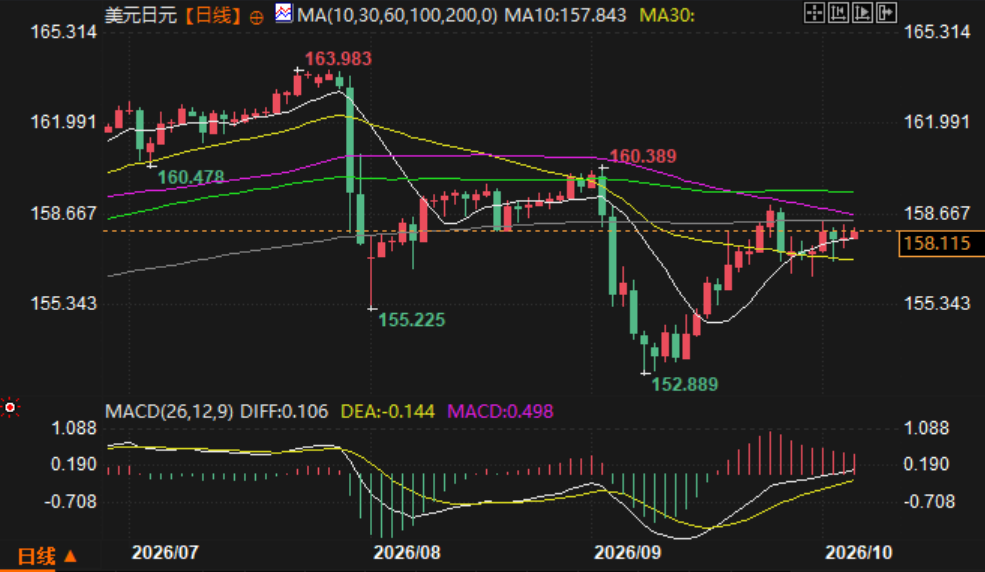 (USD/JPY daily chart, source: FX678) At 14:15 Beijing time, USD/JPY was trading at 158.10/11.
Symbolic shift: Underlying inflation nears 2% target
The Bank of Japan may hint in its October quarterly outlook that underlying inflation has roughly reached its 2% target. The symbolic significance of this shift should not be underestimated—for a central bank that has strived for sustainable inflation for years, formally acknowledging that inflation has reached its target signifies a fundamental change in the policy context. This statement will provide a theoretical basis for another rate hike in the coming months and reinforce market expectations of continued policy normalization. Sources indicate that factors supporting this shift include: stable wage growth, stronger consumer and wholesale inflation, recent Tokyo inflation data, and the Bank of Japan's Tankan survey. These data collectively strengthen the central bank's confidence that underlying inflation is close to 2%.Hold off in October: No rush to act, wait for the effects to take hold.
Despite strengthening inflation signals, reports indicate that the central bank is in no hurry to act again immediately in October. Sources indicate that "many" officials favor a more cautious approach in October, wanting to assess how previous rate hikes have transmitted to the economy. This cautious stance aligns with market pricing—traders are pricing in an approximately 86% probability that the Bank of Japan will keep rates unchanged in October, which seems reasonable after the central bank already raised rates in September. This combination of "holding steady but signaling" is key to understanding the October meeting. The central bank will not raise rates in October, but may pave the way for a rate hike in December or later through the wording of its quarterly outlook.December rate hike: 64% market-priced in; formal acknowledgment that inflation has met target will strengthen expectations.
The bigger question lies beyond October. The market is currently pricing in a roughly 64% probability of another rate hike by the Bank of Japan before December. If the central bank formally acknowledges in its October outlook that underlying inflation has effectively reached its 2% target, it will help support this expectation. More importantly, this acknowledgment would align with the gradual tightening pace so far—the Bank of Japan has already raised rates in June and September, indicating that policymakers are still attempting to normalize policy, but not overly aggressively. From this perspective, the October meeting is more like another piece of the puzzle laying the groundwork for further tightening. If the central bank is now more willing to acknowledge that underlying inflation is around 2%, the debate will gradually shift from "whether further normalization is needed" to "how quickly interest rates should rise."Market Implications: The yen received marginal support, and the USD/JPY interest rate differential remains the dominant factor.
This report provides marginal support for the yen. If the Bank of Japan signals that inflation has met its target in October, market pricing in a December rate hike may be further strengthened, and the yen's interest rate disadvantage is expected to gradually narrow. However, in the short term, the USD/JPY exchange rate will still be dominated by the US-Japan interest rate differential—the yield on 10-year US Treasury bonds remains around 5.30%, and the probability of a Fed rate hike in December is still over 84%, meaning the significant interest rate differential remains unchanged. Therefore, the Bank of Japan's signals are more likely to have a gradual effect in the medium to long term, rather than immediately reversing the USD/JPY trend. If the Bank of Japan raises rates in December while the Fed holds rates steady, the narrowing effect of the interest rate differential will be more significant. Before that, the exchange rate will likely remain in the 157-159 range.Summarize
The Bank of Japan (BOJ) may hint in its October quarterly outlook that underlying inflation has largely reached its 2% target, a symbolic policy shift signifying increased confidence in the sustainability of inflation. However, there is no rush within the BOJ to raise interest rates immediately in October; "many" officials prefer to wait and assess the transmission effects of previous rate hikes, with the market pricing in an approximately 86% probability of no change in October. The bigger focus is on December—the market prices in a 64% probability of another rate hike, and a formal acknowledgment that inflation has reached the target would reinforce this expectation. From this perspective, the October meeting is another piece of the puzzle laying the groundwork for further tightening, and the debate will gradually shift from "whether normalization is needed" to "how quickly interest rates should rise." For the yen, this signal provides marginal support, but in the short term, the USD/JPY interest rate differential remains the dominant factor, and a substantial shift in the exchange rate requires concrete action from the BOJ. (USD/JPY daily chart, source: FX678) At 14:15 Beijing time, USD/JPY was trading at 158.10/11.- Risk Warning and Disclaimer
- The market involves risk, and trading may not be suitable for all investors. This article is for reference only and does not constitute personal investment advice, nor does it take into account certain users’ specific investment objectives, financial situation, or other needs. Any investment decisions made based on this information are at your own risk.