Gold and silver prices rose as yields fell, but the risk of a Fed rate hike in December remains.
2026-10-06 21:48:18
Gold and silver prices rose during the early U.S. trading session on Tuesday (October 6). U.S. long-term Treasury yields retreated from multi-decade highs reached on Monday, while international oil prices fell below $100 per barrel, creating room for precious metals to continue their rebound following the release of the non-farm payroll data. Spot gold traded around $4,165.31 per ounce, up 0.60% on the day; spot silver traded around $61.326, up 0.44% on the day.  The market is caught in a complex interplay of bullish and bearish forces. On one hand, the labor market is signaling weakness, while on the other hand, inflationary pressures remain persistent. The US September non-farm payroll report showed the unemployment rate remained at 4.2%, with average hourly earnings rising 0.1% month-over-month. The combined non-farm payroll figures for July and August were revised downwards by 60,000. The US September ISM Services Purchasing Managers' Index (PMI) came in at 54.9, with the price sub-index reaching its highest level since July 2022. Federal funds rate futures indicate a near 78% probability of the October 28th FOMC meeting maintaining the current interest rate, but a high probability of at least one rate hike in December. The 10-year US Treasury yield is close to 5.27%, and the 30-year Treasury yield is around 5.63%. The US dollar index has retreated from its near 18-month high reached on Monday. A series of key events that will determine the path of interest rates are coming up: speeches by Fed officials on Tuesday, the release of the September Fed meeting minutes on Wednesday, the release of initial jobless claims data on Thursday, and the preliminary October University of Michigan consumer sentiment report on Friday. Weak labor market data or consumer confidence would be beneficial for gold prices; however, persistently high inflation expectations or hawkish signals in meeting minutes would continue to suppress precious metals due to the high-yield environment. The situation in the Strait of Hormuz and the US-Iran standoff remain unresolved, but short-term pressure on oil prices has eased somewhat with the recovery of regional oil exports and the release of emergency reserve crude oil into the market. In the last week of September, Middle Eastern oil exports exceeded pre-war levels for four days; meanwhile, the G7 agreed to release 100 million barrels of strategic reserves of crude oil and diesel. Saudi Arabia lowered the price of its Arab Light crude oil sold to Asia in November, indicating an improvement in oil supply. However, geopolitical risk premiums have not completely subsided: renewed tanker attacks in the Strait of Hormuz, Houthi attacks on Saudi targets, and damage to infrastructure in the Gulf region keep traders wary of further shocks to oil supply. Lower oil prices could marginally weaken the inflationary momentum driving US Treasury yields and a stronger dollar, which would be beneficial for gold; however, the ongoing security risks in the Gulf region will retain safe-haven demand for gold, and fluctuations in the energy market will continue to be considered in the Federal Reserve's policy decisions. Global market risk appetite improved slightly before the US stock market opened. Dow Jones mini futures rose 281 points, or 0.55%; S&P 500 mini futures rose 30.75 points, or 0.39%; and Nasdaq 100 mini futures rose 192 points, or 0.61%, with the artificial intelligence technology sector leading the gains again. Other major overseas markets: West Texas Intermediate crude oil prices on the New York Mercantile Exchange fell, trading below $88 per barrel; Brent crude was near $97.97 per barrel. The benchmark 10-year US Treasury yield remained around 5.284%. The US dollar index weakened somewhat but remained at a high level. Gold technical analysis.
 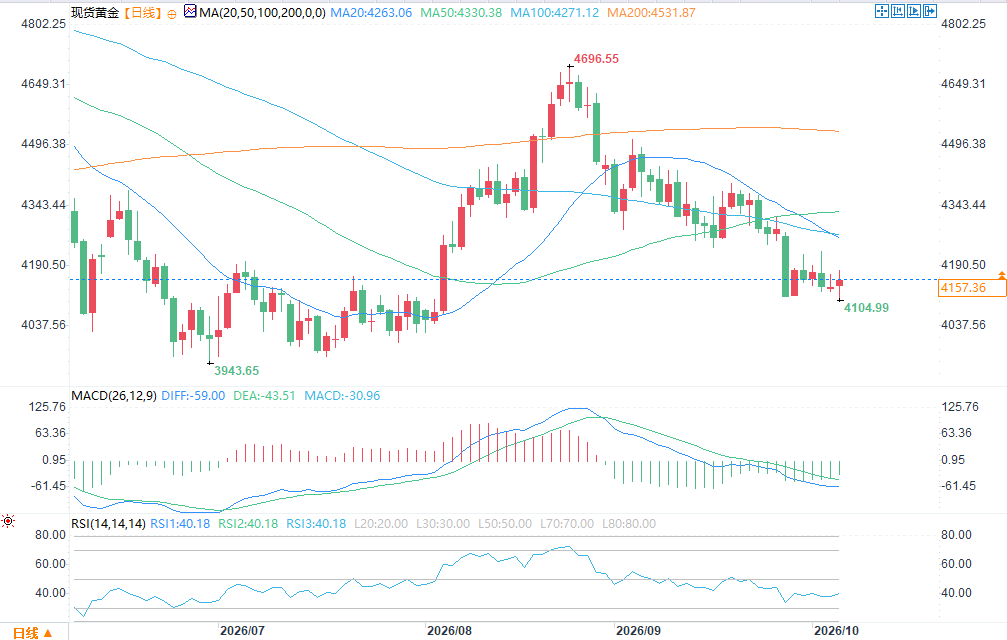 (Spot Gold Daily Chart Source: FX678) The next upside target for spot gold bulls is to push the price above the $4203.61-$4230.51 resistance zone. A successful break above this level would target $4319.61, followed by $4330.43. The short-term downside target for bears is to push the price below $4103.52, with further downside targets at $3996.06 and then $3942.10. The first resistance level is $4203.61, followed by $4230.51; the first support level is $4164.44, followed by $4103.52. Silver Technical Analysis The next upside target for spot silver bulls is to push the price above the $61.744-$63.060 range. A break above this range would target $65.090, followed by the key psychological level of $66.000. The downside target for the bears is to break silver prices below $59.960, with further downside targets at $58.940 and $57.640. The first resistance level is $61.744, followed by $63.060; the first support level is $60.715, followed by $59.960.
The market is caught in a complex interplay of bullish and bearish forces. On one hand, the labor market is signaling weakness, while on the other hand, inflationary pressures remain persistent. The US September non-farm payroll report showed the unemployment rate remained at 4.2%, with average hourly earnings rising 0.1% month-over-month. The combined non-farm payroll figures for July and August were revised downwards by 60,000. The US September ISM Services Purchasing Managers' Index (PMI) came in at 54.9, with the price sub-index reaching its highest level since July 2022. Federal funds rate futures indicate a near 78% probability of the October 28th FOMC meeting maintaining the current interest rate, but a high probability of at least one rate hike in December. The 10-year US Treasury yield is close to 5.27%, and the 30-year Treasury yield is around 5.63%. The US dollar index has retreated from its near 18-month high reached on Monday. A series of key events that will determine the path of interest rates are coming up: speeches by Fed officials on Tuesday, the release of the September Fed meeting minutes on Wednesday, the release of initial jobless claims data on Thursday, and the preliminary October University of Michigan consumer sentiment report on Friday. Weak labor market data or consumer confidence would be beneficial for gold prices; however, persistently high inflation expectations or hawkish signals in meeting minutes would continue to suppress precious metals due to the high-yield environment. The situation in the Strait of Hormuz and the US-Iran standoff remain unresolved, but short-term pressure on oil prices has eased somewhat with the recovery of regional oil exports and the release of emergency reserve crude oil into the market. In the last week of September, Middle Eastern oil exports exceeded pre-war levels for four days; meanwhile, the G7 agreed to release 100 million barrels of strategic reserves of crude oil and diesel. Saudi Arabia lowered the price of its Arab Light crude oil sold to Asia in November, indicating an improvement in oil supply. However, geopolitical risk premiums have not completely subsided: renewed tanker attacks in the Strait of Hormuz, Houthi attacks on Saudi targets, and damage to infrastructure in the Gulf region keep traders wary of further shocks to oil supply. Lower oil prices could marginally weaken the inflationary momentum driving US Treasury yields and a stronger dollar, which would be beneficial for gold; however, the ongoing security risks in the Gulf region will retain safe-haven demand for gold, and fluctuations in the energy market will continue to be considered in the Federal Reserve's policy decisions. Global market risk appetite improved slightly before the US stock market opened. Dow Jones mini futures rose 281 points, or 0.55%; S&P 500 mini futures rose 30.75 points, or 0.39%; and Nasdaq 100 mini futures rose 192 points, or 0.61%, with the artificial intelligence technology sector leading the gains again. Other major overseas markets: West Texas Intermediate crude oil prices on the New York Mercantile Exchange fell, trading below $88 per barrel; Brent crude was near $97.97 per barrel. The benchmark 10-year US Treasury yield remained around 5.284%. The US dollar index weakened somewhat but remained at a high level. Gold technical analysis. (Spot Gold Daily Chart Source: FX678) The next upside target for spot gold bulls is to push the price above the $4203.61-$4230.51 resistance zone. A successful break above this level would target $4319.61, followed by $4330.43. The short-term downside target for bears is to push the price below $4103.52, with further downside targets at $3996.06 and then $3942.10. The first resistance level is $4203.61, followed by $4230.51; the first support level is $4164.44, followed by $4103.52. Silver Technical Analysis The next upside target for spot silver bulls is to push the price above the $61.744-$63.060 range. A break above this range would target $65.090, followed by the key psychological level of $66.000. The downside target for the bears is to break silver prices below $59.960, with further downside targets at $58.940 and $57.640. The first resistance level is $61.744, followed by $63.060; the first support level is $60.715, followed by $59.960.
- Risk Warning and Disclaimer
- The market involves risk, and trading may not be suitable for all investors. This article is for reference only and does not constitute personal investment advice, nor does it take into account certain users’ specific investment objectives, financial situation, or other needs. Any investment decisions made based on this information are at your own risk.