Central bank gold purchases are becoming a long-term main theme, with reserve managers from multiple countries interpreting the strategic value of gold.
2026-10-07 07:32:22
Over the past four years, central bank gold purchases have reshaped the global gold market, providing crucial support for gold prices. Even with a slowdown in official gold purchases, reserve managers continue to view gold as a strategic asset, using it to hedge against geopolitical instability, financial market volatility, and risks stemming from declining confidence in traditional reserve assets. At the central bank-themed roundtable forum at the London Bullion Market Association's annual precious metals conference, reserve officials from Europe, Africa, and Latin America stated that gold's role has long since transcended simply hedging against inflation or preserving value. This also indicates that even after a historic surge in gold prices, central bank demand will remain a significant structural support for the gold market.
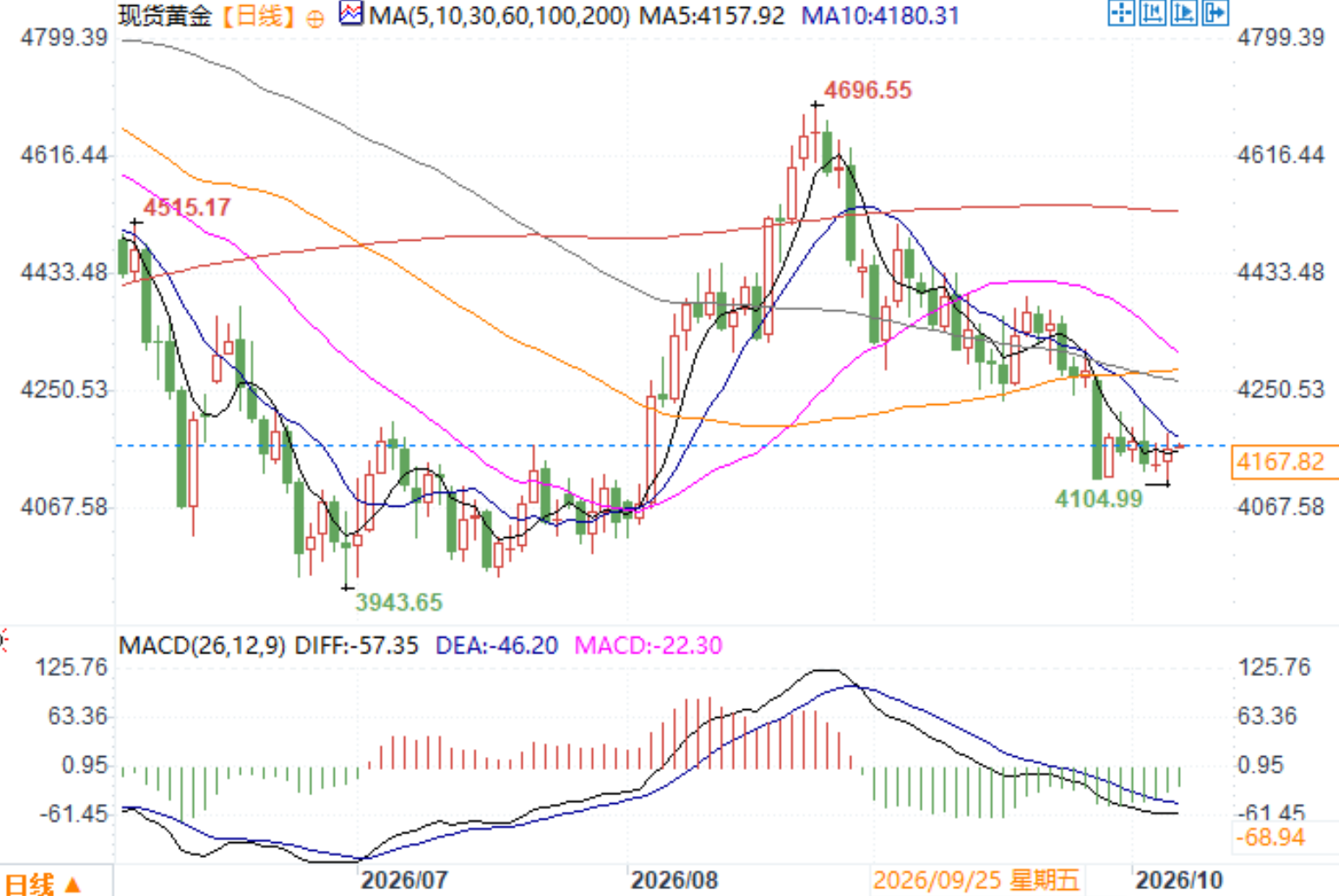 Spot gold daily chart source: FX678. At 7:27 AM Beijing time on October 7th, spot gold was trading at $4167.82 per ounce.
The concept of reserves has shifted, and diversified allocation has become the core demand.
Massimiliano Castelli, Head of Sovereign Strategy at UBS Asset Management and moderator of the forum, explained that the latest reserve management survey shows that gold remains the preferred strategic hedging tool for reserve managers. In 2026, 65% of surveyed central banks cited asset diversification as their primary reason for holding gold, followed by geopolitical risk management. Over the next 12 months, gold, along with the euro and major Asian currencies, are among the reserve assets that central banks plan to increase their holdings of. This survey reflects the evolution of central bank gold-buying logic; in addition to geopolitical risk considerations, gold has been deeply integrated into the long-term strategic asset allocation framework. Tomasz Malkowski, Chief Foreign Exchange and Gold Trader at the National Bank of Poland, stated that central banks should not limit their view of gold to short-term price fluctuations. He said, "Gold is a cornerstone of stability, representing national stability in the eyes of investors, and serving as an anchor during periods of financial turmoil." He pointed out that gold does not carry conventional credit risk, and Poland views it as a strategic asset from a long-term perspective. Poland has been one of the most active gold buyers among central banks in recent years. In 2018, it launched a program to increase its gold reserves, which at that time totaled approximately 100 tons, accounting for 5% of its total reserves. The goal is to increase these reserves to 700 tons. However, he emphasized that the gold purchases are not intended to replace euro and dollar reserves, but rather to build a more diversified reserve structure. The impact of geopolitical instability on reserve management continues to rise, and geopolitical risks have become more important than inflation.Established reserve powers hold onto gold, while emerging nations leverage gold to strengthen their national power.
Gioia Cellai, Deputy Director General of Markets and Monetary Policy Operations at the Bank of Italy, explained that Italy holds approximately 2,450 tons of gold, which has played a crucial role in numerous major economic and political crises. In 1974, when Italy faced financial difficulties, it pledged 500 tons of gold to the Bundesbank in exchange for a $2 billion loan. She stated, "Gold is an asset that can be pledged to official institutions, making it especially valuable in times of crisis." She indicated that gold provides a strong diversification and hedging effect for the Bank of Italy's balance sheet. Although the central bank does not set a fixed allocation ratio, with rising gold prices, the proportion of gold in the central bank's assets is expected to rise back to approximately 30% by 2025. Gershon Agbledzorwu, Director of Financial Markets at the Central Bank of Ghana, explained that Ghana launched its domestic gold purchase program in June 2021, using its local currency to purchase domestically produced gold, transforming mineral resources into long-term national wealth and enhancing its resilience against external shocks. The program is increasing in volume annually, with approximately 110 tons of gold purchased by 2025. Ghana has also reached an agreement with a major mining company to acquire 30% of its output, which is expected to add 30 tons of gold annually. He said, "For us, gold means more than just asset diversification." Thanks to this policy, the Ghanaian currency has strengthened, and inflation is expected to fall from 24% in 2024 to 5.4% in 2025.The debt-free nature of the process highlights that de-dollarization is not simply about abandoning the dollar.
Forum guests noted that gold is not a liability of any party, a characteristic that is particularly valuable in the current environment of geopolitical fragmentation and rising sanctions risks. Physical gold can be stored in national vaults, further reducing the risk of sanctions. Massimiliano Castelli believes that the current de-dollarization is "dissatisfaction, but not a replacement," as countries have not massively sold off US Treasury bonds but have gradually diversified their holdings based on existing reserves, from which gold has benefited. A poll at the conference showed that nearly 90% of participants believed that central bank gold purchases would continue to accelerate or maintain their current scale over the next five years. Henk Janse van Vuuren, Senior Manager of the South African Reserve Bank, pointed out that the value of gold is more reflected in tail risk events, risks that are difficult for traditional asset models to capture. The goal of central banks is to maintain the strength and credibility of national reserves in the long term, and the strategic value of gold should not be judged solely based on short-term gold price fluctuations.Conclusion
In conclusion, the underlying logic of global central bank gold purchases has shifted to long-term strategic allocation. Both established reserve powerhouses and emerging market economies value gold's characteristics of having no counterparty liabilities, resisting sanctions, and hedging tail risks. While short-term gold purchases may fluctuate, the overall trend of central banks acting as stabilizing buyers in the gold market will continue. Spot gold daily chart source: FX678. At 7:27 AM Beijing time on October 7th, spot gold was trading at $4167.82 per ounce.- Risk Warning and Disclaimer
- The market involves risk, and trading may not be suitable for all investors. This article is for reference only and does not constitute personal investment advice, nor does it take into account certain users’ specific investment objectives, financial situation, or other needs. Any investment decisions made based on this information are at your own risk.