Crude oil trading alert: A surprise drop in US crude oil inventories coupled with supply concerns kept US crude oil prices fluctuating at low levels.
2026-10-08 09:32:22
International oil prices remained range-bound in early Asian trading on Thursday, with WTI crude trading around $89.30 per barrel. Earlier, oil prices were supported by factors such as the volatile situation in the Middle East and an unexpected decline in US inventories. However, market expectations of a gradual recovery in global supply and the release of strategic reserves put significant selling pressure on WTI around $90. Data shows that WTI had previously broken through $90 but eventually fell back to around $88, indicating a clear divergence between bulls and bears in pricing supply risks.  The latest data from the U.S. Energy Information Administration shows that for the week ending October 2, U.S. commercial crude oil inventories decreased by 3.186 million barrels to approximately 424.1 million barrels, compared to an increase of approximately 922,000 barrels the previous week. The market had expected an increase of approximately 1.9 million barrels. This inventory decline significantly exceeded market expectations, becoming a key supporting factor for the short-term rebound in WTI crude oil. Simultaneously, U.S. refinery crude oil processing increased by approximately 223,000 barrels per day, with refinery utilization rising to 92.7%, and crude oil exports increased by approximately 1.2 million barrels per day to 4.77 million barrels per day. The inventory decline not only reflects the resilience of demand but was also driven by both refinery activity and export growth. Looking at the inventory structure, gasoline inventories actually increased by approximately 382,000 barrels to 204.7 million barrels, indicating that demand for refined products has not fully strengthened. Therefore, relying solely on a single inventory decline to conclude that the U.S. crude oil market has entered a sustained destocking phase remains cautious. More noteworthy is that US crude oil production rose slightly to approximately 14 million barrels per day, while Cushing inventories increased by about 444,000 barrels. This suggests that there are no signs of a comprehensive tightening in the WTI spot market, and the support for oil prices from inventory data is more of a short-term improvement in sentiment. Meanwhile, significant uncertainty remains on the global supply side. A new round of attacks in the Middle East continues to raise market concerns about the impact on energy infrastructure and transportation routes. The Houthi rebels in Yemen launched another attack on Saudi targets, and the Saudi-led coalition subsequently retaliated, making regional conflict a renewed source of risk premium in the crude oil market. At the same time, while energy transportation near the Strait of Hormuz still faces security risks, some tanker transport has resumed, easing market concerns about actual supply losses from the Middle East. The Strait of Hormuz remains one of the most important supply variables in the current crude oil market. Data from the International Energy Agency shows that by 2025, approximately one-quarter of global seaborne oil trade will pass through the strait, and about 80% of related oil and petroleum products will ultimately flow to the Asian market. Because major energy exporters such as Iran, Iraq, Kuwait, Qatar, and Bahrain are highly dependent on this transportation route, any renewed escalation of transportation risks could quickly push up the geopolitical risk premium for international oil prices. However, supply risks do not unilaterally drive up oil prices. On October 7, member countries of the International Energy Agency (IEA) agreed to accelerate the previously determined release of strategic petroleum reserves, prioritizing the release of diesel reserves. Currently, approximately 325 million barrels of oil have been released into the market under the collective action in March. If all previously committed but not yet released reserves enter the market, it is expected to add approximately 100 million barrels of supply. IEA member countries currently still hold approximately 1.1 billion barrels of public emergency petroleum reserves, including more than 200 million barrels of diesel. This policy has created a clear upward constraint on WTI. It is important to note that the addition of approximately 100 million barrels does not mean that the IEA has suddenly launched a new program of the same scale, but rather that it mainly accelerates the release of previously committed reserves. Therefore, it is more like reducing the market's panic premium by increasing short-term supply certainty. If the market further confirms the continued recovery of Middle Eastern crude oil exports, then the release of strategic reserves and the actual return of supply may create a double suppression, making it difficult for WTI to quickly challenge its previous highs again. From a global market perspective, crude oil prices are currently at the intersection of two lines of reasoning. On the one hand, the Middle East conflict, transportation risks, and potential weather disturbances along the US Gulf Coast continue to provide a supply risk premium; on the other hand, the recovery of Middle Eastern crude oil flows, the release of strategic reserves, and the maintenance of high US supply capacity limit the possibility of further price runaway. The latest outlook from the US Energy Information Administration shows that the average spot price of Brent crude oil in September rose to approximately $114 per barrel, about $23 higher than in August, mainly due to more attacks on Middle Eastern energy facilities and tankers. Therefore, current market sentiment has gradually shifted from a simple "supply disruption trade" to a "balance between supply risk and actual flow." If Middle Eastern crude oil continues to flow out steadily while the release of strategic reserves accelerates, the upside potential for WTI may be limited; however, if Houthi attacks further expand to key Saudi energy facilities, or if there is another large-scale disruption to shipping in the Strait of Hormuz, the market may quickly re-induce the supply risk premium. For investors, the key focus in the coming trading days should be on changes in US crude oil inventories, the actual navigation situation in the Strait of Hormuz, Middle Eastern crude oil exports, and the progress of strategic reserve releases. From a funding perspective, systemic funds have not yet fully shifted to a short position. Market data shows that trend-following commodity trading advisors still hold net long positions in WTI, currently at approximately 23% of their historical maximum, with the $97.70 level considered a potential upward signal that could trigger further systemic buying. This means that if WTI breaks through $90 again and further stabilizes near $92.50, quantitative funds may increase their long positions again; conversely, if prices continue to fall below key support levels, the pressure from systemic funds to reduce their positions may further intensify. From a daily chart perspective, WTI's short-term technical pattern has weakened. Oil prices have broken below the 20-day Bollinger Band, indicating that the previous upward momentum has been disrupted. Currently, prices are still trading above the 100-day moving average, suggesting that the medium-term structure has not yet fully turned bearish. The RSI is approximately 46.3, having fallen below the 50 midline, but still significantly above the oversold zone, indicating that the current situation is more like a weak consolidation after momentum weakens, rather than an extreme oversold condition. On the daily chart, the initial resistance level is around $92.50. If it re-establishes itself above this level, it could further test the $99.90 area. On the downside, the first support level to watch is $85.05, followed by the 100-day moving average around $84.15. A break below the latter could see the market seek support near $80. The 4-hour chart is more bearish. The latest technical structure shows that after WTI broke below $90, the price is still trading below the downtrend line around $92.50 and the main short-term moving averages. The RSI is around 40, and momentum indicators such as MACD remain weak, indicating that the rebound currently lacks sufficient trend confirmation. In the short term, if buying support continues around $88, WTI could potentially rebound technically to the $90-$91.20 range. A break above and sustained hold above $92.50 could weaken the short-term bearish structure and potentially lead to a recovery towards $93 or even $97. Conversely, if the support around $88 is breached, the price may first fall back to around $86.50, and then further down to the $85 level.
 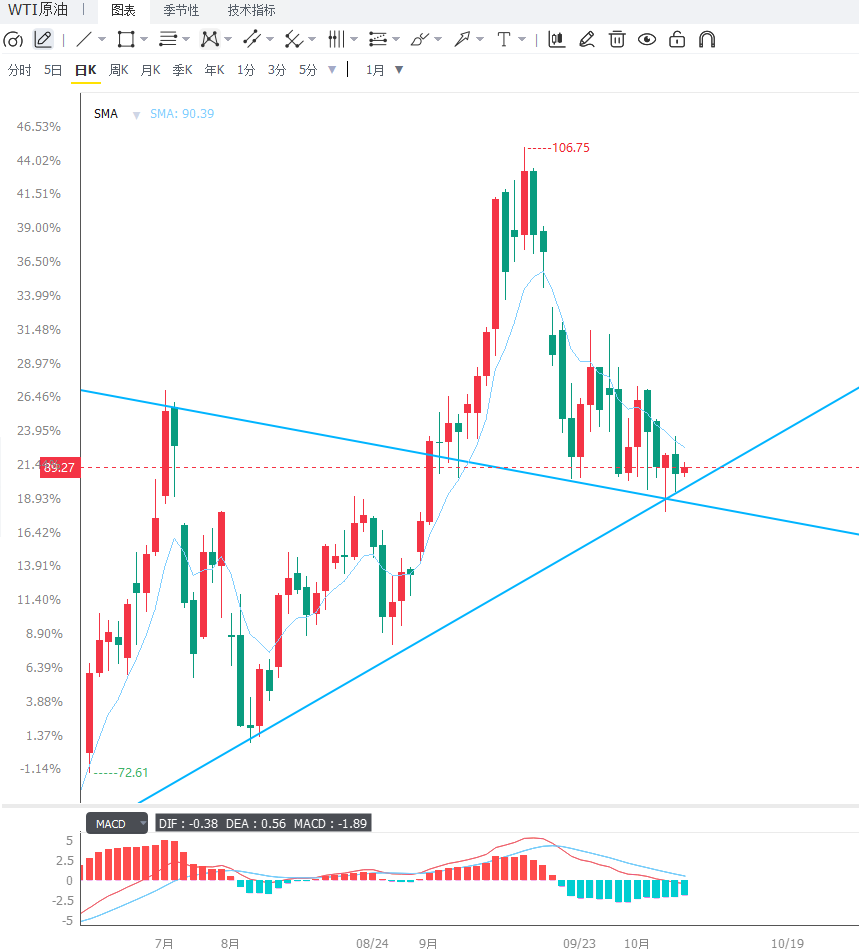 The core issue in WTI's current price movement, as summarized by the editor, is not simply inventory fluctuations, but rather the rebalancing between Middle East supply risks and actual global crude oil flows. An unexpected decline in US inventories could provide short-term support, but the International Energy Agency's accelerated release of strategic reserves and the gradual recovery of Middle Eastern crude oil exports present significant resistance to further price increases. In the short term, WTI is likely to maintain a highly volatile, sideways pattern, with $90 to $92.50 forming a significant resistance zone, and the area around $85 serving as a key support level. If Middle East supply risks escalate again, oil prices could quickly re-incorporate geopolitical premiums; conversely, if transportation recovery and inventory releases continue to improve, WTI may continue to face downward pressure. Going forward, the focus should be on actual supply flows, rather than relying solely on weekly inventory data to determine the trend.
The latest data from the U.S. Energy Information Administration shows that for the week ending October 2, U.S. commercial crude oil inventories decreased by 3.186 million barrels to approximately 424.1 million barrels, compared to an increase of approximately 922,000 barrels the previous week. The market had expected an increase of approximately 1.9 million barrels. This inventory decline significantly exceeded market expectations, becoming a key supporting factor for the short-term rebound in WTI crude oil. Simultaneously, U.S. refinery crude oil processing increased by approximately 223,000 barrels per day, with refinery utilization rising to 92.7%, and crude oil exports increased by approximately 1.2 million barrels per day to 4.77 million barrels per day. The inventory decline not only reflects the resilience of demand but was also driven by both refinery activity and export growth. Looking at the inventory structure, gasoline inventories actually increased by approximately 382,000 barrels to 204.7 million barrels, indicating that demand for refined products has not fully strengthened. Therefore, relying solely on a single inventory decline to conclude that the U.S. crude oil market has entered a sustained destocking phase remains cautious. More noteworthy is that US crude oil production rose slightly to approximately 14 million barrels per day, while Cushing inventories increased by about 444,000 barrels. This suggests that there are no signs of a comprehensive tightening in the WTI spot market, and the support for oil prices from inventory data is more of a short-term improvement in sentiment. Meanwhile, significant uncertainty remains on the global supply side. A new round of attacks in the Middle East continues to raise market concerns about the impact on energy infrastructure and transportation routes. The Houthi rebels in Yemen launched another attack on Saudi targets, and the Saudi-led coalition subsequently retaliated, making regional conflict a renewed source of risk premium in the crude oil market. At the same time, while energy transportation near the Strait of Hormuz still faces security risks, some tanker transport has resumed, easing market concerns about actual supply losses from the Middle East. The Strait of Hormuz remains one of the most important supply variables in the current crude oil market. Data from the International Energy Agency shows that by 2025, approximately one-quarter of global seaborne oil trade will pass through the strait, and about 80% of related oil and petroleum products will ultimately flow to the Asian market. Because major energy exporters such as Iran, Iraq, Kuwait, Qatar, and Bahrain are highly dependent on this transportation route, any renewed escalation of transportation risks could quickly push up the geopolitical risk premium for international oil prices. However, supply risks do not unilaterally drive up oil prices. On October 7, member countries of the International Energy Agency (IEA) agreed to accelerate the previously determined release of strategic petroleum reserves, prioritizing the release of diesel reserves. Currently, approximately 325 million barrels of oil have been released into the market under the collective action in March. If all previously committed but not yet released reserves enter the market, it is expected to add approximately 100 million barrels of supply. IEA member countries currently still hold approximately 1.1 billion barrels of public emergency petroleum reserves, including more than 200 million barrels of diesel. This policy has created a clear upward constraint on WTI. It is important to note that the addition of approximately 100 million barrels does not mean that the IEA has suddenly launched a new program of the same scale, but rather that it mainly accelerates the release of previously committed reserves. Therefore, it is more like reducing the market's panic premium by increasing short-term supply certainty. If the market further confirms the continued recovery of Middle Eastern crude oil exports, then the release of strategic reserves and the actual return of supply may create a double suppression, making it difficult for WTI to quickly challenge its previous highs again. From a global market perspective, crude oil prices are currently at the intersection of two lines of reasoning. On the one hand, the Middle East conflict, transportation risks, and potential weather disturbances along the US Gulf Coast continue to provide a supply risk premium; on the other hand, the recovery of Middle Eastern crude oil flows, the release of strategic reserves, and the maintenance of high US supply capacity limit the possibility of further price runaway. The latest outlook from the US Energy Information Administration shows that the average spot price of Brent crude oil in September rose to approximately $114 per barrel, about $23 higher than in August, mainly due to more attacks on Middle Eastern energy facilities and tankers. Therefore, current market sentiment has gradually shifted from a simple "supply disruption trade" to a "balance between supply risk and actual flow." If Middle Eastern crude oil continues to flow out steadily while the release of strategic reserves accelerates, the upside potential for WTI may be limited; however, if Houthi attacks further expand to key Saudi energy facilities, or if there is another large-scale disruption to shipping in the Strait of Hormuz, the market may quickly re-induce the supply risk premium. For investors, the key focus in the coming trading days should be on changes in US crude oil inventories, the actual navigation situation in the Strait of Hormuz, Middle Eastern crude oil exports, and the progress of strategic reserve releases. From a funding perspective, systemic funds have not yet fully shifted to a short position. Market data shows that trend-following commodity trading advisors still hold net long positions in WTI, currently at approximately 23% of their historical maximum, with the $97.70 level considered a potential upward signal that could trigger further systemic buying. This means that if WTI breaks through $90 again and further stabilizes near $92.50, quantitative funds may increase their long positions again; conversely, if prices continue to fall below key support levels, the pressure from systemic funds to reduce their positions may further intensify. From a daily chart perspective, WTI's short-term technical pattern has weakened. Oil prices have broken below the 20-day Bollinger Band, indicating that the previous upward momentum has been disrupted. Currently, prices are still trading above the 100-day moving average, suggesting that the medium-term structure has not yet fully turned bearish. The RSI is approximately 46.3, having fallen below the 50 midline, but still significantly above the oversold zone, indicating that the current situation is more like a weak consolidation after momentum weakens, rather than an extreme oversold condition. On the daily chart, the initial resistance level is around $92.50. If it re-establishes itself above this level, it could further test the $99.90 area. On the downside, the first support level to watch is $85.05, followed by the 100-day moving average around $84.15. A break below the latter could see the market seek support near $80. The 4-hour chart is more bearish. The latest technical structure shows that after WTI broke below $90, the price is still trading below the downtrend line around $92.50 and the main short-term moving averages. The RSI is around 40, and momentum indicators such as MACD remain weak, indicating that the rebound currently lacks sufficient trend confirmation. In the short term, if buying support continues around $88, WTI could potentially rebound technically to the $90-$91.20 range. A break above and sustained hold above $92.50 could weaken the short-term bearish structure and potentially lead to a recovery towards $93 or even $97. Conversely, if the support around $88 is breached, the price may first fall back to around $86.50, and then further down to the $85 level. The core issue in WTI's current price movement, as summarized by the editor, is not simply inventory fluctuations, but rather the rebalancing between Middle East supply risks and actual global crude oil flows. An unexpected decline in US inventories could provide short-term support, but the International Energy Agency's accelerated release of strategic reserves and the gradual recovery of Middle Eastern crude oil exports present significant resistance to further price increases. In the short term, WTI is likely to maintain a highly volatile, sideways pattern, with $90 to $92.50 forming a significant resistance zone, and the area around $85 serving as a key support level. If Middle East supply risks escalate again, oil prices could quickly re-incorporate geopolitical premiums; conversely, if transportation recovery and inventory releases continue to improve, WTI may continue to face downward pressure. Going forward, the focus should be on actual supply flows, rather than relying solely on weekly inventory data to determine the trend.
- Risk Warning and Disclaimer
- The market involves risk, and trading may not be suitable for all investors. This article is for reference only and does not constitute personal investment advice, nor does it take into account certain users’ specific investment objectives, financial situation, or other needs. Any investment decisions made based on this information are at your own risk.