The US dollar and US Treasury yields strengthened in tandem, while gold hit a near two-month low.
2026-10-08 09:50:20
International gold prices continued to be pressured in early Asian trading on Thursday, with spot gold falling to around $4,110, hitting a near two-month low. The recent correction in gold prices is not driven by a single factor, but rather a combined result of changes in the US dollar, US Treasury yields, and interest rate expectations. As US Treasury yields approach their highest levels since 2002, the opportunity cost of holding gold has increased significantly, while a stronger dollar has further raised the cost of gold for non-dollar investors, leading to substantial profit-taking in the short term.  The US interest rate environment is becoming one of the biggest sources of pressure on the current gold market. The minutes of the most recent Federal Reserve meeting showed that policymakers unanimously supported a rate hike in September, and most officials believed that another rate hike before the end of the year was still necessary. The market currently widely expects the Fed to keep rates unchanged at its October meeting, but according to the CME FedWatch tool, investors are still pricing in a rate hike in December at approximately 78.3% . This means that the market's previous optimism about a shift to looser monetary policy has cooled significantly, and the low-interest-rate environment that gold relied on for support is unlikely to materialize in the short term. Recent statements from Fed officials have further reinforced this change. Speeches by officials including Christopher Waller and Alberto Musaleem will be a key focus for the market. Meanwhile, Fed official Jeffrey Schmid released a hawkish signal, emphasizing that inflation remains a concern and believing that artificial intelligence-related factors are becoming a significant source of price pressure. With long-term US Treasury yields already high, if the Fed believes that short-term interest rates still need further tightening, the market may continue to revise future interest rate paths, thus exerting sustained downward pressure on gold. Rising oil prices further complicate the macroeconomic environment for gold. Crude oil prices have remained high, reigniting market concerns about the potential transmission of energy costs to overall inflation. If energy prices continue to rise, the Federal Reserve will find it more difficult to quickly shift to an easing policy. The resulting transmission chain is: "rising oil prices → increased inflation expectations → prolonged period of high interest rates → higher US Treasury yields → support for the dollar → pressure on gold." Therefore, the recent relationship between gold and crude oil is no longer just a traditional safe-haven linkage; oil prices themselves are also influencing precious metal valuations through inflation and monetary policy expectations. However, the medium- to long-term demand structure for gold has not deteriorated accordingly. Market data shows that trend-following quantitative funds have recently been reducing their gold holdings, but gold ETFs continue to see inflows, and central banks in major Asian economies continue their gold purchases. Related data shows that central banks in major Asian economies have increased their gold reserves for the 23rd consecutive month, adding approximately 23 tons in September. This indicates that the demand for gold from official sectors and long-term funds remains. The significance of this factor for gold prices is that although gold is currently suppressed by real interest rates and a stronger dollar, there is no market environment completely lacking support below. Central bank gold purchases, ETF fund reallocation, and long-term factors such as geopolitical risks, fiscal pressures, and concerns about the dollar's credibility may all create buying pressure after a rapid pullback in gold prices. Market institutions believe that these long-term capital flows may gradually weaken the traditional negative correlation between gold and real interest rates, allowing gold to maintain a relatively strong long-term valuation even in an environment of high real yields. However, from a short-term perspective, the market still needs to be wary of further deleveraging. After a sustained rise in gold prices, some trend-following funds began to reduce their positions after prices broke through key technical support levels. If the dollar index continues to strengthen and US Treasury real yields rise further, CTA funds may continue to reduce their gold exposure, thereby amplifying price volatility. Conversely, if ETF funds flow back in after a rapid decline in gold prices, coupled with stable central bank gold purchase demand, a strong technical rebound may occur. Another important change in the current market is that gold's safe-haven attribute has not yet fully translated into price support. Although global geopolitical risks and fiscal uncertainties remain, when the market focuses more on the question of "how long high interest rates will last," the yield advantage of dollar assets will temporarily outweigh the safe-haven demand for gold. Therefore, investors should not only observe geopolitical situations but also pay attention to the yields of 10-year and 30-year US Treasury bonds, the US dollar index, and the latest statements from Federal Reserve officials regarding the future path of interest rates. From a funding perspective, whether gold can stop falling depends on the interplay of two forces: on the one hand, short-term quantitative funds reducing their positions driven by the US dollar and real yields; on the other hand, bargain hunting brought by central banks, ETFs, and long-term allocation funds. If the former continues to dominate, gold prices may further test the $4,000 level. From a daily chart perspective, spot gold has clearly weakened, currently trading below the 100-day simple moving average and the middle Bollinger Band, indicating an overall bearish trend. Gold prices are currently close to the lower Bollinger Band, indicating heavy short-term selling pressure. The RSI is around 37.1, approaching oversold territory but not yet in an extremely oversold state, so technical indicators are currently insufficient to confirm a trend reversal. The first support level to watch is the lower Bollinger Band around $4,070. If this area is effectively broken, gold prices may further seek support at the $4,000 level. On the upside, the first level to watch is the Bollinger Band middle line around $4250, followed by the 100-day moving average around $4265. Only a retest of these two areas will significantly alleviate the short-term bearish structure. Further up, the upper Bollinger Band resistance is around $4425. Looking at the 4-hour chart, gold remains in a clear downtrend in the short term. After rebounds, prices have been consistently suppressed by previous breakout areas, and there are no clear reversal signals in the technical momentum. If effective support forms around $4110 and the RSI gradually moves away from its lows, gold prices may undergo a technical correction towards the $4180-$4200 range. A further move above $4250 would significantly weaken the short-term bearish structure. Conversely, a break below $4070 indicates that bearish momentum is strengthening, and prices could extend towards $4000 or even lower. The current technical outlook leans more towards a "weak consolidation followed by a search for direction" rather than a direct conclusion that the trend has reversed.
 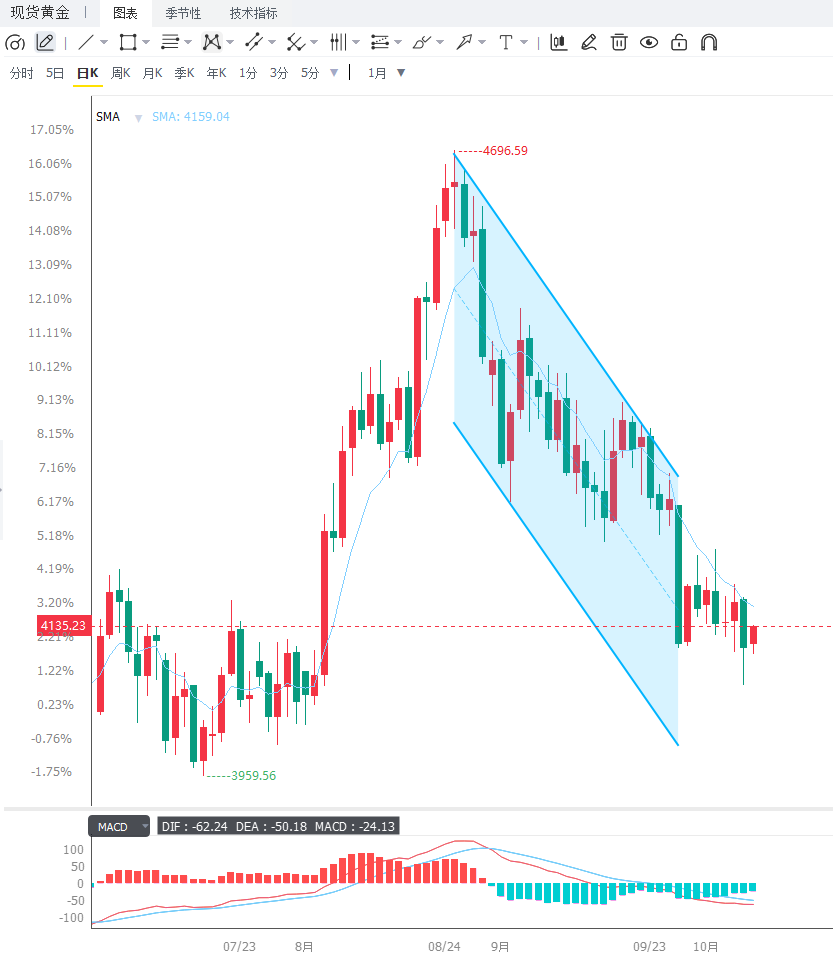 Editor's Summary: Gold is currently entering a crucial phase of macroeconomic repricing. In the short term, a stronger dollar, high US Treasury yields, and the Federal Reserve's hawkish stance are the main pressures, and gold prices, after falling to around $4110, still face the risk of further testing lower support levels. However, in the medium to long term, continued central bank gold purchases, ETF allocation demand, fiscal risks, dollar credibility, and global geopolitical uncertainties continue to provide underlying support for gold. Therefore, the current market situation is more accurately described as a deep correction after a high-level trend, rather than a simple conclusion that the long-term bull market for gold has ended. Whether gold prices can regain strength in the future depends primarily on whether US real yields and the dollar have peaked. If US Treasury yields continue to rise, gold may continue its short-term weakness; if yields fall, the dollar weakens, and central banks and ETFs increase their allocations, gold may find stronger support around $4000 and seek new medium- to long-term upward opportunities. At this stage, $4070 and $4000 are key areas to watch on the downside, while $4250 to $4265 is a crucial technical level for bulls to regain short-term initiative.
The US interest rate environment is becoming one of the biggest sources of pressure on the current gold market. The minutes of the most recent Federal Reserve meeting showed that policymakers unanimously supported a rate hike in September, and most officials believed that another rate hike before the end of the year was still necessary. The market currently widely expects the Fed to keep rates unchanged at its October meeting, but according to the CME FedWatch tool, investors are still pricing in a rate hike in December at approximately 78.3% . This means that the market's previous optimism about a shift to looser monetary policy has cooled significantly, and the low-interest-rate environment that gold relied on for support is unlikely to materialize in the short term. Recent statements from Fed officials have further reinforced this change. Speeches by officials including Christopher Waller and Alberto Musaleem will be a key focus for the market. Meanwhile, Fed official Jeffrey Schmid released a hawkish signal, emphasizing that inflation remains a concern and believing that artificial intelligence-related factors are becoming a significant source of price pressure. With long-term US Treasury yields already high, if the Fed believes that short-term interest rates still need further tightening, the market may continue to revise future interest rate paths, thus exerting sustained downward pressure on gold. Rising oil prices further complicate the macroeconomic environment for gold. Crude oil prices have remained high, reigniting market concerns about the potential transmission of energy costs to overall inflation. If energy prices continue to rise, the Federal Reserve will find it more difficult to quickly shift to an easing policy. The resulting transmission chain is: "rising oil prices → increased inflation expectations → prolonged period of high interest rates → higher US Treasury yields → support for the dollar → pressure on gold." Therefore, the recent relationship between gold and crude oil is no longer just a traditional safe-haven linkage; oil prices themselves are also influencing precious metal valuations through inflation and monetary policy expectations. However, the medium- to long-term demand structure for gold has not deteriorated accordingly. Market data shows that trend-following quantitative funds have recently been reducing their gold holdings, but gold ETFs continue to see inflows, and central banks in major Asian economies continue their gold purchases. Related data shows that central banks in major Asian economies have increased their gold reserves for the 23rd consecutive month, adding approximately 23 tons in September. This indicates that the demand for gold from official sectors and long-term funds remains. The significance of this factor for gold prices is that although gold is currently suppressed by real interest rates and a stronger dollar, there is no market environment completely lacking support below. Central bank gold purchases, ETF fund reallocation, and long-term factors such as geopolitical risks, fiscal pressures, and concerns about the dollar's credibility may all create buying pressure after a rapid pullback in gold prices. Market institutions believe that these long-term capital flows may gradually weaken the traditional negative correlation between gold and real interest rates, allowing gold to maintain a relatively strong long-term valuation even in an environment of high real yields. However, from a short-term perspective, the market still needs to be wary of further deleveraging. After a sustained rise in gold prices, some trend-following funds began to reduce their positions after prices broke through key technical support levels. If the dollar index continues to strengthen and US Treasury real yields rise further, CTA funds may continue to reduce their gold exposure, thereby amplifying price volatility. Conversely, if ETF funds flow back in after a rapid decline in gold prices, coupled with stable central bank gold purchase demand, a strong technical rebound may occur. Another important change in the current market is that gold's safe-haven attribute has not yet fully translated into price support. Although global geopolitical risks and fiscal uncertainties remain, when the market focuses more on the question of "how long high interest rates will last," the yield advantage of dollar assets will temporarily outweigh the safe-haven demand for gold. Therefore, investors should not only observe geopolitical situations but also pay attention to the yields of 10-year and 30-year US Treasury bonds, the US dollar index, and the latest statements from Federal Reserve officials regarding the future path of interest rates. From a funding perspective, whether gold can stop falling depends on the interplay of two forces: on the one hand, short-term quantitative funds reducing their positions driven by the US dollar and real yields; on the other hand, bargain hunting brought by central banks, ETFs, and long-term allocation funds. If the former continues to dominate, gold prices may further test the $4,000 level. From a daily chart perspective, spot gold has clearly weakened, currently trading below the 100-day simple moving average and the middle Bollinger Band, indicating an overall bearish trend. Gold prices are currently close to the lower Bollinger Band, indicating heavy short-term selling pressure. The RSI is around 37.1, approaching oversold territory but not yet in an extremely oversold state, so technical indicators are currently insufficient to confirm a trend reversal. The first support level to watch is the lower Bollinger Band around $4,070. If this area is effectively broken, gold prices may further seek support at the $4,000 level. On the upside, the first level to watch is the Bollinger Band middle line around $4250, followed by the 100-day moving average around $4265. Only a retest of these two areas will significantly alleviate the short-term bearish structure. Further up, the upper Bollinger Band resistance is around $4425. Looking at the 4-hour chart, gold remains in a clear downtrend in the short term. After rebounds, prices have been consistently suppressed by previous breakout areas, and there are no clear reversal signals in the technical momentum. If effective support forms around $4110 and the RSI gradually moves away from its lows, gold prices may undergo a technical correction towards the $4180-$4200 range. A further move above $4250 would significantly weaken the short-term bearish structure. Conversely, a break below $4070 indicates that bearish momentum is strengthening, and prices could extend towards $4000 or even lower. The current technical outlook leans more towards a "weak consolidation followed by a search for direction" rather than a direct conclusion that the trend has reversed. Editor's Summary: Gold is currently entering a crucial phase of macroeconomic repricing. In the short term, a stronger dollar, high US Treasury yields, and the Federal Reserve's hawkish stance are the main pressures, and gold prices, after falling to around $4110, still face the risk of further testing lower support levels. However, in the medium to long term, continued central bank gold purchases, ETF allocation demand, fiscal risks, dollar credibility, and global geopolitical uncertainties continue to provide underlying support for gold. Therefore, the current market situation is more accurately described as a deep correction after a high-level trend, rather than a simple conclusion that the long-term bull market for gold has ended. Whether gold prices can regain strength in the future depends primarily on whether US real yields and the dollar have peaked. If US Treasury yields continue to rise, gold may continue its short-term weakness; if yields fall, the dollar weakens, and central banks and ETFs increase their allocations, gold may find stronger support around $4000 and seek new medium- to long-term upward opportunities. At this stage, $4070 and $4000 are key areas to watch on the downside, while $4250 to $4265 is a crucial technical level for bulls to regain short-term initiative.
- Risk Warning and Disclaimer
- The market involves risk, and trading may not be suitable for all investors. This article is for reference only and does not constitute personal investment advice, nor does it take into account certain users’ specific investment objectives, financial situation, or other needs. Any investment decisions made based on this information are at your own risk.