Japan's better-than-expected current account surplus failed to boost the yen, while continued fiscal risks in France led to a slight rebound in the euro against the yen.
2026-10-08 15:25:33
The euro rose slightly by about 0.14% against the yen in Asian trading on Thursday, trading around 177.15, recovering some of the losses from the previous session. Despite strong Japanese current account data, the yen did not receive a significant boost, reflecting that short-term exchange rate movements are still influenced by multiple factors, including monetary policy expectations, market risk appetite, and the euro's own fundamentals. The euro has temporarily gained technical momentum, but with France's fiscal problems unresolved, further gains remain uncertain.  Japanese financial data exceeded market expectations. Japan's current account surplus rose to 406.2 billion yen in August, higher than the market expectation of 319.4 billion yen and the previous value of 298.8 billion yen. A larger current account surplus usually indicates an improvement in a country's external balance of payments, providing some fundamental support for the domestic currency. However, the positive data did not immediately translate into yen appreciation, suggesting that investors are currently more focused on interest rate differentials, market fund flows, and subsequent policy actions by the Bank of Japan (BOJ). Regarding monetary policy, hawkish signals within the BOJ are worth noting. BOJ policy board member Ayano Sato previously stated her support for a phased approach to raising interest rates. This stance helps strengthen market confidence in the BOJ's gradual exit from its easing policy. If Japanese inflation and wage growth can maintain a certain level of resilience, the likelihood of further interest rate hikes by the BOJ may increase, thereby narrowing the interest rate differential between Japan and other major economies and providing medium-term support for the yen. However, a hawkish policy stance does not necessarily mean an immediate strengthening of the yen. The market usually prices interest rate hikes in advance, and the actual exchange rate performance depends on the speed and magnitude of policy adjustments and the interest rate paths of other major central banks. If the Bank of Japan raises interest rates more slowly than the market expects, and overseas interest rates remain high, the yen may still be pressured by carry trades. The current coexistence of improved Japanese current account data and short-term yen weakness illustrates that fundamental data and money market pricing are not always synchronized. Regarding the euro, the French fiscal outlook remains a significant factor limiting its performance. In recent weeks, French government bonds have faced considerable selling pressure, with market concerns about the size of French public debt, the fiscal deficit, and political stability intensifying. While falling bond prices are typically accompanied by rising yields, if the yield increase reflects a widening fiscal risk premium rather than an improved economic outlook, it may not provide sustained support for the euro. Instead, investors may reduce their willingness to allocate to euro assets due to concerns about the sustainability of French finances. The controversy surrounding the French budget has further increased market uncertainty. French politician Marine Le Pen proposed a plan to cut approximately €140 billion in spending annually in an attempt to address fiscal pressure. However, the market remains skeptical about whether the minority government can successfully push the budget through parliament. Even if an agreement is ultimately reached, the spending cuts may face political and public opposition, hindering implementation. Analysts at Nomura Securities in Japan point out that the French budget aims to reduce the fiscal deficit as a percentage of GDP from the projected 5.4% this year to 5.0% in 2027. However, even this relatively limited improvement could be constrained by political resistance and social opposition. French Prime Minister Sébastien Le Corny may be able to push through a compromise with the opposition or by invoking Article 49.3 of the French Constitution, but even if the budget is passed, it doesn't mean the political risks will disappear quickly. With the 2027 French election approaching, the market may continue to demand higher risk compensation from French assets. This means that the euro's short-term rebound still lacks sufficiently solid fundamental support. French fiscal risks may be transmitted to the euro exchange rate through the government bond market, while a potential interest rate hike by the Bank of Japan could gradually improve the yen's interest rate differential. The interaction of these two forces will be a crucial determinant of the future trend of the euro/yen exchange rate. From a cross-currency perspective, the euro/yen exchange rate depends not only on the performance of the euro and yen against the dollar but also on changes in relative policy expectations between the two currencies. If French fiscal concerns intensify further, the euro may come under pressure; if the Bank of Japan releases a clearer signal of an interest rate hike, the yen may receive support. Conversely, if progress is made in the French budget negotiations and market risk appetite improves, while the Bank of Japan maintains its gradual policy adjustments, the euro/yen pair may continue to have opportunities for a phased rebound. From a daily chart perspective, the euro/yen pair rebounded to around 177.15 on Thursday, temporarily recovering some of the previous day's losses, but a single-day rise is insufficient to confirm a trend reversal. Currently available market data lacks complete moving averages, the Relative Strength Index (RSI), and recent highs and lows, therefore it is inappropriate to directly set unverified specific technical support and resistance levels. In the short term, the focus should be on whether the exchange rate can continue its rebound and regain its footing above the price area broken in the previous trading day; if the rebound lacks sustainability and the price weakens again, it may indicate that the previous downward pressure has not yet subsided. If a higher low is subsequently formed and the price continues to break through the short-term rebound high, it will help improve the daily chart structure. From a 4-hour chart perspective, the exchange rate recovered after a significant drop in the previous trading day, and the short-term bullish and bearish forces may be entering a rebalancing phase. If the price can maintain above 177.00 and gradually break through the recent rebound high, the short-term rebound momentum is expected to continue. However, if the exchange rate falls back below 177.00 and continues to weaken, caution is warranted regarding a potential failure of the rebound and a retest of the previous low. Due to the lack of sufficient short-term indicators and specific price structure data, it is currently more appropriate to use actual breakouts, pullbacks for confirmation, and changes in highs and lows as the basis for judgment, rather than simply following the bulls based on a single rebound. Fundamentally, French fiscal news and expectations regarding the Bank of Japan's policy may still trigger significant volatility, and technical signals need to be verified in conjunction with relevant news.
 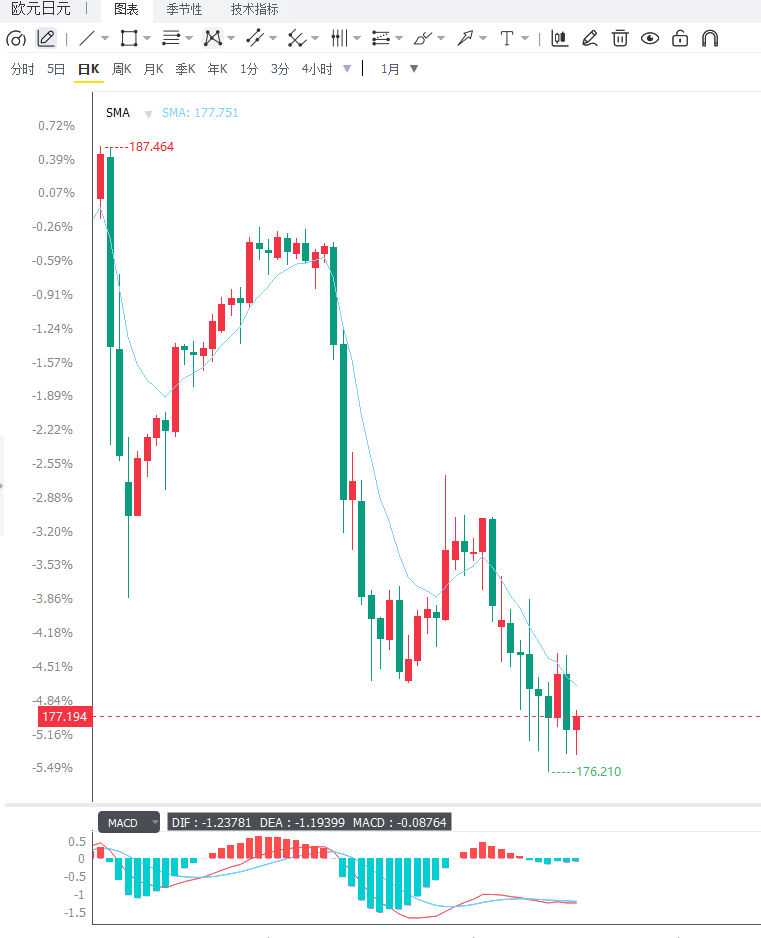 Editor's Summary: The EUR/JPY pair is currently exhibiting a pattern of short-term rebound coupled with medium-term uncertainty. Japan's August current account surplus exceeded expectations, but the yen has not yet received significant support from the positive data; however, the hawkish stance within the Bank of Japan provides potential support for the yen's medium-term trend. Regarding the euro, the French fiscal deficit, budget negotiations, and political risk premium remain the main sources of pressure, and even if the budget is ultimately passed, it may not quickly dispel market doubts. Going forward, key attention should be paid to the progress of French budget negotiations, the Bank of Japan's interest rate hike signals, and the short-term price structure of EUR/JPY. If French fiscal risks continue to escalate, or the Bank of Japan further strengthens its expectations of interest rate hikes, the exchange rate may come under renewed pressure; if the French political situation stabilizes and risk appetite improves, EUR/JPY may continue its technical rebound.
Japanese financial data exceeded market expectations. Japan's current account surplus rose to 406.2 billion yen in August, higher than the market expectation of 319.4 billion yen and the previous value of 298.8 billion yen. A larger current account surplus usually indicates an improvement in a country's external balance of payments, providing some fundamental support for the domestic currency. However, the positive data did not immediately translate into yen appreciation, suggesting that investors are currently more focused on interest rate differentials, market fund flows, and subsequent policy actions by the Bank of Japan (BOJ). Regarding monetary policy, hawkish signals within the BOJ are worth noting. BOJ policy board member Ayano Sato previously stated her support for a phased approach to raising interest rates. This stance helps strengthen market confidence in the BOJ's gradual exit from its easing policy. If Japanese inflation and wage growth can maintain a certain level of resilience, the likelihood of further interest rate hikes by the BOJ may increase, thereby narrowing the interest rate differential between Japan and other major economies and providing medium-term support for the yen. However, a hawkish policy stance does not necessarily mean an immediate strengthening of the yen. The market usually prices interest rate hikes in advance, and the actual exchange rate performance depends on the speed and magnitude of policy adjustments and the interest rate paths of other major central banks. If the Bank of Japan raises interest rates more slowly than the market expects, and overseas interest rates remain high, the yen may still be pressured by carry trades. The current coexistence of improved Japanese current account data and short-term yen weakness illustrates that fundamental data and money market pricing are not always synchronized. Regarding the euro, the French fiscal outlook remains a significant factor limiting its performance. In recent weeks, French government bonds have faced considerable selling pressure, with market concerns about the size of French public debt, the fiscal deficit, and political stability intensifying. While falling bond prices are typically accompanied by rising yields, if the yield increase reflects a widening fiscal risk premium rather than an improved economic outlook, it may not provide sustained support for the euro. Instead, investors may reduce their willingness to allocate to euro assets due to concerns about the sustainability of French finances. The controversy surrounding the French budget has further increased market uncertainty. French politician Marine Le Pen proposed a plan to cut approximately €140 billion in spending annually in an attempt to address fiscal pressure. However, the market remains skeptical about whether the minority government can successfully push the budget through parliament. Even if an agreement is ultimately reached, the spending cuts may face political and public opposition, hindering implementation. Analysts at Nomura Securities in Japan point out that the French budget aims to reduce the fiscal deficit as a percentage of GDP from the projected 5.4% this year to 5.0% in 2027. However, even this relatively limited improvement could be constrained by political resistance and social opposition. French Prime Minister Sébastien Le Corny may be able to push through a compromise with the opposition or by invoking Article 49.3 of the French Constitution, but even if the budget is passed, it doesn't mean the political risks will disappear quickly. With the 2027 French election approaching, the market may continue to demand higher risk compensation from French assets. This means that the euro's short-term rebound still lacks sufficiently solid fundamental support. French fiscal risks may be transmitted to the euro exchange rate through the government bond market, while a potential interest rate hike by the Bank of Japan could gradually improve the yen's interest rate differential. The interaction of these two forces will be a crucial determinant of the future trend of the euro/yen exchange rate. From a cross-currency perspective, the euro/yen exchange rate depends not only on the performance of the euro and yen against the dollar but also on changes in relative policy expectations between the two currencies. If French fiscal concerns intensify further, the euro may come under pressure; if the Bank of Japan releases a clearer signal of an interest rate hike, the yen may receive support. Conversely, if progress is made in the French budget negotiations and market risk appetite improves, while the Bank of Japan maintains its gradual policy adjustments, the euro/yen pair may continue to have opportunities for a phased rebound. From a daily chart perspective, the euro/yen pair rebounded to around 177.15 on Thursday, temporarily recovering some of the previous day's losses, but a single-day rise is insufficient to confirm a trend reversal. Currently available market data lacks complete moving averages, the Relative Strength Index (RSI), and recent highs and lows, therefore it is inappropriate to directly set unverified specific technical support and resistance levels. In the short term, the focus should be on whether the exchange rate can continue its rebound and regain its footing above the price area broken in the previous trading day; if the rebound lacks sustainability and the price weakens again, it may indicate that the previous downward pressure has not yet subsided. If a higher low is subsequently formed and the price continues to break through the short-term rebound high, it will help improve the daily chart structure. From a 4-hour chart perspective, the exchange rate recovered after a significant drop in the previous trading day, and the short-term bullish and bearish forces may be entering a rebalancing phase. If the price can maintain above 177.00 and gradually break through the recent rebound high, the short-term rebound momentum is expected to continue. However, if the exchange rate falls back below 177.00 and continues to weaken, caution is warranted regarding a potential failure of the rebound and a retest of the previous low. Due to the lack of sufficient short-term indicators and specific price structure data, it is currently more appropriate to use actual breakouts, pullbacks for confirmation, and changes in highs and lows as the basis for judgment, rather than simply following the bulls based on a single rebound. Fundamentally, French fiscal news and expectations regarding the Bank of Japan's policy may still trigger significant volatility, and technical signals need to be verified in conjunction with relevant news. Editor's Summary: The EUR/JPY pair is currently exhibiting a pattern of short-term rebound coupled with medium-term uncertainty. Japan's August current account surplus exceeded expectations, but the yen has not yet received significant support from the positive data; however, the hawkish stance within the Bank of Japan provides potential support for the yen's medium-term trend. Regarding the euro, the French fiscal deficit, budget negotiations, and political risk premium remain the main sources of pressure, and even if the budget is ultimately passed, it may not quickly dispel market doubts. Going forward, key attention should be paid to the progress of French budget negotiations, the Bank of Japan's interest rate hike signals, and the short-term price structure of EUR/JPY. If French fiscal risks continue to escalate, or the Bank of Japan further strengthens its expectations of interest rate hikes, the exchange rate may come under renewed pressure; if the French political situation stabilizes and risk appetite improves, EUR/JPY may continue its technical rebound.
- Risk Warning and Disclaimer
- The market involves risk, and trading may not be suitable for all investors. This article is for reference only and does not constitute personal investment advice, nor does it take into account certain users’ specific investment objectives, financial situation, or other needs. Any investment decisions made based on this information are at your own risk.