Geopolitical disturbances disrupt oil markets, US-Iran negotiations change course, and shipping risks surge.
2026-10-08 16:22:22
During the Asian and European sessions on October 8th, WTI crude oil stabilized above $90 and fluctuated at high levels. The core driver of current oil prices is not simply a supply shortage, but rather the repeated geopolitical maneuvering in the Middle East, the breakdown of US-Iran negotiations, increased shipping risk premiums on key shipping routes, and the combined effect of inventory levels and energy policy data, all contributing to the resilience of oil prices. 
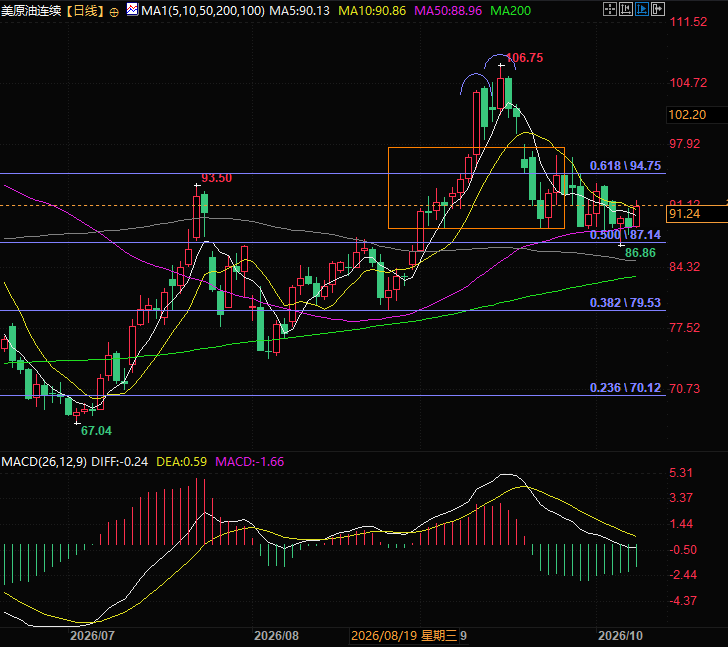 (WTI crude oil futures main contract daily chart, source: FX678) At 16:17 Beijing time, WTI crude oil futures main contract is currently trading at $91.45 per barrel.
Trump officially announced the abandonment of negotiations with Iran! Military strike option remains, raising geopolitical risk premium.
A major shift in US policy toward Iran, with Trump announcing a public abandonment of efforts to push for an Iran agreement, directly ended previous market expectations of de-escalation. The market had anticipated US restraint before the election, but the Trump administration had already instructed the Pentagon to develop contingency plans for a strike against Iran, leaving long-term geopolitical risks. The core conflict between the two sides centers on Iran's nuclear program: the US demands Iran abandon its uranium enrichment capabilities and provide irreversible nuclear security guarantees, which Iran has firmly rejected. Currently, the US has not finalized its action, but US and Israeli sources indicate that military action could occur around the time of the US midterm elections or the Israeli elections. Iran's Foreign Ministry has refuted the US's inconsistent stance, essentially closing the door to short-term de-escalation and continuing to provide a geopolitical premium for oil prices.Houthi and Saudi Arabia launch large-scale attacks! Airports and military targets are hit, escalating the conflict in the Middle East.
Escalating tensions between the US and Iran have led to a full-scale escalation of the conflict in Yemen. The Houthis launched ballistic missile attacks on Saudi military camps and weapons depots, simultaneously striking King Khalid International Airport in Riyadh and designating most of Saudi airspace as a combat zone, disrupting regional aviation operations. In retaliation, the Saudi-led coalition launched airstrikes on 82 Houthi military facilities across four Yemeni provinces. The conflict has also spread to the seas, with oil tankers in northern Qatar being attacked by missiles, resulting in casualties. Shipping risks in the Persian Gulf and the Gulf of Oman have soared, driving up the cost of hedging crude oil transport.Shipping capacity in the Strait of Hormuz plummets by 27%! Route restructuring drives up shipping premiums, reinforcing oil price resilience.
Current situation in the Strait of Hormuz: Navigation remains uninterrupted, but efficiency has plummeted and risks have risen sharply. Iran and Oman are negotiating a dedicated safe passage route, but the US and Iran have completely contradictory statements, exacerbating market disagreements. The US claims that approximately 20 million barrels of crude oil can still pass through the strait daily. The current average daily throughput is 10.1 million barrels, a 27% decrease from the previous wartime peak, only 74% of pre-war levels; the lowest number of ships passing through daily is only 7, a new low since late July. Traders have shifted to the Gulf of Oman and Red Sea routes, which export an average of 6.7 million barrels per day, more than double the pre-war level, bringing the total supply of Middle Eastern crude oil back to pre-war levels. The core market contradiction is evident: total supply is sufficient, but navigation efficiency has deteriorated, leading to a continuous rise in war risk premiums and ocean freight rates. Maersk announced a 20% increase in global import and export emergency fuel surcharges starting October 12, confirming the pressure on logistics costs.EIA inventory reduction exceeded expectations, with strategic reserves hitting a multi-decade low! Tight supply and demand balance supports oil prices.
The latest EIA data shows a structurally tight balance in US crude oil prices. Crude oil inventories fell sharply by 3.186 million barrels in the week ending October 2nd, while refinery utilization rates rose slightly by 0.2%, indicating a marginal recovery in crude oil demand. US crude oil production hit a record high, but strategic petroleum reserves fell to their lowest level since October 1982, significantly shrinking the domestic energy buffer and providing support for oil prices. Gasoline and Cushing delivery inventories saw slight accumulation, only slightly easing near-term pressure and not changing the overall tight supply situation.IEA accelerates reserve releases and EIA raises oil price forecasts, shifting the medium- to long-term price center of gravity upwards.
The IEA announced an accelerated release of oil reserves, accelerating the release of the remaining approximately 100 million barrels on top of the 325 million barrels already released, prioritizing the release of scarce diesel reserves to alleviate supply and demand pressures on refined oil products. IEA member countries still hold 1.1 billion barrels of emergency reserves and over 200 million barrels of diesel reserves, providing ample room for further adjustments. Iraq simultaneously began using trucks to transport crude oil via Syria to supplement regional supply. The EIA raised its oil price forecasts: the 2026 WTI forecast was revised upwards from $84.65/barrel to $88.21/barrel; the 2027 forecast was revised upwards from $69.74/barrel to $79.74/barrel, indicating a comprehensive upward shift in the medium- to long-term oil price center.Geopolitical premiums are impacting the real economy! Fuel prices surge in the UAE, fuel inflation continues to rise.
Rising oil prices are impacting end-consumer demand. The UAE raised fuel prices in October, with gasoline increasing by 15.8%-16.6% and diesel by 11.6%. Brent crude stabilized above $102 per barrel, while WTI approached $90 per barrel. This energy inflation is spreading outwards, increasing transportation and commodity trade costs and exposing the fragility of the global energy system.Market Summary: Triple premiums dominate the market, with geopolitical conflicts as the core trading theme.
The current oil market logic has shifted from traditional supply and demand to a triple driver of geopolitical risk premium, logistics cost premium, and policy expectation recovery. Although total Middle Eastern crude oil supply has returned to pre-war levels, the breakdown of US-Iran negotiations, recurring local conflicts, and impaired navigation efficiency in the Strait of Hormuz, coupled with low strategic reserves and upward revisions to oil price expectations by institutions, make it difficult to reverse the high-level fluctuation pattern of oil prices in the short term. Key areas to monitor include: the pace of Houthi attacks, the stability of navigation in the Strait of Hormuz, the developments in the US-Iran rivalry, and the progress of IEA reserve releases. Technically, WTI crude oil futures rebounded after touching the 0.500 level, with short-term support at the bottom of the previous trading range and resistance around $95. (WTI crude oil futures main contract daily chart, source: FX678) At 16:17 Beijing time, WTI crude oil futures main contract is currently trading at $91.45 per barrel.
- Risk Warning and Disclaimer
- The market involves risk, and trading may not be suitable for all investors. This article is for reference only and does not constitute personal investment advice, nor does it take into account certain users’ specific investment objectives, financial situation, or other needs. Any investment decisions made based on this information are at your own risk.