Rising expectations of a Fed rate hike this year, coupled with energy inflation pressures, have kept the dollar index above 102, continuing its high-level consolidation.
2026-10-08 15:25:43
The US dollar index edged lower in Asian trading on Thursday, continuing its decline from near its highest level since April 2025 in the previous session, but remained above the 102 level overall. The dollar's short-term rally has slowed, but no clear trend reversal signal has yet emerged. Expectations regarding Federal Reserve policy, the relative resilience of the US economy, changes in energy prices, and geopolitical risks continue to provide significant support for the dollar. The market remains cautious about whether the dollar's pullback can be sustained.  The minutes of the Federal Reserve's September 15-16 policy meeting have become a significant factor influencing the recent performance of the US dollar. The minutes showed that policymakers unanimously supported raising the target range for the federal funds rate, with most officials believing that another rate hike before the end of the year might still be necessary to address persistent inflationary pressures. According to the CME Group's FedWatch tool, the market currently expects an approximately 80% probability of a Fed rate hike in December. This expectation indicates that investors remain highly vigilant about the risk of further tightening of US monetary policy, thus supporting the dollar's short-term interest rate advantage. Volatility in energy prices further reinforces this policy logic. International crude oil prices are affected by Middle East supply risks, transportation uncertainties, and expectations of a global supply recovery; changes in energy costs may continue to be transmitted to overall inflation. If oil prices remain high for an extended period, transportation, production, and consumption costs may rise accordingly, complicating the process of inflation decline. For the Fed, this means that even if economic growth slows to some extent, monetary policy may not be able to quickly shift to easing. The market therefore needs to reassess the duration of high interest rates and the possibility of further rate hikes. The resilience of the US economy relative to other major economies also provides additional support for the dollar. Brown Brothers Harriman points out that persistently high energy prices could push up inflation, policy rates, and benchmark bond yields, while also benefiting the currencies of energy-exporting countries and the US dollar. Relatively strong US economic growth, coupled with continued high demand from overseas investors for US securities, also helps maintain the dollar's advantage in capital inflows. This factor means the dollar's performance is no longer entirely dependent on a single policy decision by the Federal Reserve. Even if the market lowers its expectations for interest rate hikes in the short term, as long as the US economy continues to outperform other major economies and US Treasury yields remain relatively high, the dollar is likely to continue to receive support from asset allocation demand. Conversely, if US employment and consumption data continue to weaken, and the market begins to lower its expectations for US economic growth, the dollar's relative advantage may weaken more significantly. The situation in the Middle East provides another layer of support for the dollar. Continued regional conflict increases global energy supply and transportation risks, and market concerns about further escalation have not completely subsided. When uncertainty rises, investors typically increase their allocation to highly liquid assets such as the dollar, thereby driving inflows of safe-haven funds. However, the impact of geopolitical risks on the dollar is not one-way. If the situation eases and energy supplies gradually recover, safe-haven demand may decrease, and the dollar may face profit-taking pressure. The key question for the current US dollar index is whether the short-term pullback is a normal consolidation after a strong rally or a signal of a weakening trend. From the current fundamentals, the Fed's hawkish stance, the relative resilience of the US economy, and energy inflation risks still support the dollar's relative strength. If the index pullback does not involve sustained selling, and US Treasury yields remain high, funds may buy dollars again at lower levels. Going forward, the US weekly initial jobless claims and speeches by Fed officials will be important catalysts for the market. If the job market performs robustly and officials continue to emphasize inflation risks, the market may further solidify expectations of a rate hike at the end of the year, and the dollar index may retest recent highs. Conversely, if employment data is significantly weaker than expected, or if Fed officials release more dovish policy signals, the dollar may continue to adjust. Furthermore, energy prices and the situation in the Middle East remain significant external variables. Rising oil prices may push up US Treasury yields through inflation expectations, but if rising energy prices begin to significantly damage consumer demand and economic growth, the market may turn to concerns about the US economic outlook. Therefore, the future trend of the dollar depends on the combined impact of energy prices on inflation and growth, not just the rise and fall of oil prices themselves. From a daily chart perspective, the US dollar index maintains an overall bullish trend, hovering above the 101.75-101.65 range. This area, previously a significant resistance zone, may now act as short-term support. The Relative Strength Index (RSI) is around 70.67, in overbought territory, indicating strong upward momentum but also suggesting the possibility of profit-taking and a technical pullback in the short term. Overbought conditions do not necessarily mean an immediate trend reversal. If the index can hold above the 101.65-101.75 range, the overall bullish structure is likely to continue; however, a break below this range could lead to a larger pullback, requiring observation of whether new support can form at lower levels. From a 4-hour chart perspective, the US dollar index has retreated slightly after reaching a recent high, with short-term momentum cooling somewhat, but a clear signal of a sustained bearish reversal is currently lacking. If the index finds support near the 102 level and breaks through the recent short-term high, it may further confirm that the bulls have regained control. However, if the rebound is weak and the price continues to fall below the 101.65-101.75 area, it may trigger further technical selling. Given that the RSI is currently at a relatively high level, short-term attention should be paid to changes in trading momentum and price structure during the pullback. If a higher low is formed after the pullback, it indicates that the bulls are still in control of the trend; if key support levels are broken consecutively, it is necessary to reassess whether the upward structure has changed.
 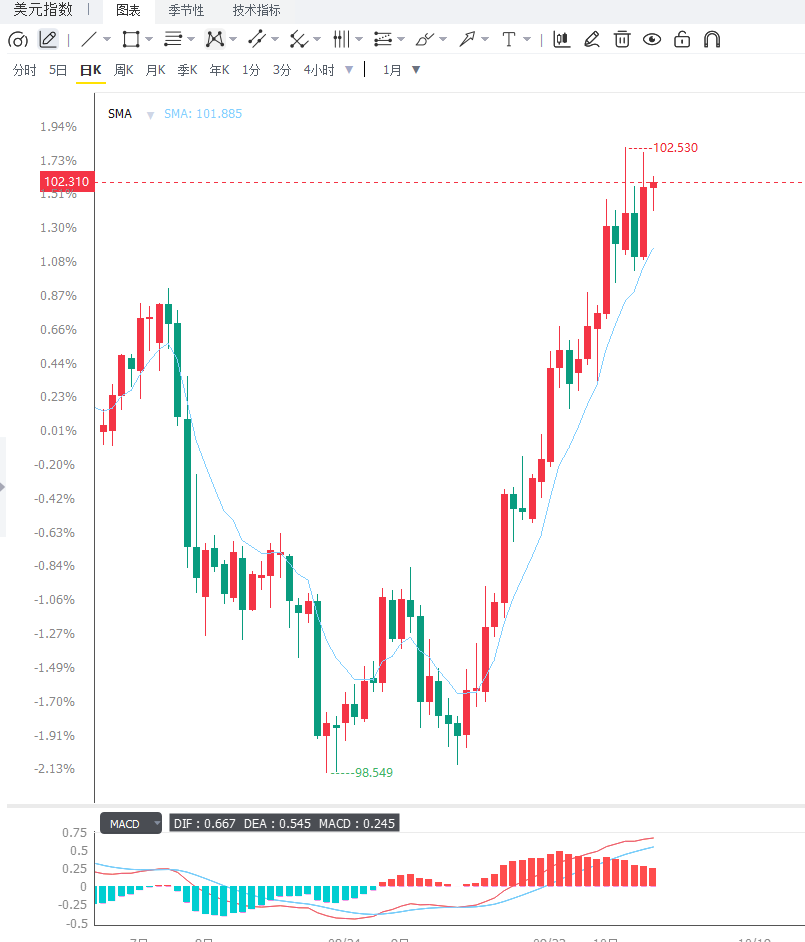 Editor's Summary: The US dollar index is currently in a short-term consolidation phase within a strong trend. Hawkish Fed minutes, high market expectations for a year-end rate hike, relative resilience of the US economy, and Middle East geopolitical risks are all providing support for the dollar. Although technical indicators have entered overbought territory, increasing the risk of a short-term pullback, this is not yet sufficient to confirm a trend reversal. In the short term, the 102 level is a crucial point for observing market sentiment, while the 101.65 to 101.75 area is key support for determining whether the dollar's strong structure can continue. If US employment data is robust and Treasury yields remain high, the dollar may retest recent highs; if data weakens and interest rate expectations cool, the dollar may pull back further. The medium-term trend will still depend on the balance between US inflation and economic growth, and whether the Fed will actually proceed with further rate hikes. Investors should focus on US employment data, Fed officials' speeches, Treasury yields, and energy price changes, avoiding judging a dollar top solely based on short-term pullbacks. Until key support levels are effectively broken, the dollar should be observed with a generally bullish, oscillating outlook.
The minutes of the Federal Reserve's September 15-16 policy meeting have become a significant factor influencing the recent performance of the US dollar. The minutes showed that policymakers unanimously supported raising the target range for the federal funds rate, with most officials believing that another rate hike before the end of the year might still be necessary to address persistent inflationary pressures. According to the CME Group's FedWatch tool, the market currently expects an approximately 80% probability of a Fed rate hike in December. This expectation indicates that investors remain highly vigilant about the risk of further tightening of US monetary policy, thus supporting the dollar's short-term interest rate advantage. Volatility in energy prices further reinforces this policy logic. International crude oil prices are affected by Middle East supply risks, transportation uncertainties, and expectations of a global supply recovery; changes in energy costs may continue to be transmitted to overall inflation. If oil prices remain high for an extended period, transportation, production, and consumption costs may rise accordingly, complicating the process of inflation decline. For the Fed, this means that even if economic growth slows to some extent, monetary policy may not be able to quickly shift to easing. The market therefore needs to reassess the duration of high interest rates and the possibility of further rate hikes. The resilience of the US economy relative to other major economies also provides additional support for the dollar. Brown Brothers Harriman points out that persistently high energy prices could push up inflation, policy rates, and benchmark bond yields, while also benefiting the currencies of energy-exporting countries and the US dollar. Relatively strong US economic growth, coupled with continued high demand from overseas investors for US securities, also helps maintain the dollar's advantage in capital inflows. This factor means the dollar's performance is no longer entirely dependent on a single policy decision by the Federal Reserve. Even if the market lowers its expectations for interest rate hikes in the short term, as long as the US economy continues to outperform other major economies and US Treasury yields remain relatively high, the dollar is likely to continue to receive support from asset allocation demand. Conversely, if US employment and consumption data continue to weaken, and the market begins to lower its expectations for US economic growth, the dollar's relative advantage may weaken more significantly. The situation in the Middle East provides another layer of support for the dollar. Continued regional conflict increases global energy supply and transportation risks, and market concerns about further escalation have not completely subsided. When uncertainty rises, investors typically increase their allocation to highly liquid assets such as the dollar, thereby driving inflows of safe-haven funds. However, the impact of geopolitical risks on the dollar is not one-way. If the situation eases and energy supplies gradually recover, safe-haven demand may decrease, and the dollar may face profit-taking pressure. The key question for the current US dollar index is whether the short-term pullback is a normal consolidation after a strong rally or a signal of a weakening trend. From the current fundamentals, the Fed's hawkish stance, the relative resilience of the US economy, and energy inflation risks still support the dollar's relative strength. If the index pullback does not involve sustained selling, and US Treasury yields remain high, funds may buy dollars again at lower levels. Going forward, the US weekly initial jobless claims and speeches by Fed officials will be important catalysts for the market. If the job market performs robustly and officials continue to emphasize inflation risks, the market may further solidify expectations of a rate hike at the end of the year, and the dollar index may retest recent highs. Conversely, if employment data is significantly weaker than expected, or if Fed officials release more dovish policy signals, the dollar may continue to adjust. Furthermore, energy prices and the situation in the Middle East remain significant external variables. Rising oil prices may push up US Treasury yields through inflation expectations, but if rising energy prices begin to significantly damage consumer demand and economic growth, the market may turn to concerns about the US economic outlook. Therefore, the future trend of the dollar depends on the combined impact of energy prices on inflation and growth, not just the rise and fall of oil prices themselves. From a daily chart perspective, the US dollar index maintains an overall bullish trend, hovering above the 101.75-101.65 range. This area, previously a significant resistance zone, may now act as short-term support. The Relative Strength Index (RSI) is around 70.67, in overbought territory, indicating strong upward momentum but also suggesting the possibility of profit-taking and a technical pullback in the short term. Overbought conditions do not necessarily mean an immediate trend reversal. If the index can hold above the 101.65-101.75 range, the overall bullish structure is likely to continue; however, a break below this range could lead to a larger pullback, requiring observation of whether new support can form at lower levels. From a 4-hour chart perspective, the US dollar index has retreated slightly after reaching a recent high, with short-term momentum cooling somewhat, but a clear signal of a sustained bearish reversal is currently lacking. If the index finds support near the 102 level and breaks through the recent short-term high, it may further confirm that the bulls have regained control. However, if the rebound is weak and the price continues to fall below the 101.65-101.75 area, it may trigger further technical selling. Given that the RSI is currently at a relatively high level, short-term attention should be paid to changes in trading momentum and price structure during the pullback. If a higher low is formed after the pullback, it indicates that the bulls are still in control of the trend; if key support levels are broken consecutively, it is necessary to reassess whether the upward structure has changed. Editor's Summary: The US dollar index is currently in a short-term consolidation phase within a strong trend. Hawkish Fed minutes, high market expectations for a year-end rate hike, relative resilience of the US economy, and Middle East geopolitical risks are all providing support for the dollar. Although technical indicators have entered overbought territory, increasing the risk of a short-term pullback, this is not yet sufficient to confirm a trend reversal. In the short term, the 102 level is a crucial point for observing market sentiment, while the 101.65 to 101.75 area is key support for determining whether the dollar's strong structure can continue. If US employment data is robust and Treasury yields remain high, the dollar may retest recent highs; if data weakens and interest rate expectations cool, the dollar may pull back further. The medium-term trend will still depend on the balance between US inflation and economic growth, and whether the Fed will actually proceed with further rate hikes. Investors should focus on US employment data, Fed officials' speeches, Treasury yields, and energy price changes, avoiding judging a dollar top solely based on short-term pullbacks. Until key support levels are effectively broken, the dollar should be observed with a generally bullish, oscillating outlook.
- Risk Warning and Disclaimer
- The market involves risk, and trading may not be suitable for all investors. This article is for reference only and does not constitute personal investment advice, nor does it take into account certain users’ specific investment objectives, financial situation, or other needs. Any investment decisions made based on this information are at your own risk.