The pound is caught in an interest rate paradox: interest rate hike expectations exceed 80%, but what is the market afraid of?
2026-10-08 19:14:17
On Thursday, October 8th, the pound was trading around 1.320 against the dollar, a performance that contrasts sharply with the Bank of England's increasingly strong inflation warnings. The Bank of England maintained its benchmark interest rate at 3.75% in September, but internal policy disagreements have widened. Monetary Policy Committee member Megan Green recently warned that wage growth could perpetuate inflationary pressures. With the November 5th interest rate decision approaching, market focus has shifted from a single rate adjustment to the complex relationship between wages, corporate pricing, and monetary policy transmission. 
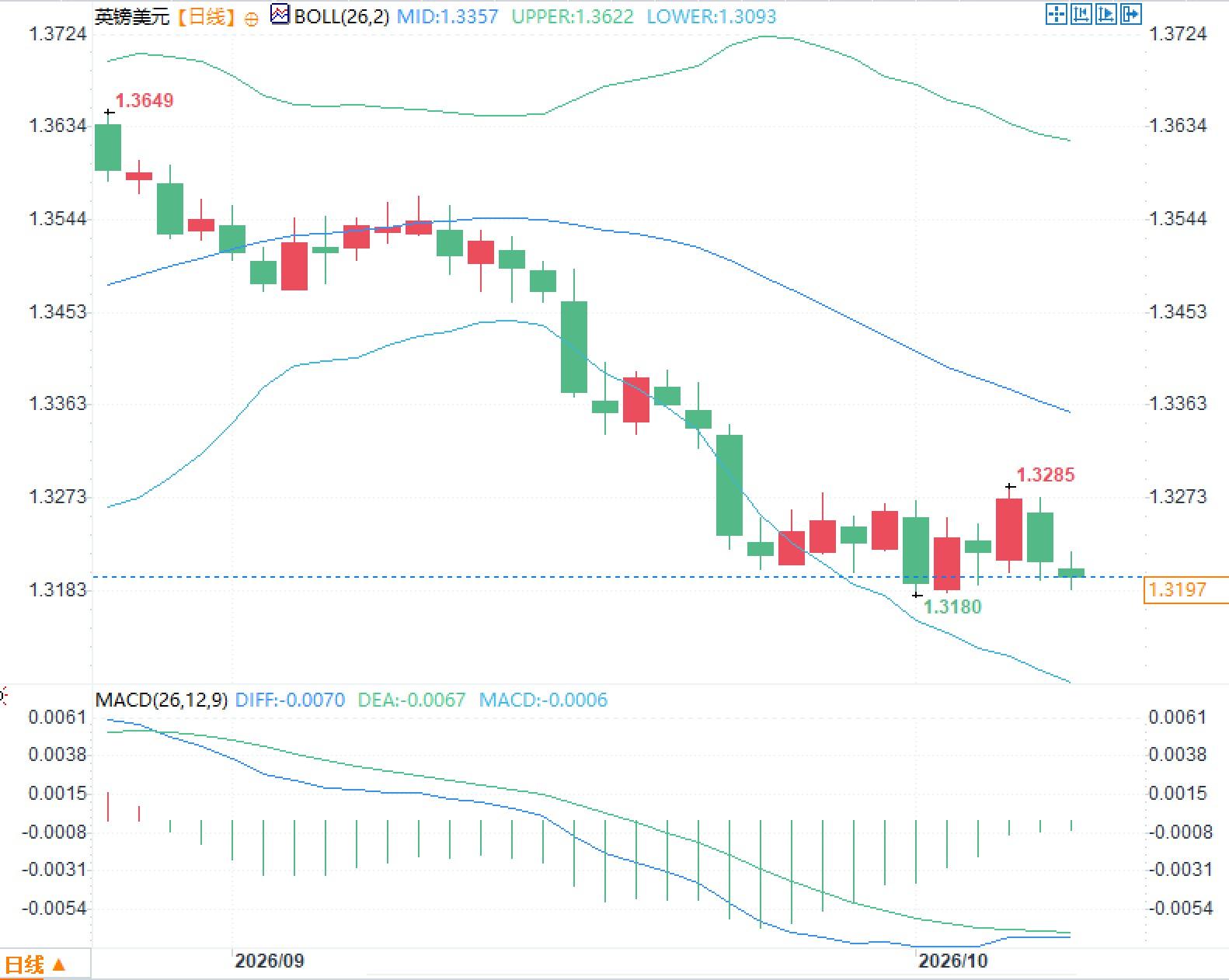 Momentum indicators present information from different perspectives. The daily chart shows the MACD DIFF at -0.0070, DEA at -0.0067, and histogram value at -0.0006. Both indicator lines are below the zero line, and the fast line is still lower than the slow line. The gradually shortening negative bars indicate that the gap between the two indicator lines is narrowing, but this does not necessarily mean the previous trend has ended.
I. Green warns of wage risks, deepening policy divisions within the Bank of England.
On October 8th, Green pointed out that preliminary signs indicated a possible 3.5% increase in the UK's wage agreement by 2027, and expressed concern that progress in slowing wage inflation was insufficient. This statement continued his existing policy stance. At the September Monetary Policy Committee meeting, the Bank of England voted 6-3 to maintain the interest rate at 3.75%, while Green and two other members advocated for a 25 basis point increase to 4%. Green's concern was not primarily about the 3.5% figure itself, but rather the possibility that wage negotiations might compensate for persistently high prices. Employees demanding higher wages, and businesses passing on these costs through product and service prices, could create a mutually reinforcing cycle between wages and prices. The policy debate thus centers on the timing of risk management: premature intervention could burden economic activity, while waiting for sufficient evidence could solidify inflation expectations.II. Inflation data reveals deep-seated contradictions: wages and corporate pricing have not cooled down in tandem.
The latest official UK data shows that the Consumer Price Index (CPI) rose 3.1% year-on-year in August, higher than July's 2.9% and exceeding the Bank of England's 2% policy target. Core inflation was 2.6%, while the services sector inflation rate remained at 3.4%. More noteworthy is the structural difference in wage data. From May to July, UK general wages rose 3.5% year-on-year, total wages including bonuses rose 3.9%, while private sector wages rose 2.9%. A business survey released on October 2nd further revealed that real wage growth over the past three months was 4.0%, with expected wage growth of 3.4% over the next year and expected price increases of 3.7% for their own products over the next year. The survey also found that 57% of businesses expect energy shocks to drive up prices, and 70% expect profit margins to be squeezed. This data indicates that cost shocks have not yet fully translated into final prices. Businesses can absorb some costs by compressing profits, but the ability to buffer profits and the strength of end-user demand determine the extent of subsequent price transmission. It is important to distinguish that the 3.5% mentioned by Green is a preliminary assessment of future wage agreements, not a wage increase that has already been realized, and it cannot be directly equated with the 3.4% expectation in the enterprise survey.Third, the expectation of a November rate hike has already been priced in; the real variable lies in the majority vote on policy.
As of October 8th, the probability of a Bank of England rate hike in November, as reflected in the interest rate derivatives market, exceeded 80%. This expectation implies that the additional information provided by Green's reiteration of his existing hawkish stance is relatively limited. The Policy Committee has nine members. If the three members who advocated for a rate hike in September maintain their positions, at least two more members who previously supported keeping rates unchanged would need to change their judgment to form a majority for a rate hike. Therefore, how members who have not yet clearly shifted their stance assess the degree of labor market slack, energy price transmission, and inflation expectations has higher informational value. Interest rate expectations cannot explain the pound against the dollar in isolation. Rising UK government bond yields could reflect adjustments in policy rate expectations, or they could reflect inflation compensation, fiscal financing pressures, and increased term premiums. Especially when rising financing costs and growth pressures coexist, changes in nominal yields do not equate to improvements in real interest rate spreads. The pound exchange rate is also influenced by dollar interest rates, cross-border capital flows, and risk appetite. Market-implied probabilities are pricing results at a specific point in time, not definitive predictions of policy outcomes.IV. GBP/USD Daily Technical Structure
Observing the daily chart, after a continuous decline, the recent candlestick bodies of the GBP/USD pair have shortened significantly, with price fluctuations mainly concentrated in the previously lower-positioned area, reflecting a contraction in short-term price changes. The Bollinger Band's middle band continues to shift downwards, and the price is below it, indicating that the average of the past 26 trading days is still influenced by previous price changes. The extension of the lower band reflects the combined effect of the rolling standard deviation and mean changes. Momentum indicators present information from different perspectives. The daily chart shows the MACD DIFF at -0.0070, DEA at -0.0067, and histogram value at -0.0006. Both indicator lines are below the zero line, and the fast line is still lower than the slow line. The gradually shortening negative bars indicate that the gap between the two indicator lines is narrowing, but this does not necessarily mean the previous trend has ended.
- Risk Warning and Disclaimer
- The market involves risk, and trading may not be suitable for all investors. This article is for reference only and does not constitute personal investment advice, nor does it take into account certain users’ specific investment objectives, financial situation, or other needs. Any investment decisions made based on this information are at your own risk.