Rising bond yields raise the investment threshold for stocks.
2026-10-08 19:20:23
For most of this year, the warning that "interest rates will remain high for a long time" was just a casual remark, but now it has become a reality that the market has to face. 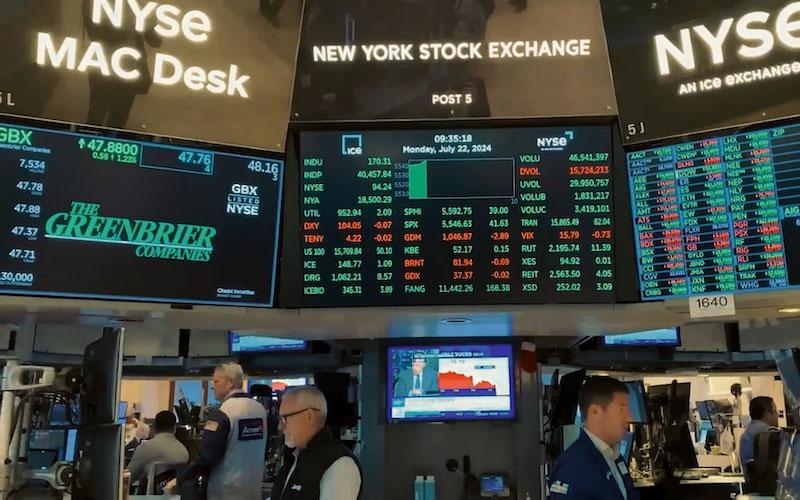 The yield on 10-year US Treasury bonds broke through 5.25%, reaching a new high in nearly two decades. The ever-increasing borrowing costs have reached a point where no market participant can ignore them. With the continued rise in yields, bonds are beginning to compete directly with stocks for investor funds—when the risk-free side can provide substantial returns, the balance of capital flows is naturally re-evaluated. This has profound implications for stock valuations. When investors can reliably obtain returns from high-grade bonds, stocks must offer a more compelling combination of earnings growth, cash flow, and valuation to justify taking on the additional risk. Rising yields do not necessarily mean falling stock prices, but they certainly raise the bar for stocks to win market favor. In other words, the same fundamentals will have diluted support for stock prices in a high-interest-rate environment; investors will scrutinize the quality of every bit of profit and every unit of free cash flow more rigorously than in a low-interest-rate era. However, there is another side to the story. Higher long-term yields may also reflect stronger economic growth. If rising yields are accompanied by stronger demand and improved corporate profits, then stocks can still experience a good rally. The key lies in the driving factors behind rising yields: yield increases driven by economic growth are fundamentally different from those primarily driven by inflation or fiscal issues, and their implications for risk assets are vastly different—the former often aligns with corporate profit expansion, while the latter is more of a headwind eroding purchasing power and squeezing valuations. The Federal Reserve is facing a delicate balancing act . This distinction is becoming increasingly crucial for the Federal Reserve. The September jobs report showed a significant weakening of economic momentum, with the unemployment rate climbing to 4.2%. Following the data release, market expectations for another Fed rate hike in the near term further declined, but the policy path did not become clearer—a tug-of-war exists between a cooling labor market and sticky inflation. The cooling labor market has reduced market expectations for another Fed rate hike in the near term, but inflation remains above the policy target, and energy costs have also risen. The Fed needs to balance two conflicting objectives: on the one hand, avoiding unnecessary pressure on the slowing labor market, and on the other hand, ensuring that inflation continues to fall towards the target. A premature shift to easing before inflation is tamed could damage previously accumulated policy credibility; conversely, an overly hawkish stance could exacerbate an already weakening economy. If the economy gradually cools down, policymakers may ultimately have more room to maneuver. For now, subsequent inflation and employment data will remain crucial indicators for judging policy direction. Oil prices further complicate the situation. Oil prices have added another layer of uncertainty to the overall situation. Brent crude oil prices have broken through $100 per barrel, and OPEC+ has confirmed it will maintain current production levels in November. Given that global supply risks have not been fully resolved, this decision means the energy market will remain in a tight balance, and the short-term trend of rising oil prices is unlikely to reverse. If oil prices continue to rise further, it will put pressure on inflation, household consumption, and corporate profit margins, but the impact will not be evenly distributed across different sectors. Higher oil prices will benefit the energy sector's profitability; simultaneously, strong economic demand will also push up oil prices. The core issue is whether rising oil prices will substantially weaken market demand or be absorbed by strong economic growth—this directly determines whether it will be a stressor or a neutral factor for the overall market. Strong earnings remain a key support. The market landscape behind major indices is increasingly diverging. Although the S&P 500 is not far from its historical high, less than half of its constituent stocks are trading above their 200-day moving averages, meaning the index's performance still largely depends on a small group of large-cap leading companies. A clear divergence exists between new index highs and widespread stock gains; this structural concentration amplifies the reliance on the earnings performance of a few top companies. This further highlights the importance of corporate earnings. Investors should pay attention not only to financial reports but also to statements from company management regarding profit margins and market demand. In a high-interest-rate environment, companies with ample free cash flow, sound balance sheets, and sustainable pricing power will be in a more advantageous position. Companies with high leverage and heavy reliance on refinancing will face the combined pressure of rising interest burdens and valuation discounts. More importantly, the fundamentals of corporate earnings remain strong. The S&P 500's forward price-to-earnings ratio has fallen from around 22 earlier this year to around 20. Part of the valuation contraction is due to the market's upward revision of forward earnings expectations outpacing the rise in stock prices. Bloomberg consensus forecasts indicate that S&P 500 earnings growth will exceed 16% in both 2027 and 2028. In other words, the market's upward momentum is shifting from "valuation inflation" to "earnings-driven," a relatively healthy shift during periods of high interest rates. While stocks are not exactly undervalued, corporate earnings are playing a greater role in driving the market. If corporate profits largely meet current expectations, the ability of stocks to absorb a high-yield environment may be better than conclusions drawn solely from interest rate headlines. Historical data offers positive signals . Market seasonality also provides positive guidance. Going back to 1950, the US has held 19 midterm elections, and in the 12 months following each election, the S&P 500 rose. Of course, this historical pattern cannot be taken as a prediction, but with the 2026 US midterm elections approaching, this historical trend is still worth noting. It is important to emphasize that historical patterns only provide a general reference, not a definitive basis; ultimately, the verification must come down to economic fundamentals and corporate profits. The overall market environment is not as pessimistic as simply looking at bond yield levels suggests. High interest rates and high oil prices present challenges, but economic resilience, strong corporate profits, and declining valuations continue to provide support. Looking at the big picture: The core issue is not whether high yields are inherently good or bad, but how they alter the trade-offs between different asset classes. Bond yields are attractive, offering substantial returns while achieving asset diversification; while stocks still possess long-term growth potential. The complementary relationship between the two remains unchanged—bonds act as ballast and hedges, while stocks absorb volatility and generate excess returns. The appropriate ratio of stocks to bonds depends on investment horizon, liquidity needs, investment objectives, and risk tolerance. Higher yields may mean a need for minor adjustments to holdings, but this should not lead to a complete change in investment strategy. This should be seen as an opportunity to re-examine portfolios and adjust risk exposure, rather than a reason for panic rebalancing. While higher bond yields have indeed raised the investment threshold for stocks, economic resilience and strong earnings suggest that stocks still have the potential to overcome this hurdle. Any adjustments to the portfolio should ultimately be considered in conjunction with the investor's overall wealth plan.
The yield on 10-year US Treasury bonds broke through 5.25%, reaching a new high in nearly two decades. The ever-increasing borrowing costs have reached a point where no market participant can ignore them. With the continued rise in yields, bonds are beginning to compete directly with stocks for investor funds—when the risk-free side can provide substantial returns, the balance of capital flows is naturally re-evaluated. This has profound implications for stock valuations. When investors can reliably obtain returns from high-grade bonds, stocks must offer a more compelling combination of earnings growth, cash flow, and valuation to justify taking on the additional risk. Rising yields do not necessarily mean falling stock prices, but they certainly raise the bar for stocks to win market favor. In other words, the same fundamentals will have diluted support for stock prices in a high-interest-rate environment; investors will scrutinize the quality of every bit of profit and every unit of free cash flow more rigorously than in a low-interest-rate era. However, there is another side to the story. Higher long-term yields may also reflect stronger economic growth. If rising yields are accompanied by stronger demand and improved corporate profits, then stocks can still experience a good rally. The key lies in the driving factors behind rising yields: yield increases driven by economic growth are fundamentally different from those primarily driven by inflation or fiscal issues, and their implications for risk assets are vastly different—the former often aligns with corporate profit expansion, while the latter is more of a headwind eroding purchasing power and squeezing valuations. The Federal Reserve is facing a delicate balancing act . This distinction is becoming increasingly crucial for the Federal Reserve. The September jobs report showed a significant weakening of economic momentum, with the unemployment rate climbing to 4.2%. Following the data release, market expectations for another Fed rate hike in the near term further declined, but the policy path did not become clearer—a tug-of-war exists between a cooling labor market and sticky inflation. The cooling labor market has reduced market expectations for another Fed rate hike in the near term, but inflation remains above the policy target, and energy costs have also risen. The Fed needs to balance two conflicting objectives: on the one hand, avoiding unnecessary pressure on the slowing labor market, and on the other hand, ensuring that inflation continues to fall towards the target. A premature shift to easing before inflation is tamed could damage previously accumulated policy credibility; conversely, an overly hawkish stance could exacerbate an already weakening economy. If the economy gradually cools down, policymakers may ultimately have more room to maneuver. For now, subsequent inflation and employment data will remain crucial indicators for judging policy direction. Oil prices further complicate the situation. Oil prices have added another layer of uncertainty to the overall situation. Brent crude oil prices have broken through $100 per barrel, and OPEC+ has confirmed it will maintain current production levels in November. Given that global supply risks have not been fully resolved, this decision means the energy market will remain in a tight balance, and the short-term trend of rising oil prices is unlikely to reverse. If oil prices continue to rise further, it will put pressure on inflation, household consumption, and corporate profit margins, but the impact will not be evenly distributed across different sectors. Higher oil prices will benefit the energy sector's profitability; simultaneously, strong economic demand will also push up oil prices. The core issue is whether rising oil prices will substantially weaken market demand or be absorbed by strong economic growth—this directly determines whether it will be a stressor or a neutral factor for the overall market. Strong earnings remain a key support. The market landscape behind major indices is increasingly diverging. Although the S&P 500 is not far from its historical high, less than half of its constituent stocks are trading above their 200-day moving averages, meaning the index's performance still largely depends on a small group of large-cap leading companies. A clear divergence exists between new index highs and widespread stock gains; this structural concentration amplifies the reliance on the earnings performance of a few top companies. This further highlights the importance of corporate earnings. Investors should pay attention not only to financial reports but also to statements from company management regarding profit margins and market demand. In a high-interest-rate environment, companies with ample free cash flow, sound balance sheets, and sustainable pricing power will be in a more advantageous position. Companies with high leverage and heavy reliance on refinancing will face the combined pressure of rising interest burdens and valuation discounts. More importantly, the fundamentals of corporate earnings remain strong. The S&P 500's forward price-to-earnings ratio has fallen from around 22 earlier this year to around 20. Part of the valuation contraction is due to the market's upward revision of forward earnings expectations outpacing the rise in stock prices. Bloomberg consensus forecasts indicate that S&P 500 earnings growth will exceed 16% in both 2027 and 2028. In other words, the market's upward momentum is shifting from "valuation inflation" to "earnings-driven," a relatively healthy shift during periods of high interest rates. While stocks are not exactly undervalued, corporate earnings are playing a greater role in driving the market. If corporate profits largely meet current expectations, the ability of stocks to absorb a high-yield environment may be better than conclusions drawn solely from interest rate headlines. Historical data offers positive signals . Market seasonality also provides positive guidance. Going back to 1950, the US has held 19 midterm elections, and in the 12 months following each election, the S&P 500 rose. Of course, this historical pattern cannot be taken as a prediction, but with the 2026 US midterm elections approaching, this historical trend is still worth noting. It is important to emphasize that historical patterns only provide a general reference, not a definitive basis; ultimately, the verification must come down to economic fundamentals and corporate profits. The overall market environment is not as pessimistic as simply looking at bond yield levels suggests. High interest rates and high oil prices present challenges, but economic resilience, strong corporate profits, and declining valuations continue to provide support. Looking at the big picture: The core issue is not whether high yields are inherently good or bad, but how they alter the trade-offs between different asset classes. Bond yields are attractive, offering substantial returns while achieving asset diversification; while stocks still possess long-term growth potential. The complementary relationship between the two remains unchanged—bonds act as ballast and hedges, while stocks absorb volatility and generate excess returns. The appropriate ratio of stocks to bonds depends on investment horizon, liquidity needs, investment objectives, and risk tolerance. Higher yields may mean a need for minor adjustments to holdings, but this should not lead to a complete change in investment strategy. This should be seen as an opportunity to re-examine portfolios and adjust risk exposure, rather than a reason for panic rebalancing. While higher bond yields have indeed raised the investment threshold for stocks, economic resilience and strong earnings suggest that stocks still have the potential to overcome this hurdle. Any adjustments to the portfolio should ultimately be considered in conjunction with the investor's overall wealth plan.
- Risk Warning and Disclaimer
- The market involves risk, and trading may not be suitable for all investors. This article is for reference only and does not constitute personal investment advice, nor does it take into account certain users’ specific investment objectives, financial situation, or other needs. Any investment decisions made based on this information are at your own risk.