A chart shows that Capesize freight rates dragged down the overall market, causing the Baltic Dry Index to fall to a six-week low.
2026-10-08 23:20:16
Latest data shows that the Baltic Dry Index (BDI) closed at 2973 points on October 8, 2026, a new low since August 25, 2026, down 0.70% month-on-month, the largest drop since October 6, 2026, and marking the fourth consecutive day of decline (including zero growth). Looking at the short-term charts, the recent 11 BDI data points show: 3 positive increases, 8 negative increases, and 0 zero increases. Specifically, the Panamax Freight Index (BPI) closed at 2410 points, up 1.09% from the previous value; the Capesize Freight Index (BCI) closed at 4512 points, down 1.85%; and the Supramax Freight Index (BSI) closed at 1808 points, up 0.44%. For detailed 720-day and 10-year trend charts of the Baltic Dry Index and its three main sub-indices, please refer to the charts specially created by FX678. 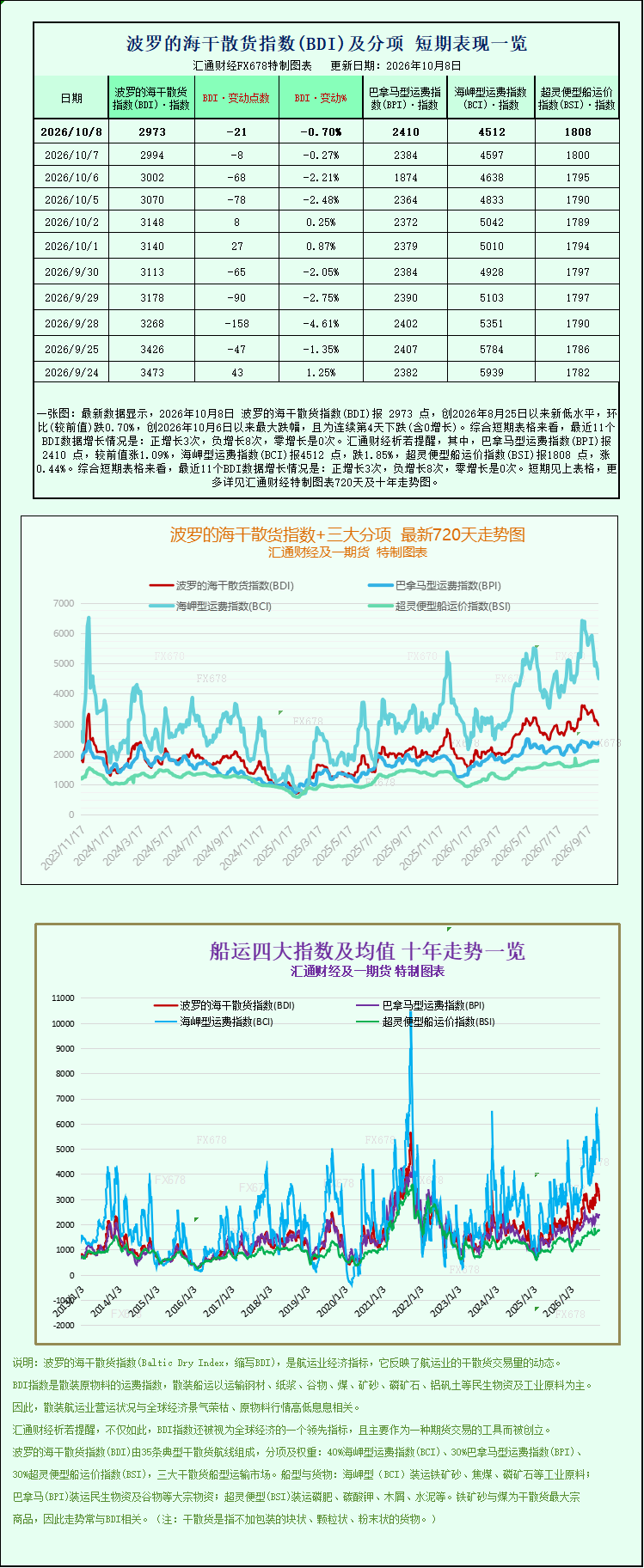 On Thursday, the international dry bulk shipping market exhibited a clear structural divergence. Dragged down by a sharp decline in Capesize freight rates, the Baltic Dry Index (BDI) fell to its lowest level in over six weeks. Although Panamax and Supramax freight rates saw a steady increase that day, the gains were limited and failed to offset the significant drop in Capesize rates, ultimately putting downward pressure on the overall index and reflecting the uneven demand in the global dry bulk shipping market. Specifically, the Baltic Dry Index (BDI), which tracks freight rates for the three major vessel types (Capesmax, Panamax, and Supramax), fell 21 points, or 0.7%, to close at 2973 points, a new low in over six weeks since August 25th, marking the temporary end of the previous slight recovery in the shipping market. The core drag on this round of index decline is concentrated in the large Capesize bulk carrier market. This vessel type primarily carries bulk industrial raw materials such as iron ore and coal, and is a core carrier in the global heavy industry supply chain's maritime transport. Its freight rate fluctuations have a significant impact on the overall market index. Data shows that the Capesize vessel-specific index fell sharply by 85 points that day, a drop of 1.9%, closing at 4512 points, a new low since August 20th, far exceeding the overall market decline. In terms of actual operating revenue, the average daily operating revenue of Capesize vessels mainly engaged in the transportation of 150,000-ton bulk cargoes decreased by $768 compared to the previous period, ultimately settling at $37,420. The continued weakness in Capesize freight rates is primarily due to a temporary cooling in global demand for iron ore and thermal coal ocean shipping, coupled with the concentrated delivery of large vessels in the previous period and a slight easing of market capacity supply. This supply-demand imbalance directly suppressed the profit margins of large vessels. It is noteworthy that the decline in Capesize freight rates is clearly linked to the trend of the bulk commodity market. On the same day, iron ore futures prices on the Dalian Commodity Exchange in China hit an 18-month low. This was the first trading day after China's National Day holiday. As the world's largest consumer of iron ore and a major steel producer, the pace of recovery in the domestic market directly impacts global iron ore trade demand. Currently, the domestic steel industry's profit performance is weak, and the recovery in steel demand from downstream manufacturing and infrastructure sectors is slower than expected. Steel mills are cautious about production, and the demand for raw material restocking has contracted significantly, dimming the long-term demand outlook for iron ore, a core steelmaking raw material. This, in turn, is transmitted to the upstream shipping market, suppressing freight rates for ocean-going iron ore transportation. In contrast to the sluggish large vessel market, the small and medium-sized bulk carrier market maintained a steady recovery, exhibiting a clear structural trend. Among them, the Panamax market, which mainly focuses on short- and medium-distance bulk cargo transportation, performed strongly. The Panamax index rose 26 points, or 1.1%, to close at 2410 points. This vessel type primarily carries 60,000 to 70,000 tons of cargo such as coal, grain, and fertilizer, and is widely used in regional energy and agricultural product trade transportation. The average daily revenue per vessel increased by $232 to $21,688. The release of seasonal demand for agricultural products and increased activity in regional coal transportation were the core drivers of the Panamax freight rate increase. The market for smaller Supramax vessels also maintained a slight upward trend, with the Supramax index rising 8 points, or 0.4%, to close at 1808 points. These vessels offer greater flexibility, are suitable for short- and medium-haul bulk cargo transportation across multiple categories and routes, and are less affected by fluctuations in demand for bulk industrial raw materials, resulting in a more stable market trend and becoming a stabilizing force supporting the overall shipping market. Overall, the current global dry bulk shipping market exhibits a significant divergence. Large industrial raw material transport vessels continue to weaken due to the sluggish steel industry chain, while small and medium-sized vessels are steadily recovering thanks to demand for agricultural products and regional energy trade. In the short term, the recovery of profitability in the domestic steel industry and the pace of raw material restocking by steel mills will directly determine the stabilization of Capesize freight rates. Meanwhile, the peak season for agricultural product transportation in autumn and winter is expected to continue to support the market for small and medium-sized vessels. The overall market trend will still depend on the strength of the recovery in global bulk commodity trade demand.
On Thursday, the international dry bulk shipping market exhibited a clear structural divergence. Dragged down by a sharp decline in Capesize freight rates, the Baltic Dry Index (BDI) fell to its lowest level in over six weeks. Although Panamax and Supramax freight rates saw a steady increase that day, the gains were limited and failed to offset the significant drop in Capesize rates, ultimately putting downward pressure on the overall index and reflecting the uneven demand in the global dry bulk shipping market. Specifically, the Baltic Dry Index (BDI), which tracks freight rates for the three major vessel types (Capesmax, Panamax, and Supramax), fell 21 points, or 0.7%, to close at 2973 points, a new low in over six weeks since August 25th, marking the temporary end of the previous slight recovery in the shipping market. The core drag on this round of index decline is concentrated in the large Capesize bulk carrier market. This vessel type primarily carries bulk industrial raw materials such as iron ore and coal, and is a core carrier in the global heavy industry supply chain's maritime transport. Its freight rate fluctuations have a significant impact on the overall market index. Data shows that the Capesize vessel-specific index fell sharply by 85 points that day, a drop of 1.9%, closing at 4512 points, a new low since August 20th, far exceeding the overall market decline. In terms of actual operating revenue, the average daily operating revenue of Capesize vessels mainly engaged in the transportation of 150,000-ton bulk cargoes decreased by $768 compared to the previous period, ultimately settling at $37,420. The continued weakness in Capesize freight rates is primarily due to a temporary cooling in global demand for iron ore and thermal coal ocean shipping, coupled with the concentrated delivery of large vessels in the previous period and a slight easing of market capacity supply. This supply-demand imbalance directly suppressed the profit margins of large vessels. It is noteworthy that the decline in Capesize freight rates is clearly linked to the trend of the bulk commodity market. On the same day, iron ore futures prices on the Dalian Commodity Exchange in China hit an 18-month low. This was the first trading day after China's National Day holiday. As the world's largest consumer of iron ore and a major steel producer, the pace of recovery in the domestic market directly impacts global iron ore trade demand. Currently, the domestic steel industry's profit performance is weak, and the recovery in steel demand from downstream manufacturing and infrastructure sectors is slower than expected. Steel mills are cautious about production, and the demand for raw material restocking has contracted significantly, dimming the long-term demand outlook for iron ore, a core steelmaking raw material. This, in turn, is transmitted to the upstream shipping market, suppressing freight rates for ocean-going iron ore transportation. In contrast to the sluggish large vessel market, the small and medium-sized bulk carrier market maintained a steady recovery, exhibiting a clear structural trend. Among them, the Panamax market, which mainly focuses on short- and medium-distance bulk cargo transportation, performed strongly. The Panamax index rose 26 points, or 1.1%, to close at 2410 points. This vessel type primarily carries 60,000 to 70,000 tons of cargo such as coal, grain, and fertilizer, and is widely used in regional energy and agricultural product trade transportation. The average daily revenue per vessel increased by $232 to $21,688. The release of seasonal demand for agricultural products and increased activity in regional coal transportation were the core drivers of the Panamax freight rate increase. The market for smaller Supramax vessels also maintained a slight upward trend, with the Supramax index rising 8 points, or 0.4%, to close at 1808 points. These vessels offer greater flexibility, are suitable for short- and medium-haul bulk cargo transportation across multiple categories and routes, and are less affected by fluctuations in demand for bulk industrial raw materials, resulting in a more stable market trend and becoming a stabilizing force supporting the overall shipping market. Overall, the current global dry bulk shipping market exhibits a significant divergence. Large industrial raw material transport vessels continue to weaken due to the sluggish steel industry chain, while small and medium-sized vessels are steadily recovering thanks to demand for agricultural products and regional energy trade. In the short term, the recovery of profitability in the domestic steel industry and the pace of raw material restocking by steel mills will directly determine the stabilization of Capesize freight rates. Meanwhile, the peak season for agricultural product transportation in autumn and winter is expected to continue to support the market for small and medium-sized vessels. The overall market trend will still depend on the strength of the recovery in global bulk commodity trade demand.
- Risk Warning and Disclaimer
- The market involves risk, and trading may not be suitable for all investors. This article is for reference only and does not constitute personal investment advice, nor does it take into account certain users’ specific investment objectives, financial situation, or other needs. Any investment decisions made based on this information are at your own risk.