With US Treasury yields approaching 5.3%, what is spot silver experiencing?
2026-10-08 22:00:17
On Thursday, October 8th, the precious metals market was experiencing a typical scenario of "escalating geopolitical risks putting pressure on silver." Spot silver was currently trading around $59 per ounce, down nearly 1% on the day; meanwhile, Brent crude rose to approximately $104.5 per barrel, and West Texas Intermediate crude rose to approximately $92 per barrel; the 10-year US Treasury yield was at a multi-year high of around 5.32%. The simultaneous changes in these asset groups indicate that the dominant variable in silver pricing is not simply safe-haven demand, but rather a rebalancing between energy shocks, inflation expectations, interest rate paths, and the strength of the US dollar. 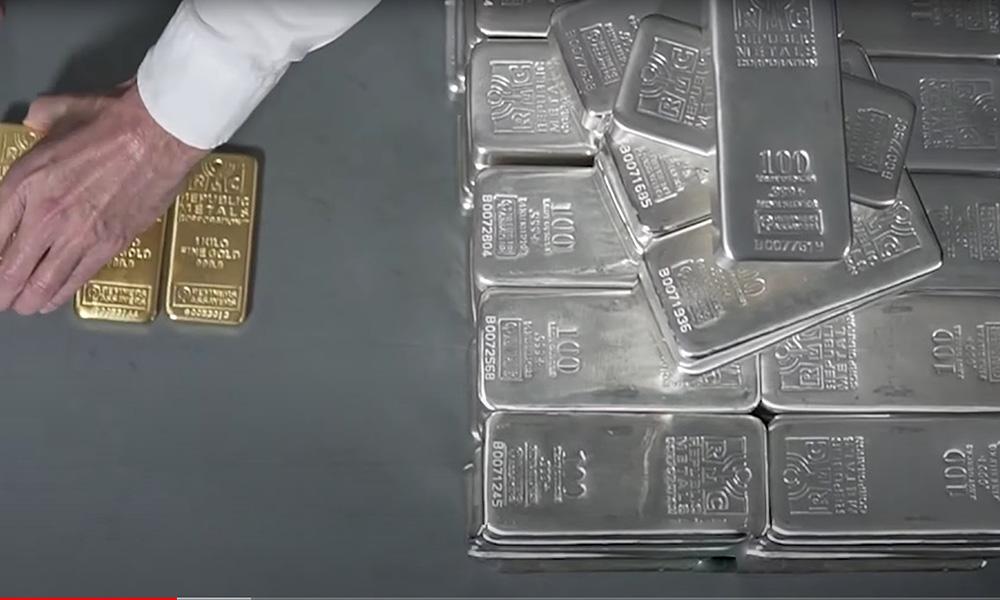
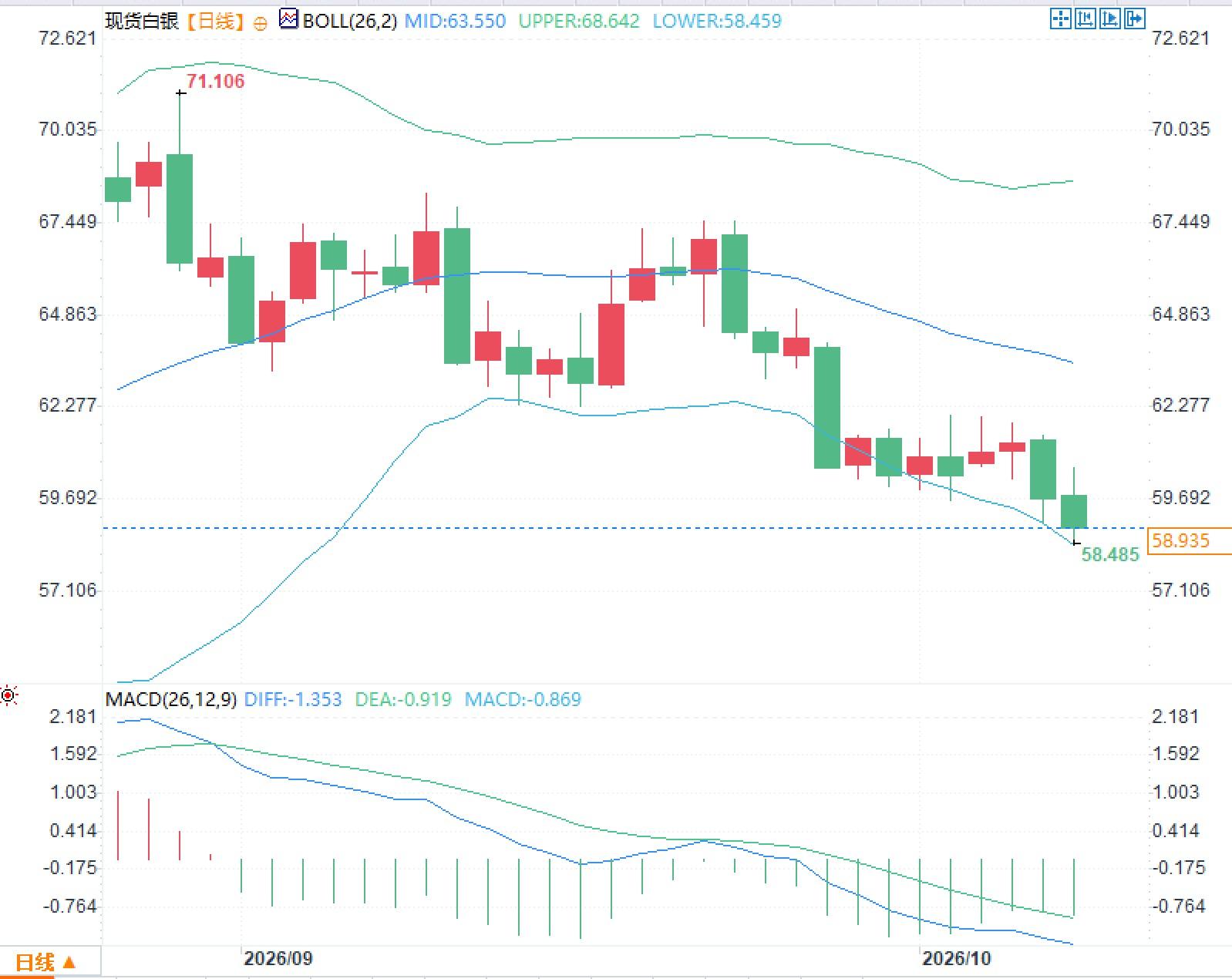 What is more informative at present is the consistency between indicators: the price is below the middle band, the trend center is shifting downward, the MACD is below the zero axis, and the US dollar and US Treasury yields are at high levels, indicating that technical weakness and macroeconomic financial conditions are temporarily within the same framework.
Why is spot silver under pressure despite escalating geopolitical risks?
Recent reports indicate that the US government has reportedly asked the Department of Defense to prepare military plans targeting Iran, and relevant departments have also been asked to prepare for a possible resurgence of military operations, though no final decision has been made yet. What the market is truly sensitive to is not the individual news item itself, but whether the conflict will further impact energy transportation and crude oil supply in the Gulf region. This explains a seemingly paradoxical phenomenon: geopolitical risks typically increase demand for precious metals as safe havens, but this round of oil price increases has primarily altered global inflation and interest rate pricing. Rising energy prices mean that the process of inflation easing may be disrupted, leading the bond market to subsequently increase long-term interest rate compensation. When the rate of increase in nominal yields and even real interest rates exceeds the rate of safe-haven inflows, the cost of holding silver increases, and its safe-haven attributes may be overshadowed by interest rate factors. Silver possesses both financial and industrial attributes, making its price mechanism more complex than that of a purely safe-haven asset. If energy shocks lead to increased corporate costs and tighter financing conditions, the market will reassess the industrial demand environment. This is also a key reason why silver and crude oil do not currently exhibit a simple, directly correlated relationship.Oil prices, yields, and the US dollar form a three-tiered transmission mechanism.
The core chain of this market trend can be summarized as follows: supply risks push up crude oil prices, crude oil strengthens inflation risks, inflation risks raise interest rate expectations, rising US Treasury yields further strengthen the US dollar, and ultimately increase the opportunity cost of precious metals. The 10-year US Treasury yield is currently around 5.32%, having reached a level rarely seen since 2002; the US dollar index is above 102 and is near an 18-month high. This chain is particularly important for silver. If it were merely a matter of escalating risk events and a decline in real yields, precious metals would typically achieve a clearer safe-haven pricing; however, the current environment is exactly the opposite. Rising oil prices are increasing market vigilance regarding inflation stickiness, and long-term yields have not declined. Therefore, silver faces a situation where safe-haven demand and high interest rate pressure coexist.The Federal Reserve has once again become a key constraint on silver pricing.
The Federal Reserve raised its policy rate by 25 basis points to 3.75% to 4.00% in September. On October 8, Fed Governor Waller stated that if economic data continues to broadly meet expectations, further rate hikes are still anticipated, but they do not need to be implemented in consecutive meetings. In the latest forecasts, 16 out of 18 participants expect at least one more rate hike this year. Interest rate futures previously reflected an approximately 85% probability of at least one more rate hike before the end of the December meeting. This information is more important for silver than a single economic data point. Silver lacks coupon income, and when short-term policy rates, long-term yields, and the US dollar are all at high levels, holding precious metals incurs a more significant opportunity cost. Therefore, the real determinant of the macroeconomic environment for silver is not whether a "safe-haven event" occurs, but rather which changes faster: inflation expectations or nominal yields. If rising energy prices primarily drive up nominal yields and policy rate expectations, the real interest rate environment will remain tight; conversely, if inflation expectations rise while real yields fall, the financial conditions faced by precious metals will undergo a substantial change.Technical structure shows weak momentum
Observing the daily chart, spot silver has traded below the Bollinger Middle Band and is approaching the lower Bollinger Band area, with the Middle Band itself trending downwards. As for the MACD, both the fast and slow lines are below the zero line, with the fast line below the slow line, and the histogram remaining negative, reflecting that the current daily trend and momentum are still in a weak structure. What is more informative at present is the consistency between indicators: the price is below the middle band, the trend center is shifting downward, the MACD is below the zero axis, and the US dollar and US Treasury yields are at high levels, indicating that technical weakness and macroeconomic financial conditions are temporarily within the same framework.
- Risk Warning and Disclaimer
- The market involves risk, and trading may not be suitable for all investors. This article is for reference only and does not constitute personal investment advice, nor does it take into account certain users’ specific investment objectives, financial situation, or other needs. Any investment decisions made based on this information are at your own risk.