Trump's election countdown takes a sharp turn as he refuses to attack Iran before the midterm elections, causing oil prices to retreat from a two-week high and gold prices to rebound.
2026-10-09 10:04:16
With less than a month to go before the November 3rd midterm elections, US President Trump staged a dramatic reversal in his Iran policy: on Wednesday he threatened to consider new strikes, but on Thursday he clearly stated that he would not take military action against Iran before the election. This statement directly links military decisions to the domestic political agenda. The daily traffic volume in the Strait of Hormuz plummeted to seven vessels. Regional tensions and economic pressures intertwined, and the election and the war situation were deeply intertwined. Brent crude oil briefly broke through $105 per barrel on Thursday, reaching a high of $105.88 per barrel, a two-week high. After Trump's statement, oil prices fluctuated and fell back. On Friday (October 9th) in Asian trading, Brent crude oil was trading around $103.36, down about 0.5%. This also eased the pressure on the Federal Reserve to raise interest rates. The US dollar index fluctuated and fell back in Asian trading on Friday, once down 0.12%, hitting a two-day low of around 101.97. Spot gold, on the other hand, rebounded, once rising 1% to $4174.78 per ounce, a three-day high.  I. A Shift in Stance: From "Considering New Strikes" to "No Action Before the Election" US President Trump completed a dramatic shift in his Iran policy in less than 24 hours. On Wednesday evening (October 7th) local time, Trump stated at a campaign rally that reaching an agreement with Iran was "really not something I want to do," and told reporters that his administration was considering a new military strike against Tehran before the midterm elections. This statement directly drove Brent crude oil prices up more than 4% on Thursday, briefly breaking through the $105 per barrel mark. However, just one night later, Trump changed his tune in a post on Truth Social: "We will not take any action against Iran before the midterm elections," adding that the US was having "productive discussions" with Tehran. He reiterated that the naval blockade against Iran would continue and emphasized that Tehran would not be allowed to acquire nuclear weapons. This reversal is not a fundamental change in policy ideology, but rather a direct intervention of the election schedule in military decision-making. According to media reports in September, Trump's senior aides have been pushing for weeks to keep the war situation under control before the midterm elections in order to limit the Republican Party's electoral losses, while retaining the option of a more aggressive attack after the vote count.
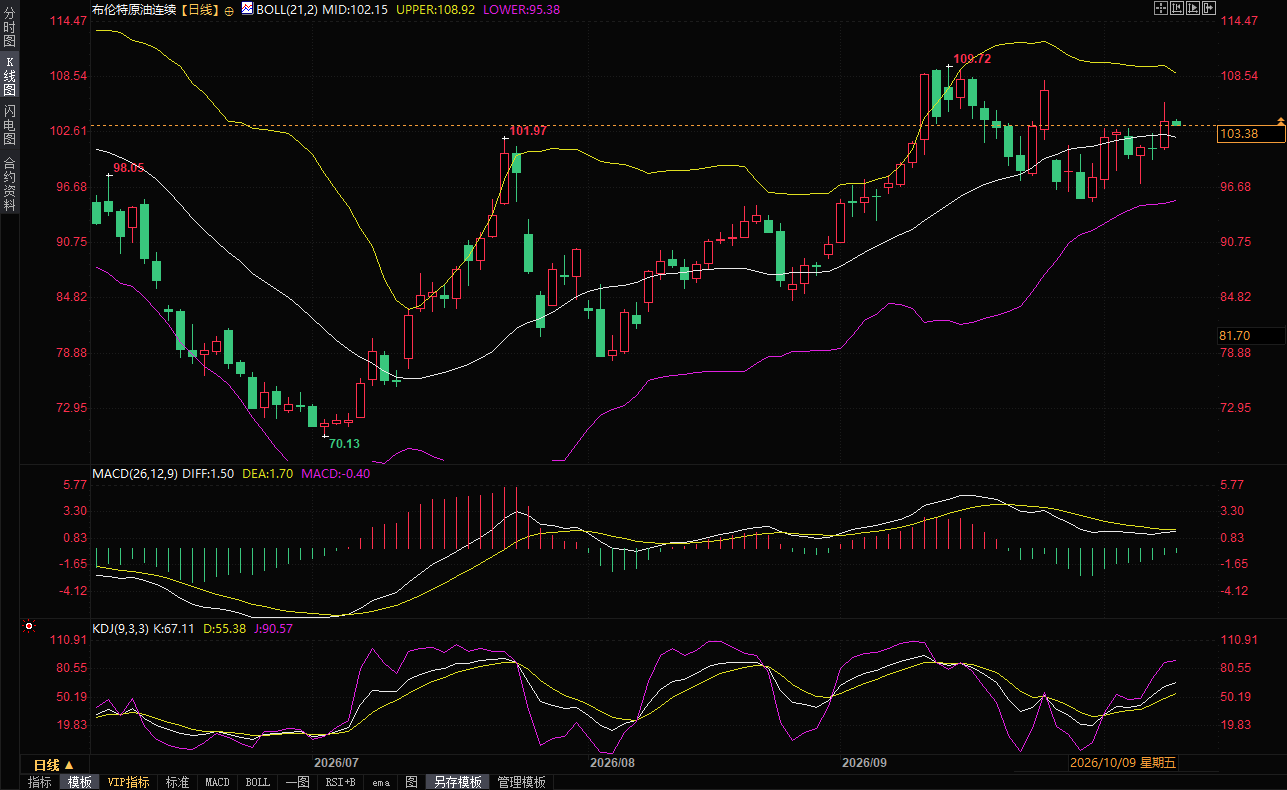 (Brent crude oil daily chart, source: EasyForex)
I. A Shift in Stance: From "Considering New Strikes" to "No Action Before the Election" US President Trump completed a dramatic shift in his Iran policy in less than 24 hours. On Wednesday evening (October 7th) local time, Trump stated at a campaign rally that reaching an agreement with Iran was "really not something I want to do," and told reporters that his administration was considering a new military strike against Tehran before the midterm elections. This statement directly drove Brent crude oil prices up more than 4% on Thursday, briefly breaking through the $105 per barrel mark. However, just one night later, Trump changed his tune in a post on Truth Social: "We will not take any action against Iran before the midterm elections," adding that the US was having "productive discussions" with Tehran. He reiterated that the naval blockade against Iran would continue and emphasized that Tehran would not be allowed to acquire nuclear weapons. This reversal is not a fundamental change in policy ideology, but rather a direct intervention of the election schedule in military decision-making. According to media reports in September, Trump's senior aides have been pushing for weeks to keep the war situation under control before the midterm elections in order to limit the Republican Party's electoral losses, while retaining the option of a more aggressive attack after the vote count.II. Energy Market Volatility: Oil Prices Remain High, Gasoline Prices Hit October Record High
Trump's tough stance on Wednesday and his abrupt reversal on Thursday created significant volatility in the energy market. Brent crude oil rose more than 4% to $105.88 a barrel on Thursday before falling back to around $103.50 after Trump's change of tone, though it still remained above $100 a barrel. Domestic fuel cost pressures in the United States are even more pronounced. According to AAA data, the national average price of regular gasoline was $4.36 a gallon on Thursday, up about 40% from $3.12 a year ago. This is the first time on record that the national average price in October has remained above $4, while gasoline prices were only $2.98 a gallon in late February, just before the outbreak of war.III. Strait of Hormuz in Crisis: Traffic Volume Plummets to Two-Month Low
Iran has not eased its control over the Strait of Hormuz despite Trump's conciliatory remarks. According to Reuters, Iran has warned regional countries that any attempt to open new oil export routes will be considered an act of hostility. A senior regional diplomat briefed by Tehran described Iran as pursuing a "policy of fear and threats," which could include using missiles and drones to attack ships or sending speedboats to scare away merchant vessels. Actual traffic data confirms the sharp increase in risk. Data from shipping analytics firm Kpler shows that only seven commodity carriers passed through the Strait of Hormuz on Tuesday, the lowest level since July 23; this slightly increased to 10 on Wednesday, but remained far below the more than 20 ships per day on Sunday and Monday. The amount of crude oil transported through the strait has fallen 27% from the previous week's wartime peak to at least 10.1 million barrels per day, equivalent to 74% of pre-war levels. Last week saw the highest number of tanker attacks in the Strait of Hormuz since the start of the war. In the latest incident, the chemical tanker Acers, flying the flags of Antigua and Barbuda, was struck by multiple projectiles about 51 nautical miles off the coast of Qatar, and the crew sustained minor injuries. Maritime risk intelligence agency Clearwater Dynamics warned that the attack "increases the likelihood of the conflict expanding and could affect shipping routes to Qatar, Bahrain, Saudi Arabia, Kuwait, and Iraq."IV. Poll Warning: 60% of Americans Disapprove of Iran Policy; Republican Candidates Accelerate Efforts to Disassociate Themselves
Trump's election calculations have a clear popular base. Recent polls show that about 60% of Americans disapprove of Trump's handling of the Iran situation, including a quarter of Republicans. In an August survey, only 31% of Americans supported military action against Iran, a further decline from 37% in March, while 83% of respondents expected the conflict to last a long time. Voters' top concerns have shifted from foreign policy and security to the cost of living. Leading up to the November 3rd election, a series of polls show that the cost of living has become the most pressing issue for voters. Republican candidates face a dilemma: maintaining support for Trump's base while distancing themselves from unpopular war policies in competitive districts. Reports indicate that many Republican candidates have begun publicly distancing themselves from Trump's stance on Iran.V. Military Deployment and Negotiation Stalemate: The Assembly of Three Aircraft Carriers and the Uranium Enrichment Red Line
While Trump is sending diplomatic signals, the US troop buildup has not stopped. The US is sending approximately 9,000 sailors and marines and an aircraft carrier to the Middle East, with three US aircraft carriers expected to be deployed by the end of October. Currently, the USS George H.W. Bush and USS Washington are already operating in the region. Once the USS Theodore Roosevelt arrives, this will be the first time since April that the US has simultaneously deployed three carrier strike groups to the Middle East. At the negotiating level, the two sides remain far apart. Iranian state media reported on Thursday, citing the head of the country's Atomic Energy Organization, that Iran will not abandon uranium enrichment or hand over its uranium stockpile. Previously, US Vice President Vance told Reuters that Iran must "substantially" reduce its uranium enrichment capacity. Iran has refused to hand over approximately 440.9 kilograms of 60% enriched uranium, a quantity only a short technical distance from weapons-grade enriched uranium. The International Atomic Energy Agency, due to limitations in its inspections, cannot confirm the status and whereabouts of these materials.Editor's Summary
Trump's latest statement is essentially a tactical adjustment driven by the election schedule, rather than a strategic shift. The rapid reversal from "considering new strikes" to "never taking action before the election" exposes a deep contradiction within the White House between military pressure and domestic political costs. Oil prices remaining above $100 a barrel, gasoline prices hitting a record high for October, and 60% of the public disapproving of Iran policy—these data constitute a real constraint for Trump, forcing him to temporarily "back off." However, the deployment of approximately 9,000 reinforcements and three aircraft carriers indicates that the military option has only been postponed, not abandoned. The daily traffic through the Strait of Hormuz has dropped to seven vessels, and Iran's "policy of fear and threats" continues to escalate, meaning that the risks to passage through the strait have not been alleviated by Trump's election truce. After the midterm elections, whether escalating strikes or being forced to compromise, the United States will face a Middle Eastern energy landscape profoundly reshaped by war. (Brent crude oil daily chart, source: EasyForex)Frequently Asked Questions
Question 1: Why did Trump change his stance on Iran in less than a day? The core driving force was the political pressure of the November 3rd midterm elections. The war has driven up gasoline prices, with the national average reaching $4.36 per gallon, up about 40% from a year ago. The cost of living has become a top concern for voters, and about 60% of Americans disapprove of Trump's handling of the Iran situation. The Republican Party's slim majority in Congress is facing a severe test, and White House staff have been pushing for weeks to keep the war out of the election. Question 2: What impact will the decline in traffic through the Strait of Hormuz have on global energy supply? Crude oil transported through the strait has fallen by 27% from its wartime peak, to at least 10.1 million barrels per day, equivalent to 74% of pre-war levels. However, data shows that exports from the Gulf Coast of Oman and the Red Sea have risen to an average of 6.7 million barrels per day, more than double pre-war levels, partially offsetting the shortfall and keeping overall Middle Eastern exports at pre-war levels. However, alternative routes are more expensive, and ship-to-ship transshipment activities face additional security risks. Question 3: Has Iran shown any signs of softening its stance on the nuclear issue? Not at present. The head of the Atomic Energy Organization of Iran has clearly stated that it will not abandon uranium enrichment, nor will it hand over its uranium stockpile. Iran possesses approximately 440.9 kilograms of 60% enriched uranium, only a short technological distance from weapons-grade enriched uranium. Due to limitations in its inspections, the International Atomic Energy Agency cannot confirm the current status and location of these materials. The United States demands that Iran "substantially" reduce its enrichment capabilities, but the positions of the two sides remain vastly different. Question 4: Does the deployment of three US aircraft carriers indicate an escalation of military action after the election? The deployment of three aircraft carriers is itself an important military signal. Currently, the USS Bush and USS Washington are already in the Middle East, and the arrival of the USS Roosevelt will form a three-carrier strike group. Reuters reports that the strategy of Trump's senior aides is to control the situation before the election while retaining the option of a more aggressive strike after the vote count. Therefore, the possibility of escalation after the election cannot be ruled out, but the specific direction depends on the election results and whether Iran makes concessions in negotiations. Question 5: Where do current oil prices stand compared to pre-war levels? Brent crude oil surged from pre-war levels, briefly breaking $105 a barrel on Thursday before retreating to trade above $103. Gasoline prices, which were $2.98 a gallon before the war, are currently at a national average of $4.36, representing a rise of approximately 46%. Trump has repeatedly stated his expectation that oil prices will fall after the election, but has yet to offer a concrete roadmap to ending the war. With persistently low traffic in the Strait of Hormuz and unabated Iranian threats, the likelihood of a significant drop in oil prices in the short term is limited. At 10:01 Beijing time, Brent crude was trading at $103.35 per barrel.- Risk Warning and Disclaimer
- The market involves risk, and trading may not be suitable for all investors. This article is for reference only and does not constitute personal investment advice, nor does it take into account certain users’ specific investment objectives, financial situation, or other needs. Any investment decisions made based on this information are at your own risk.