US Treasury yields fell slightly, and gold rebounded from its lows, continuing its range-bound trading.
2026-10-09 10:20:16
International gold prices rebounded slightly in Asian trading on Friday, with spot gold (XAU/USD) trading around $4,170 per ounce, attempting to recover from a two-month low. Recent pressure on gold prices has been primarily due to hawkish expectations surrounding the Federal Reserve's monetary policy, fueling market concerns about further interest rate hikes. Meanwhile, developments in the Middle East and energy price movements continue to influence investors' assessments of inflation, interest rates, and safe-haven assets, creating multiple constraints on any potential gold rebound.  US President Donald Trump stated that the US will not attack Iran before the midterm elections, and said that the two sides are having "productive discussions," but did not disclose specific details. Previously, the White House had considered military action against Iran before the November midterm elections. This latest statement has temporarily eased market concerns about an immediate escalation of the conflict and may weaken some short-term safe-haven buying. However, diplomatic communication does not mean the risks have been completely eliminated. If subsequent negotiations lack substantial progress, or energy transportation is disrupted again, gold may still receive new safe-haven demand. Compared to the support from geopolitical situations, the impact of Federal Reserve policy expectations on gold is more direct. The latest released minutes of the Federal Reserve meeting show that policymakers unanimously supported a September rate hike, and most officials believed that raising the target range for the federal funds rate again this year might be an appropriate option. This means that even if the market begins to discuss whether future meetings will pause rate hikes, policymakers have not yet clearly shifted to an easing stance. Federal Reserve Governor Christopher Waller said on Thursday that further rate hikes may still be necessary, but the pace of rate hikes is flexible, and he did not rule out the possibility of pausing rate hikes in October. This statement conveys two different signals: First, the Federal Reserve remains concerned about the persistence of inflation, and policy rates may need to remain at a high level, or even be raised further; second, future policy actions will not necessarily be implemented continuously at every meeting, and policymakers will still adjust the pace based on economic and inflation data. The CME FedWatch Tool shows that the market prices a 17.7% probability of a rate hike in October and an 81.3% probability of a rate hike in December. These figures reflect market pricing, not the policy decisions already made by the Fed. High expectations for a year-end rate hike mean that gold will likely remain under pressure from interest rates in the short term. If subsequent inflation data continues to be strong, the market may further raise its expectations for terminal interest rates, pushing up the dollar and US Treasury yields, thereby increasing the opportunity cost of holding non-interest-bearing gold. Conversely, if economic activity cools significantly and inflationary pressures ease, market expectations for further tightening may decline, providing room for gold prices to recover. Changes in the energy market also complicate this policy game. Rising oil prices may push up transportation, production, and energy consumption costs, making the process of inflation decline more tortuous. If the energy shock continues, the Federal Reserve may need to maintain its tightening stance for longer, putting pressure on gold from the interest rate front. However, if rising oil prices further damage economic growth, causing the market to focus on downside economic risks, safe-haven demand could support gold. Therefore, energy prices are not a one-way negative for gold; the key lies in whether the inflationary effect or the growth effect dominates. Looking at the performance of precious metals, gold has recently been significantly weaker than some metals such as copper. Scotiabank analysis points out that copper prices are still consolidating near historical highs, while gold has been vulnerable after falling below $4,100 per ounce on Wednesday, with prices falling back to levels seen since early August. This divergence suggests that the current pressure on gold does not come entirely from the entire metals sector, but is closely related to real interest rate expectations, the performance of the US dollar, and investors' reassessment of monetary policy. The high-level fluctuations in copper prices reflect more the industrial demand, supply and demand dynamics, and market judgments on economic activity; these cannot be simply viewed as the same trading logic. Furthermore, public statements by Federal Reserve officials continue to reinforce market focus on tightening policies. Relevant speech tracking indicators show that Waller's speech received a hawkish rating of 8 out of 10, higher than his historical average of 7.2. The Fed sentiment index rose 0.42 points to 138.34, significantly higher than the neutral benchmark of 100. These indicators are quantitative results under a specific analytical framework and do not directly determine interest rates or the dollar's trajectory, but they reflect that recent policy communication has generally remained hawkish. Against this backdrop, even if gold receives temporary buying due to geopolitical risks, it will face continued resistance from a stronger dollar and rising yields. The most important factors to watch are whether Fed rate hike expectations strengthen further, whether US Treasury yields continue to rise, and whether gold prices can establish stable support near recent lows. If inflation and employment data continue to show economic resilience, the gold rebound may be limited; if policy expectations cool or geopolitical risks escalate again, gold prices may gain new upward momentum. In the short term, the market remains in a phase of balancing policy pressure and safe-haven demand, and a single-day rebound is insufficient to confirm a trend reversal. From a fundamental perspective, gold is currently still suppressed by the Federal Reserve's hawkish stance and expectations of interest rate hikes this year, while the easing of tensions between the US and Iran has somewhat weakened safe-haven demand. If US inflation data remains strong and the dollar and US Treasury yields continue to rise, gold prices may retest recent lows; if interest rate hike expectations cool or geopolitical risks escalate again, a stronger technical rebound cannot be ruled out. On the daily chart, spot gold is still trading below the Bollinger Band middle line and the 100-day simple moving average, indicating an overall weak trend. The Relative Strength Index (RSI) is approximately 39.99, below the neutral level of 50, indicating that sellers still have a certain advantage, but it has not yet entered the typical extreme oversold zone. The first support level to watch is around $4060, which corresponds to the lower Bollinger Band; if gold prices break below this level and the dollar and US Treasury yields strengthen simultaneously, the market may further test lower levels. Initial resistance is located around $4240, corresponding to the Bollinger Band middle line, followed by the 100-day moving average around $4265. If gold prices can regain their footing above these two areas, the short-term rebound may extend further; the stronger resistance level to watch is the upper Bollinger Band around $4420. Overall, until gold prices recover the middle Bollinger Band and the 100-day moving average, the daily rebound should be viewed with caution. Looking at the 4-hour chart, gold prices rebounded from near a two-month low to around $4170, indicating some support at lower levels, but there is still insufficient evidence to confirm a short-term trend reversal. If prices can remain stable above $4100 and gradually break through the recent local highs, the short-term recovery may continue; if the rebound is consistently suppressed by resistance and falls below $4100 again, a retest of the support around $4060 should be anticipated. Due to the lack of complete 4-hour moving average, RSI, and MACD real-time data, it is currently impossible to confirm whether momentum has strengthened.
 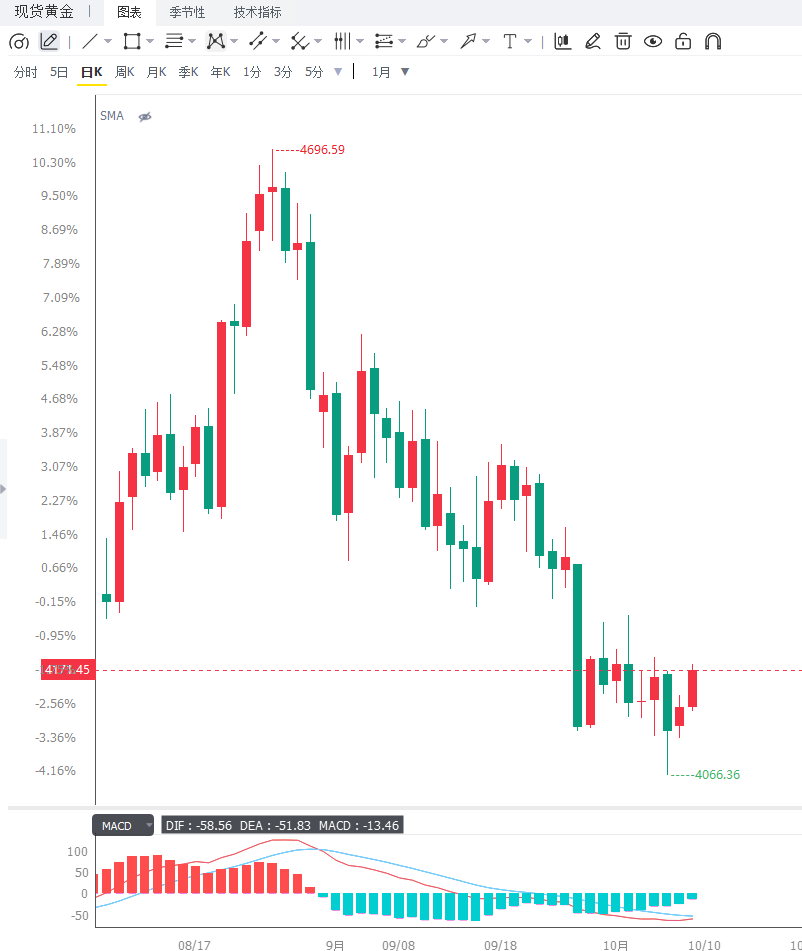 Editor's Summary: Spot gold is currently in a phase of balancing pressure from monetary policy and safe-haven demand. The Fed meeting minutes and Waller's hawkish remarks have strengthened expectations of further interest rate hikes this year, increasing the cost of holding gold; the conciliatory signals from the US-Iran dialogue have temporarily limited safe-haven buying driven by geopolitical risks. These two forces combined mean that even if gold prices rebound, they still face strong upward pressure. Fed policy expectations, the dollar's performance, US Treasury yields, and energy price changes will continue to determine gold's direction. If inflationary pressures persist and interest rate hike expectations intensify further, gold prices may retest the support around $4060, or even continue their correction; if US economic data weakens, yields fall, or geopolitical risks escalate again, gold may see a more significant recovery. The current rebound around $4170 is insufficient to confirm a trend reversal; close attention should be paid to the breakout of the $4060 support level and the $4240-$4265 resistance zone, and vigilance should be exercised regarding sharp price fluctuations triggered by macroeconomic data and unexpected news.
US President Donald Trump stated that the US will not attack Iran before the midterm elections, and said that the two sides are having "productive discussions," but did not disclose specific details. Previously, the White House had considered military action against Iran before the November midterm elections. This latest statement has temporarily eased market concerns about an immediate escalation of the conflict and may weaken some short-term safe-haven buying. However, diplomatic communication does not mean the risks have been completely eliminated. If subsequent negotiations lack substantial progress, or energy transportation is disrupted again, gold may still receive new safe-haven demand. Compared to the support from geopolitical situations, the impact of Federal Reserve policy expectations on gold is more direct. The latest released minutes of the Federal Reserve meeting show that policymakers unanimously supported a September rate hike, and most officials believed that raising the target range for the federal funds rate again this year might be an appropriate option. This means that even if the market begins to discuss whether future meetings will pause rate hikes, policymakers have not yet clearly shifted to an easing stance. Federal Reserve Governor Christopher Waller said on Thursday that further rate hikes may still be necessary, but the pace of rate hikes is flexible, and he did not rule out the possibility of pausing rate hikes in October. This statement conveys two different signals: First, the Federal Reserve remains concerned about the persistence of inflation, and policy rates may need to remain at a high level, or even be raised further; second, future policy actions will not necessarily be implemented continuously at every meeting, and policymakers will still adjust the pace based on economic and inflation data. The CME FedWatch Tool shows that the market prices a 17.7% probability of a rate hike in October and an 81.3% probability of a rate hike in December. These figures reflect market pricing, not the policy decisions already made by the Fed. High expectations for a year-end rate hike mean that gold will likely remain under pressure from interest rates in the short term. If subsequent inflation data continues to be strong, the market may further raise its expectations for terminal interest rates, pushing up the dollar and US Treasury yields, thereby increasing the opportunity cost of holding non-interest-bearing gold. Conversely, if economic activity cools significantly and inflationary pressures ease, market expectations for further tightening may decline, providing room for gold prices to recover. Changes in the energy market also complicate this policy game. Rising oil prices may push up transportation, production, and energy consumption costs, making the process of inflation decline more tortuous. If the energy shock continues, the Federal Reserve may need to maintain its tightening stance for longer, putting pressure on gold from the interest rate front. However, if rising oil prices further damage economic growth, causing the market to focus on downside economic risks, safe-haven demand could support gold. Therefore, energy prices are not a one-way negative for gold; the key lies in whether the inflationary effect or the growth effect dominates. Looking at the performance of precious metals, gold has recently been significantly weaker than some metals such as copper. Scotiabank analysis points out that copper prices are still consolidating near historical highs, while gold has been vulnerable after falling below $4,100 per ounce on Wednesday, with prices falling back to levels seen since early August. This divergence suggests that the current pressure on gold does not come entirely from the entire metals sector, but is closely related to real interest rate expectations, the performance of the US dollar, and investors' reassessment of monetary policy. The high-level fluctuations in copper prices reflect more the industrial demand, supply and demand dynamics, and market judgments on economic activity; these cannot be simply viewed as the same trading logic. Furthermore, public statements by Federal Reserve officials continue to reinforce market focus on tightening policies. Relevant speech tracking indicators show that Waller's speech received a hawkish rating of 8 out of 10, higher than his historical average of 7.2. The Fed sentiment index rose 0.42 points to 138.34, significantly higher than the neutral benchmark of 100. These indicators are quantitative results under a specific analytical framework and do not directly determine interest rates or the dollar's trajectory, but they reflect that recent policy communication has generally remained hawkish. Against this backdrop, even if gold receives temporary buying due to geopolitical risks, it will face continued resistance from a stronger dollar and rising yields. The most important factors to watch are whether Fed rate hike expectations strengthen further, whether US Treasury yields continue to rise, and whether gold prices can establish stable support near recent lows. If inflation and employment data continue to show economic resilience, the gold rebound may be limited; if policy expectations cool or geopolitical risks escalate again, gold prices may gain new upward momentum. In the short term, the market remains in a phase of balancing policy pressure and safe-haven demand, and a single-day rebound is insufficient to confirm a trend reversal. From a fundamental perspective, gold is currently still suppressed by the Federal Reserve's hawkish stance and expectations of interest rate hikes this year, while the easing of tensions between the US and Iran has somewhat weakened safe-haven demand. If US inflation data remains strong and the dollar and US Treasury yields continue to rise, gold prices may retest recent lows; if interest rate hike expectations cool or geopolitical risks escalate again, a stronger technical rebound cannot be ruled out. On the daily chart, spot gold is still trading below the Bollinger Band middle line and the 100-day simple moving average, indicating an overall weak trend. The Relative Strength Index (RSI) is approximately 39.99, below the neutral level of 50, indicating that sellers still have a certain advantage, but it has not yet entered the typical extreme oversold zone. The first support level to watch is around $4060, which corresponds to the lower Bollinger Band; if gold prices break below this level and the dollar and US Treasury yields strengthen simultaneously, the market may further test lower levels. Initial resistance is located around $4240, corresponding to the Bollinger Band middle line, followed by the 100-day moving average around $4265. If gold prices can regain their footing above these two areas, the short-term rebound may extend further; the stronger resistance level to watch is the upper Bollinger Band around $4420. Overall, until gold prices recover the middle Bollinger Band and the 100-day moving average, the daily rebound should be viewed with caution. Looking at the 4-hour chart, gold prices rebounded from near a two-month low to around $4170, indicating some support at lower levels, but there is still insufficient evidence to confirm a short-term trend reversal. If prices can remain stable above $4100 and gradually break through the recent local highs, the short-term recovery may continue; if the rebound is consistently suppressed by resistance and falls below $4100 again, a retest of the support around $4060 should be anticipated. Due to the lack of complete 4-hour moving average, RSI, and MACD real-time data, it is currently impossible to confirm whether momentum has strengthened. Editor's Summary: Spot gold is currently in a phase of balancing pressure from monetary policy and safe-haven demand. The Fed meeting minutes and Waller's hawkish remarks have strengthened expectations of further interest rate hikes this year, increasing the cost of holding gold; the conciliatory signals from the US-Iran dialogue have temporarily limited safe-haven buying driven by geopolitical risks. These two forces combined mean that even if gold prices rebound, they still face strong upward pressure. Fed policy expectations, the dollar's performance, US Treasury yields, and energy price changes will continue to determine gold's direction. If inflationary pressures persist and interest rate hike expectations intensify further, gold prices may retest the support around $4060, or even continue their correction; if US economic data weakens, yields fall, or geopolitical risks escalate again, gold may see a more significant recovery. The current rebound around $4170 is insufficient to confirm a trend reversal; close attention should be paid to the breakout of the $4060 support level and the $4240-$4265 resistance zone, and vigilance should be exercised regarding sharp price fluctuations triggered by macroeconomic data and unexpected news.
- Risk Warning and Disclaimer
- The market involves risk, and trading may not be suitable for all investors. This article is for reference only and does not constitute personal investment advice, nor does it take into account certain users’ specific investment objectives, financial situation, or other needs. Any investment decisions made based on this information are at your own risk.