A pricing contradiction emerges behind the pound: The more hawkish the Bank of England becomes, the more complex the exchange rate logic becomes?
2026-10-09 19:44:19
On Friday, October 9th, the pound sterling consolidated against the dollar after a sharp decline, currently trading around 1.3240. Expectations of a Bank of England interest rate hike continue to rise, but rising UK gilt yields, energy price volatility, and expectations for dollar interest rates have led to a significant divergence in exchange rate pricing. On October 8th, the yield on 10-year UK gilts reached 5.527%, a high since 2007. Entering Friday, international oil prices retreated somewhat, and the market reassessed previously accumulated inflation and interest rate risks. The core issue facing the pound has shifted from simple monetary policy differences to a complex interplay between interest rate expectations, fiscal credit, and the global capital pricing mechanism. 
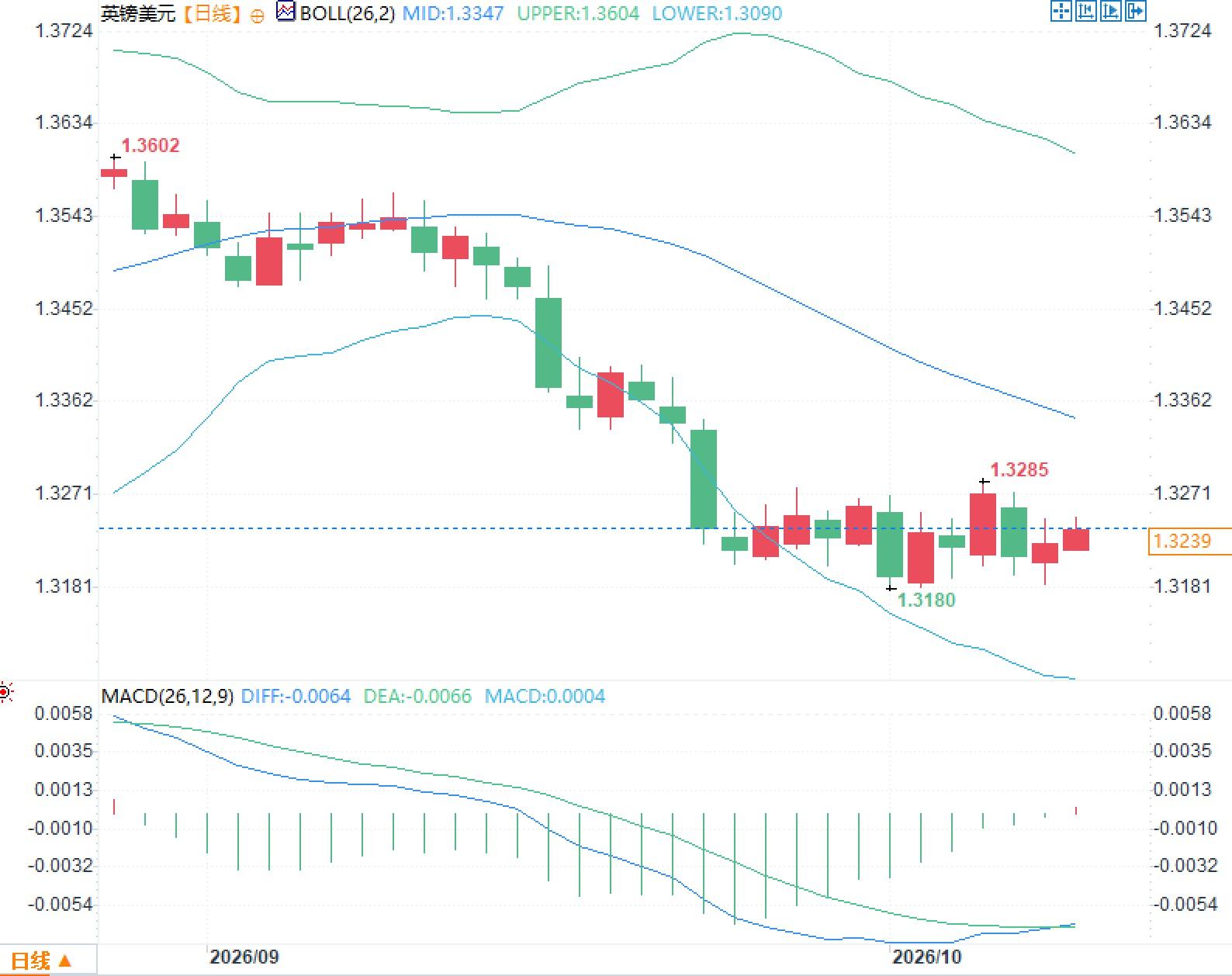 The Bollinger Band's middle band remains downward sloping, with the price trading below it, while the volatility near the lower band has narrowed. This indicates that the downward trend momentum hasn't completely dissipated, but short-term price movements have entered a more volatile phase than the sharp decline. The MACD indicator also presents a signal worth noting. In the chart, the DIFF is approximately -0.0064, the DEA is approximately -0.0066, and the histogram has slightly turned positive to around 0.0004. This combination suggests that the negative gap between the fast and slow lines has narrowed, but both lines remain below the zero line. This primarily reflects weakening downward momentum and cannot alone prove a trend reversal.
I. Why has the pound failed to strengthen in tandem with rising expectations of interest rate hikes?
The Bank of England's September Monetary Policy Committee voted 6-3 to maintain the benchmark interest rate at 3.75%, with three members supporting a 25 basis point hike. This voting structure indicates a substantial disagreement within the policy committee regarding the sustainability of inflation. The next policy meeting is scheduled for November 5th. On October 8th, the market priced in an over 80% probability of a November rate hike, and by October 9th, some market reports had raised this probability to approximately 90%. Previously, the interest rate market had also largely priced in an expectation of a cumulative 50 basis point rate hike by February 2027. However, implied probabilities are dynamic market pricing and do not represent a policy commitment by the Bank of England. The pound has not appreciated as significantly as these expectations suggest, primarily because changes in money market interest rates are not entirely driven by factors within the UK itself. Foreign exchange pricing reflects the relative changes in expected yields of two currencies, not just the interest rate level of a single central bank. When interest rate expectations in the UK and the US adjust simultaneously, the marginal impact of UK policy tightening on bilateral exchange rates may be weakened. At the same time, if expectations of interest rate hikes primarily stem from cost-push inflation rather than productivity improvements and real economic growth, their support for the local currency may be offset by rising risk premiums. Therefore, it is necessary to distinguish between nominal interest rate differentials, real interest rate differentials, and fiscal and credit risks, rather than simply establishing a linear relationship between the probability of interest rate hikes and the pound exchange rate.II. Changes in the inflation transmission mechanism pose policy constraints for the Bank of England.
The UK's latest consumer price index (CPI) rose 3.1% year-on-year in August, exceeding the Bank of England's 2% inflation target. Core inflation was 2.6% and services inflation was 3.4% during the same period. The Bank of England's September meeting minutes showed that of the 1.1 percentage point increase in overall inflation exceeding the target, approximately 0.7 percentage points came from the direct impact of energy prices. This means that the rise in inflation has a clear characteristic of external cost shocks. The real factor determining the complexity of policy is not a single energy price increase, but whether the cost shock enters wage negotiations, corporate pricing, and household inflation expectations. Increased energy spending first compresses residents' actual purchasing power and corporate profit margins. If companies pass on costs by raising prices, and workers compensate for the loss of purchasing power through wage negotiations, the price shock, initially confined to the energy sector, could evolve into persistent inflation. In a speech on October 8, Bank of England member Megan Green warned that relying solely on rising bond yields to curb inflation is dangerous. Her previous support for interest rate hikes reflects concerns among some members that tightening market interest rates is insufficient to stabilize medium-term inflation expectations. Bank of England Governor Andrew Bailey emphasized on the same day that only when inflation expectations remain stable can monetary policy tolerate temporary supply shocks. The policy logic behind the two statements is not entirely contradictory, but rather they assign different weights to the persistence of tight financial conditions, idle economic capacity, and the risk of secondary transmission of inflation.III. Soaring UK government bond yields indicate that fiscal risks are altering exchange rate logic.
On October 8th, the yield on 10-year UK government bonds rose to 5.527%, while the 30-year yield reached approximately 6.05%. Long-term financing costs, at multi-year highs, have become a significant constraint on UK asset pricing. Generally, higher bond yields increase the nominal attractiveness of local currency interest-bearing assets. However, this logic relies on the premise that rising yields primarily reflect expectations of monetary policy or higher real returns. If the yield increase stems from inflation compensation, debt supply pressures, and term risk premiums, the situation is significantly different. Investors demanding higher yields may imply higher compensation for long-term fiscal solvency and financial market volatility. This portion of the yield increase does not necessarily translate into net attractiveness for sterling assets. In his Istanbul speech on October 8th, Bailey emphasized that fiscal policy must be credible, and a clear fiscal framework helps control risk premiums during economic shocks. The UK's budget, scheduled for release on October 28th, is therefore of great importance. Higher financing costs will increase government interest payments and compress the flexibility of future fiscal arrangements. More importantly, the participation structure in the government bond market is changing. When leveraged funds hold large bond positions, sharp fluctuations in yields can trigger margin calls and passive deleveraging, further amplifying market volatility. This means that the pound sterling exchange rate is not only affected by short-term policy rates, but also by the combined constraints of long-term government bond liquidity, fiscal credit, and cross-asset risk appetite.IV. Daily chart technical structure: Weakening downward momentum does not necessarily mean the trend has reversed.
Observing the daily chart, the exchange rate had previously experienced a relatively concentrated downward adjustment, and recently the candlestick bodies have gradually shrunk and formed a relatively dense horizontal arrangement. The Bollinger Band's middle band remains downward sloping, with the price trading below it, while the volatility near the lower band has narrowed. This indicates that the downward trend momentum hasn't completely dissipated, but short-term price movements have entered a more volatile phase than the sharp decline. The MACD indicator also presents a signal worth noting. In the chart, the DIFF is approximately -0.0064, the DEA is approximately -0.0066, and the histogram has slightly turned positive to around 0.0004. This combination suggests that the negative gap between the fast and slow lines has narrowed, but both lines remain below the zero line. This primarily reflects weakening downward momentum and cannot alone prove a trend reversal.
- Risk Warning and Disclaimer
- The market involves risk, and trading may not be suitable for all investors. This article is for reference only and does not constitute personal investment advice, nor does it take into account certain users’ specific investment objectives, financial situation, or other needs. Any investment decisions made based on this information are at your own risk.