A chart shows the Baltic Dry Index closing lower for the week, with Capesize bulk carrier freight rates plunging to a new low.
2026-10-09 22:44:17
Latest data shows that the Baltic Dry Index (BDI) closed at 2917 points on October 9, 2026, a new low since August 24, 2026, down 1.88% month-on-month, marking the largest drop in three days and the fifth consecutive day of decline (including zero growth). Looking at the short-term charts, the recent 11 BDI data points show: 2 positive increases, 9 negative increases, and 0 zero increases. Specifically, the Panamax Freight Index (BPI) closed at 2424 points, up 0.58% from the previous value; the Capesize Freight Index (BCI) closed at 4340 points, down 3.81%; and the Supramax Freight Index (BSI) closed at 1814 points, up 0.33%. For detailed charts of the latest 720-day and 10-year trends of the Baltic Dry Index and its three main sub-indices, please refer to the charts specially created by FX678. 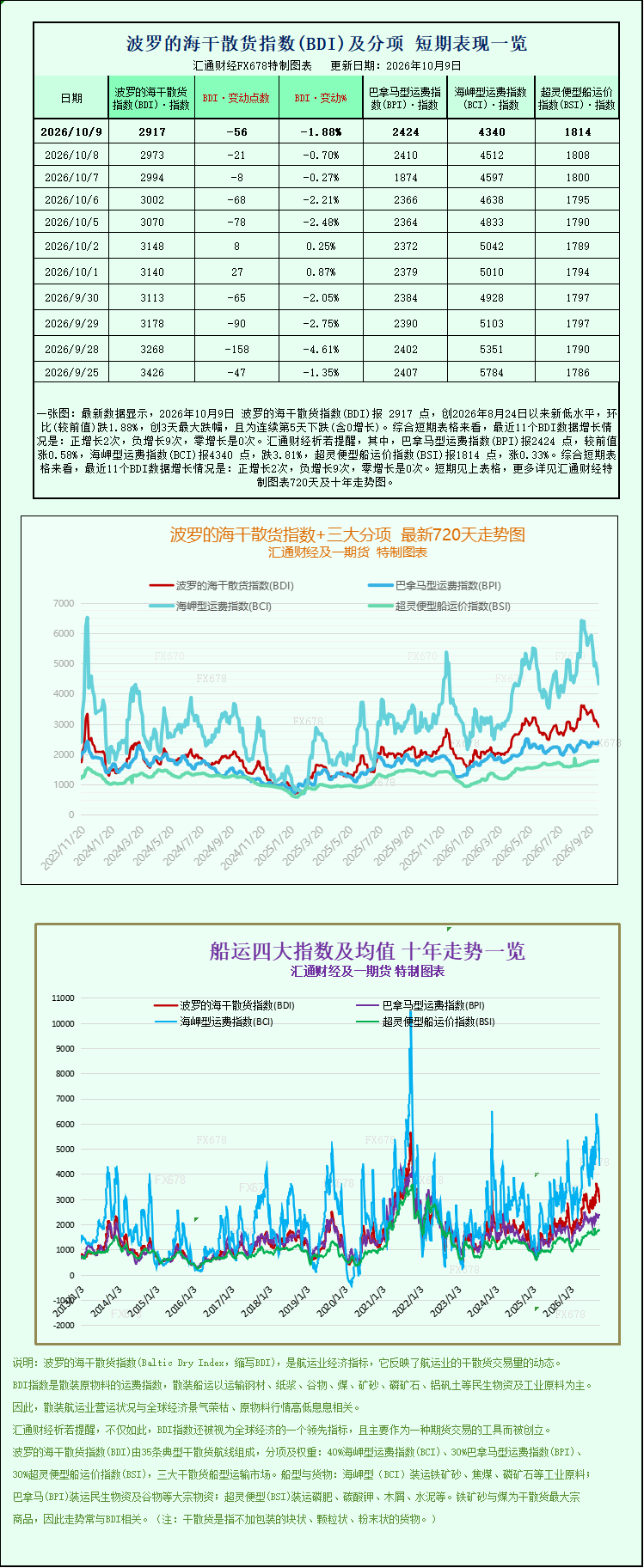 The global dry bulk shipping market experienced a significant correction, dragged down by a sharp drop in Capesize freight rates. The Baltic Dry Index (BDI) fell to its lowest point in six weeks, recording a significant decline for the week and ending the previous period of upward trend. The deep decline in large bulk carrier freight rates, coupled with weakening demand for commodities, became the core characteristic of the shipping market this week, directly reflecting a shift in the global supply and demand pattern for industrial raw materials. Data shows that the Baltic Dry Index, which tracks the freight rates of the three major bulk carrier types—Capesma, Panamax, and Supramax—fell 56 points, a 1.9% drop, closing at 2917 points, the lowest closing level since August 24. On a weekly basis, the index fell 7.3% this week, its weakest weekly performance in recent months, fully demonstrating the overall cooling trend in the dry bulk market. The core drag on this sharp decline in the index was Capesize bulk carriers. This type of vessel primarily carries the demand for ultra-large industrial raw materials such as iron ore and coal, and is a key indicator of the dry bulk shipping market. Data shows that the Capesize index plummeted 172 points that day, a single-day drop of 3.8%, closing at 4340 points, a nearly two-and-a-half-month low since July 31st. The cumulative drop this week reached 13.9%, far exceeding the overall market decline, making it the absolute main driver of the Baltic Dry Index (BDI). Looking at actual vessel revenue data, the profit margins for Capesize vessels have shrunk significantly. Market data shows that Capesize vessels capable of carrying 150,000 tons of bulk industrial raw materials such as iron ore and thermal coal saw an average daily revenue decrease of $1560, with the latest daily earnings falling to $35,860. The profitability of chartering large ocean freight vessels continues to cool. Industry analysts point out that the sharp drop in Capesize freight rates is not accidental, but rather the result of pressure from both the supply and demand sides. On the demand side, global steel consumption remains weak. Downstream steel mills, in order to control production costs, have continued to slow down the pace of raw material restocking and moderately adjust production capacity, leading to a significant reduction in orders for ocean-going iron ore and thermal coal freight. Meanwhile, the market generally expects continued ample iron ore supply, further suppressing traders' forward purchasing intentions, resulting in a significant decrease in bulk raw material seaborne cargoes. On the supply side, the available capacity of Capesize vessels in core shipping areas such as East Asia and the Atlantic continues to increase. The benefits of concentrated vessel deliveries in the early stages are gradually being released, leading to a relative surplus of shipping capacity in the market, further exacerbating downward pressure on freight rates. It is worth noting that the shipping market trend is closely linked to commodity prices. With the continued decline in Capesize vessel freight rates, global iron ore prices have continued their downward trend, falling again to a multi-month low on October 9th. The overall weakness in the industrial raw material market is highlighted, which in turn further suppresses dry bulk shipping demand, forming a negative cycle of "falling freight rates, weakening demand, and lower raw material prices." In stark contrast to the sharp decline in large Capesize vessels, the medium and small bulk carrier market rebounded, exhibiting a clear structural divergence. Panamax vessels, primarily transporting coal and grain, performed steadily, with the Panamax index rising slightly by 14 points, or 0.6%, to close at 2424 points, a cumulative increase of 2.2% this week, marking its first consecutive weekly gain. Corresponding vessel revenue also steadily increased, with Panamax vessels mainly carrying 60,000 to 70,000 tons of coal and grain seeing an average daily revenue increase of $125 to $21,813. Supramax vessels also maintained a slight upward trend, with the Very Large Vessel Index rising 6 points, or 0.3%, to 1814 points, a cumulative increase of 1.4% this week. The core reason for the counter-trend rise in small and medium-sized vessels lies in the stable regional transportation demand for commodities such as grain and regional thermal coal. Furthermore, small and medium-sized vessels are flexible in scheduling, suitable for short-haul and regional routes, and less affected by fluctuations in global industrial raw material demand. Coupled with a relatively balanced supply and demand in the market, they have achieved independent upward movement. Overall, the current dry bulk shipping market exhibits highly structural characteristics, with a stark contrast between cooling demand for large-scale industrial raw material transportation and stable demand for consumer and regional freight. Industry analysts believe that the current situation of weak inland steel consumption and ample iron ore supply is unlikely to reverse quickly in the short term, putting continued pressure on Capesize freight rates, and the Baltic Dry Index (BDI) is likely to maintain a weak and volatile trend. Meanwhile, small and medium-sized vessels, relying on stable demand for grain and regional energy transportation, will likely maintain a relatively firm performance, and the market divergence may continue. Future market trends will heavily depend on the pace of global steel capacity recovery, commodity import and export policies, and changes in ocean shipping capacity deployment.
The global dry bulk shipping market experienced a significant correction, dragged down by a sharp drop in Capesize freight rates. The Baltic Dry Index (BDI) fell to its lowest point in six weeks, recording a significant decline for the week and ending the previous period of upward trend. The deep decline in large bulk carrier freight rates, coupled with weakening demand for commodities, became the core characteristic of the shipping market this week, directly reflecting a shift in the global supply and demand pattern for industrial raw materials. Data shows that the Baltic Dry Index, which tracks the freight rates of the three major bulk carrier types—Capesma, Panamax, and Supramax—fell 56 points, a 1.9% drop, closing at 2917 points, the lowest closing level since August 24. On a weekly basis, the index fell 7.3% this week, its weakest weekly performance in recent months, fully demonstrating the overall cooling trend in the dry bulk market. The core drag on this sharp decline in the index was Capesize bulk carriers. This type of vessel primarily carries the demand for ultra-large industrial raw materials such as iron ore and coal, and is a key indicator of the dry bulk shipping market. Data shows that the Capesize index plummeted 172 points that day, a single-day drop of 3.8%, closing at 4340 points, a nearly two-and-a-half-month low since July 31st. The cumulative drop this week reached 13.9%, far exceeding the overall market decline, making it the absolute main driver of the Baltic Dry Index (BDI). Looking at actual vessel revenue data, the profit margins for Capesize vessels have shrunk significantly. Market data shows that Capesize vessels capable of carrying 150,000 tons of bulk industrial raw materials such as iron ore and thermal coal saw an average daily revenue decrease of $1560, with the latest daily earnings falling to $35,860. The profitability of chartering large ocean freight vessels continues to cool. Industry analysts point out that the sharp drop in Capesize freight rates is not accidental, but rather the result of pressure from both the supply and demand sides. On the demand side, global steel consumption remains weak. Downstream steel mills, in order to control production costs, have continued to slow down the pace of raw material restocking and moderately adjust production capacity, leading to a significant reduction in orders for ocean-going iron ore and thermal coal freight. Meanwhile, the market generally expects continued ample iron ore supply, further suppressing traders' forward purchasing intentions, resulting in a significant decrease in bulk raw material seaborne cargoes. On the supply side, the available capacity of Capesize vessels in core shipping areas such as East Asia and the Atlantic continues to increase. The benefits of concentrated vessel deliveries in the early stages are gradually being released, leading to a relative surplus of shipping capacity in the market, further exacerbating downward pressure on freight rates. It is worth noting that the shipping market trend is closely linked to commodity prices. With the continued decline in Capesize vessel freight rates, global iron ore prices have continued their downward trend, falling again to a multi-month low on October 9th. The overall weakness in the industrial raw material market is highlighted, which in turn further suppresses dry bulk shipping demand, forming a negative cycle of "falling freight rates, weakening demand, and lower raw material prices." In stark contrast to the sharp decline in large Capesize vessels, the medium and small bulk carrier market rebounded, exhibiting a clear structural divergence. Panamax vessels, primarily transporting coal and grain, performed steadily, with the Panamax index rising slightly by 14 points, or 0.6%, to close at 2424 points, a cumulative increase of 2.2% this week, marking its first consecutive weekly gain. Corresponding vessel revenue also steadily increased, with Panamax vessels mainly carrying 60,000 to 70,000 tons of coal and grain seeing an average daily revenue increase of $125 to $21,813. Supramax vessels also maintained a slight upward trend, with the Very Large Vessel Index rising 6 points, or 0.3%, to 1814 points, a cumulative increase of 1.4% this week. The core reason for the counter-trend rise in small and medium-sized vessels lies in the stable regional transportation demand for commodities such as grain and regional thermal coal. Furthermore, small and medium-sized vessels are flexible in scheduling, suitable for short-haul and regional routes, and less affected by fluctuations in global industrial raw material demand. Coupled with a relatively balanced supply and demand in the market, they have achieved independent upward movement. Overall, the current dry bulk shipping market exhibits highly structural characteristics, with a stark contrast between cooling demand for large-scale industrial raw material transportation and stable demand for consumer and regional freight. Industry analysts believe that the current situation of weak inland steel consumption and ample iron ore supply is unlikely to reverse quickly in the short term, putting continued pressure on Capesize freight rates, and the Baltic Dry Index (BDI) is likely to maintain a weak and volatile trend. Meanwhile, small and medium-sized vessels, relying on stable demand for grain and regional energy transportation, will likely maintain a relatively firm performance, and the market divergence may continue. Future market trends will heavily depend on the pace of global steel capacity recovery, commodity import and export policies, and changes in ocean shipping capacity deployment.
- Risk Warning and Disclaimer
- The market involves risk, and trading may not be suitable for all investors. This article is for reference only and does not constitute personal investment advice, nor does it take into account certain users’ specific investment objectives, financial situation, or other needs. Any investment decisions made based on this information are at your own risk.