Gold prices struggled to hold onto early gains as the dollar neared an 18-month high and bond yields remained high.
2026-10-12 21:44:17
The recent rebound in the gold market is proving unsustainable. Persistent inflationary pressures, high US Treasury yields, and the dollar trading near 18-month highs continue to exert significant downward pressure on precious metals as another week of key economic data is due. Gold prices rose slightly at the beginning of the week, briefly breaking through $4,200 per ounce during Asian trading hours; however, bullish momentum gradually faded, with investors hesitant to build large positions ahead of Wednesday's US Consumer Price Index (CPI) report.  On Monday (October 12), spot gold was quoted at approximately $4,170.16 per ounce during the US trading session, down 0.58%. Gold prices had previously briefly fallen below $4,100 per ounce, but are now struggling to maintain last week's rebound. Despite recent buying interest, gold prices remain well below August highs as investors continue to assess the various impacts of tightening monetary policy and persistent inflation. Silver also struggled to rebound, briefly rising above $61 before trading around $60.408 per ounce. The latest US economic data paints a complex picture for financial markets: consumer confidence is weakening, but inflation expectations remain high. The University of Michigan's preliminary October consumer sentiment index came in at 46.3, down from 48.1 in September and below market expectations of 47.6; the current conditions index fell sharply to 44.7, a record low. Meanwhile, consumer one-year inflation expectations rose from 4.6% to 4.7%, and long-term inflation expectations rose from 3.4% to 3.5%. US nonfarm payrolls increased by only 29,000 in September, and the unemployment rate climbed to 4.2%. Signals of slowing economic growth would normally fuel expectations of monetary easing, but persistent inflation has complicated the Federal Reserve's policy outlook. Market positioning remains biased towards further monetary tightening. Interest rate futures indicate an approximately 85% probability of at least one more rate hike by December, compared to only about a 17% probability at the October meeting. The contradiction between slowing job growth and high inflation expectations supports stronger US Treasury yields and a stronger dollar, limiting the upside potential for gold. The dollar remains a major obstacle for precious metals, with the dollar index holding steady around 102.20, approaching its highest level in 18 months. Simon-Peter Massabni, head of business development at XS, stated that persistently high energy inflation, geopolitical uncertainty, and rising US Treasury yields continue to benefit the dollar. Massabni added that persistent inflationary pressures make it difficult for central banks to initiate easing, forcing the fixed-income market to repric higher interest rate expectations. While a stronger dollar has pressured gold prices, analysts point out that gold continues to be supported by safe-haven buying amid a deteriorating economic environment and escalating geopolitical risks. The ongoing conflict between the US and Iran remains a significant source of uncertainty. Negotiations to reopen the Strait of Hormuz have failed to reach a lasting solution; Iranian officials believe the US proposal is insufficient; attacks on Saudi infrastructure have resumed; military deployments continue to escalate; and the risk of further regional escalation is rising. Although oil prices have retreated somewhat after President Trump announced a proposed energy ceasefire between Russia and Ukraine, the risk of renewed disruptions to Middle Eastern energy supplies remains high. Brent crude has fallen back to around $105 per barrel, while West Texas Intermediate (WTI) crude has remained above $92 per barrel. The conflict is a double-edged sword for gold: geopolitical risks boost safe-haven demand, but higher energy prices will push up inflation, further reinforcing expectations of tighter monetary policy. Meanwhile, the US Treasury market presents another major challenge for gold: the benchmark 10-year Treasury yield remains firmly above 5%, near a 20-year high. Gold itself does not generate interest, and higher yields increase the opportunity cost of holding gold. However, analysts believe the underlying reasons for the weakening bond market are increasingly noteworthy. With US sovereign debt exceeding $40 trillion and annual interest payments exceeding $1 trillion, investors are demanding higher risk compensation to hold long-term US Treasuries. Stubborn inflation, increased government borrowing demand, and concerns about the sustainability of US fiscal policy are collectively pushing up term premiums. While these factors are bearish for gold in the short term, they will enhance its attractiveness as an alternative currency asset and a diversification tool in the long run. Massabni stated that despite current headwinds, gold is at a crucial technical and fundamental turning point. "The core issue is not whether gold prices can rebound from their current levels, but whether the macroeconomic fundamentals are solid enough to transform this rebound into a sustainable bull market trend." He considers $4155-$4177 per ounce as a key support range. For gold prices to sustain a rebound, inflation data needs to weaken, causing US Treasury yields and the dollar to lose upward momentum. However, he cautioned that if inflation data is stronger than expected, it will reinforce expectations of further policy tightening, potentially leading to another sell-off in gold. The next key test for the market is the September CPI data to be released on Wednesday. Investors will be focusing on whether rising energy prices will translate into broader inflation, especially core consumer prices. If the inflation data falls short of expectations, it will reduce expectations of further interest rate hikes by the Federal Reserve, giving gold and silver some breathing room. Conversely, if inflation rises more than expected again, it will push up US Treasury yields and the US dollar, and the entire precious metals sector will face a new round of sell-off risk. Gold Technical Analysis
 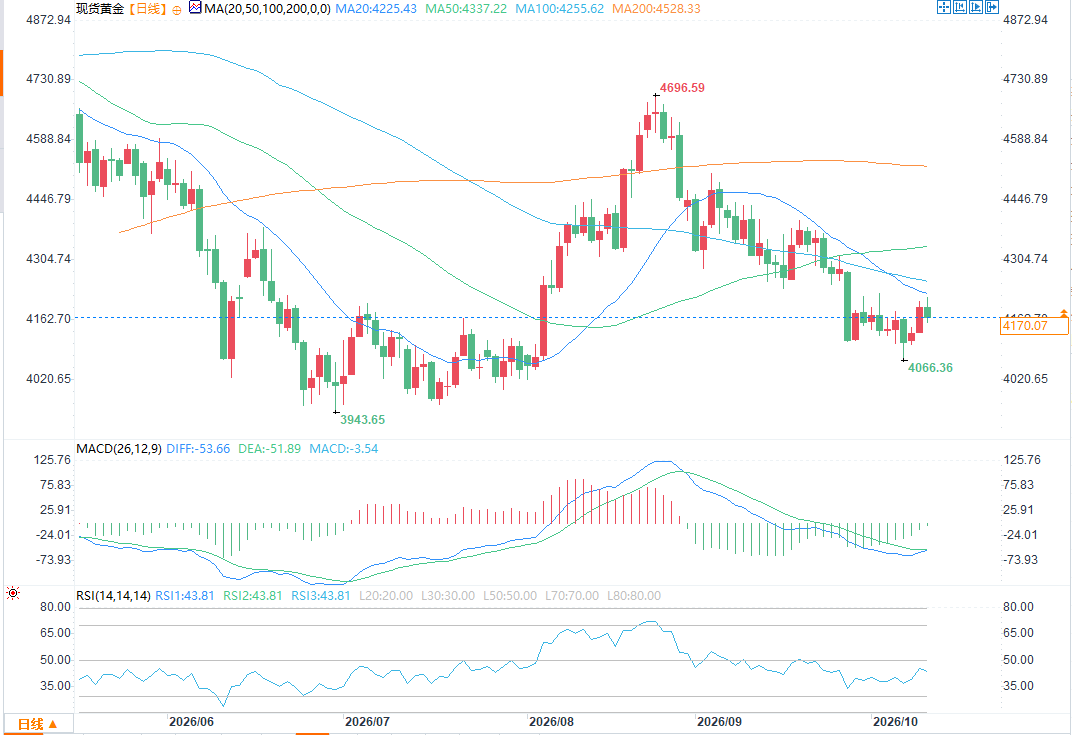 (Spot Gold Daily Chart Source: FX678) Gold prices are trading below the downtrend line and long-term moving averages, indicating a bearish short-term outlook. Initial support is at $4175.03, followed by $4141.86, and then $4103.24; a break below these levels could see gold prices further decline to $4067.42. On the upside, initial resistance is at $4226.82; a decisive break above this level could lead to targets at $4271.57 and $4311.17. Analysts suggest that gold must break the downtrend line to initiate a sustainable upward correction. Silver Technical Analysis The technical outlook for silver is also cautious, with prices struggling to break through the downtrend line resistance. Initial support is at $59.96, followed by $58.74 and $57.64; the first resistance level is $61.72, followed by $63.06 and $65.09. A sustained move above $61.72 would be a significant signal of improved bullish momentum; a break below $59.96 would indicate a new round of selling pressure. While precious metals still face high volatility risks in the short term, investment demand provides some support to the market. Global gold ETFs saw net inflows of approximately $10 billion in September, with total holdings climbing to a record 4,256 tons; central bank gold demand is also strong, with official gold purchases this year estimated at around 720 tons. The US Treasury market was closed on Monday for Columbus Day. Trading is likely to remain thin until fresh inflation data is released and the outlook for the Federal Reserve's monetary policy becomes clearer.
On Monday (October 12), spot gold was quoted at approximately $4,170.16 per ounce during the US trading session, down 0.58%. Gold prices had previously briefly fallen below $4,100 per ounce, but are now struggling to maintain last week's rebound. Despite recent buying interest, gold prices remain well below August highs as investors continue to assess the various impacts of tightening monetary policy and persistent inflation. Silver also struggled to rebound, briefly rising above $61 before trading around $60.408 per ounce. The latest US economic data paints a complex picture for financial markets: consumer confidence is weakening, but inflation expectations remain high. The University of Michigan's preliminary October consumer sentiment index came in at 46.3, down from 48.1 in September and below market expectations of 47.6; the current conditions index fell sharply to 44.7, a record low. Meanwhile, consumer one-year inflation expectations rose from 4.6% to 4.7%, and long-term inflation expectations rose from 3.4% to 3.5%. US nonfarm payrolls increased by only 29,000 in September, and the unemployment rate climbed to 4.2%. Signals of slowing economic growth would normally fuel expectations of monetary easing, but persistent inflation has complicated the Federal Reserve's policy outlook. Market positioning remains biased towards further monetary tightening. Interest rate futures indicate an approximately 85% probability of at least one more rate hike by December, compared to only about a 17% probability at the October meeting. The contradiction between slowing job growth and high inflation expectations supports stronger US Treasury yields and a stronger dollar, limiting the upside potential for gold. The dollar remains a major obstacle for precious metals, with the dollar index holding steady around 102.20, approaching its highest level in 18 months. Simon-Peter Massabni, head of business development at XS, stated that persistently high energy inflation, geopolitical uncertainty, and rising US Treasury yields continue to benefit the dollar. Massabni added that persistent inflationary pressures make it difficult for central banks to initiate easing, forcing the fixed-income market to repric higher interest rate expectations. While a stronger dollar has pressured gold prices, analysts point out that gold continues to be supported by safe-haven buying amid a deteriorating economic environment and escalating geopolitical risks. The ongoing conflict between the US and Iran remains a significant source of uncertainty. Negotiations to reopen the Strait of Hormuz have failed to reach a lasting solution; Iranian officials believe the US proposal is insufficient; attacks on Saudi infrastructure have resumed; military deployments continue to escalate; and the risk of further regional escalation is rising. Although oil prices have retreated somewhat after President Trump announced a proposed energy ceasefire between Russia and Ukraine, the risk of renewed disruptions to Middle Eastern energy supplies remains high. Brent crude has fallen back to around $105 per barrel, while West Texas Intermediate (WTI) crude has remained above $92 per barrel. The conflict is a double-edged sword for gold: geopolitical risks boost safe-haven demand, but higher energy prices will push up inflation, further reinforcing expectations of tighter monetary policy. Meanwhile, the US Treasury market presents another major challenge for gold: the benchmark 10-year Treasury yield remains firmly above 5%, near a 20-year high. Gold itself does not generate interest, and higher yields increase the opportunity cost of holding gold. However, analysts believe the underlying reasons for the weakening bond market are increasingly noteworthy. With US sovereign debt exceeding $40 trillion and annual interest payments exceeding $1 trillion, investors are demanding higher risk compensation to hold long-term US Treasuries. Stubborn inflation, increased government borrowing demand, and concerns about the sustainability of US fiscal policy are collectively pushing up term premiums. While these factors are bearish for gold in the short term, they will enhance its attractiveness as an alternative currency asset and a diversification tool in the long run. Massabni stated that despite current headwinds, gold is at a crucial technical and fundamental turning point. "The core issue is not whether gold prices can rebound from their current levels, but whether the macroeconomic fundamentals are solid enough to transform this rebound into a sustainable bull market trend." He considers $4155-$4177 per ounce as a key support range. For gold prices to sustain a rebound, inflation data needs to weaken, causing US Treasury yields and the dollar to lose upward momentum. However, he cautioned that if inflation data is stronger than expected, it will reinforce expectations of further policy tightening, potentially leading to another sell-off in gold. The next key test for the market is the September CPI data to be released on Wednesday. Investors will be focusing on whether rising energy prices will translate into broader inflation, especially core consumer prices. If the inflation data falls short of expectations, it will reduce expectations of further interest rate hikes by the Federal Reserve, giving gold and silver some breathing room. Conversely, if inflation rises more than expected again, it will push up US Treasury yields and the US dollar, and the entire precious metals sector will face a new round of sell-off risk. Gold Technical Analysis (Spot Gold Daily Chart Source: FX678) Gold prices are trading below the downtrend line and long-term moving averages, indicating a bearish short-term outlook. Initial support is at $4175.03, followed by $4141.86, and then $4103.24; a break below these levels could see gold prices further decline to $4067.42. On the upside, initial resistance is at $4226.82; a decisive break above this level could lead to targets at $4271.57 and $4311.17. Analysts suggest that gold must break the downtrend line to initiate a sustainable upward correction. Silver Technical Analysis The technical outlook for silver is also cautious, with prices struggling to break through the downtrend line resistance. Initial support is at $59.96, followed by $58.74 and $57.64; the first resistance level is $61.72, followed by $63.06 and $65.09. A sustained move above $61.72 would be a significant signal of improved bullish momentum; a break below $59.96 would indicate a new round of selling pressure. While precious metals still face high volatility risks in the short term, investment demand provides some support to the market. Global gold ETFs saw net inflows of approximately $10 billion in September, with total holdings climbing to a record 4,256 tons; central bank gold demand is also strong, with official gold purchases this year estimated at around 720 tons. The US Treasury market was closed on Monday for Columbus Day. Trading is likely to remain thin until fresh inflation data is released and the outlook for the Federal Reserve's monetary policy becomes clearer.
- Risk Warning and Disclaimer
- The market involves risk, and trading may not be suitable for all investors. This article is for reference only and does not constitute personal investment advice, nor does it take into account certain users’ specific investment objectives, financial situation, or other needs. Any investment decisions made based on this information are at your own risk.