A chart shows the Baltic Dry Index continuing to fall, dragged down to a more than seven-week low by weak demand for Capesize vessels.
2026-10-12 22:36:19
Latest data shows that on October 12, 2026, the Baltic Dry Index (BDI) stood at 2852 points, a new low since August 21, 2026, down 2.23% month-on-month, the largest drop since October 5, 2026, and marking the sixth consecutive day of decline (including zero growth). Looking at the short-term charts, the recent 11 BDI data points show: 2 positive increases, 9 negative increases, and 0 zero increases. Specifically, the Panamax Freight Index (BPI) was 2432 points, up 0.33% from the previous value; the Capesize Freight Index (BCI) was 4148 points, down 4.42%; and the Supramax Freight Index (BSI) was 1821 points, up 0.39%. For detailed 720-day and 10-year trend charts of the Baltic Dry Index and its three main sub-indices, please refer to the charts specially created by FX678. 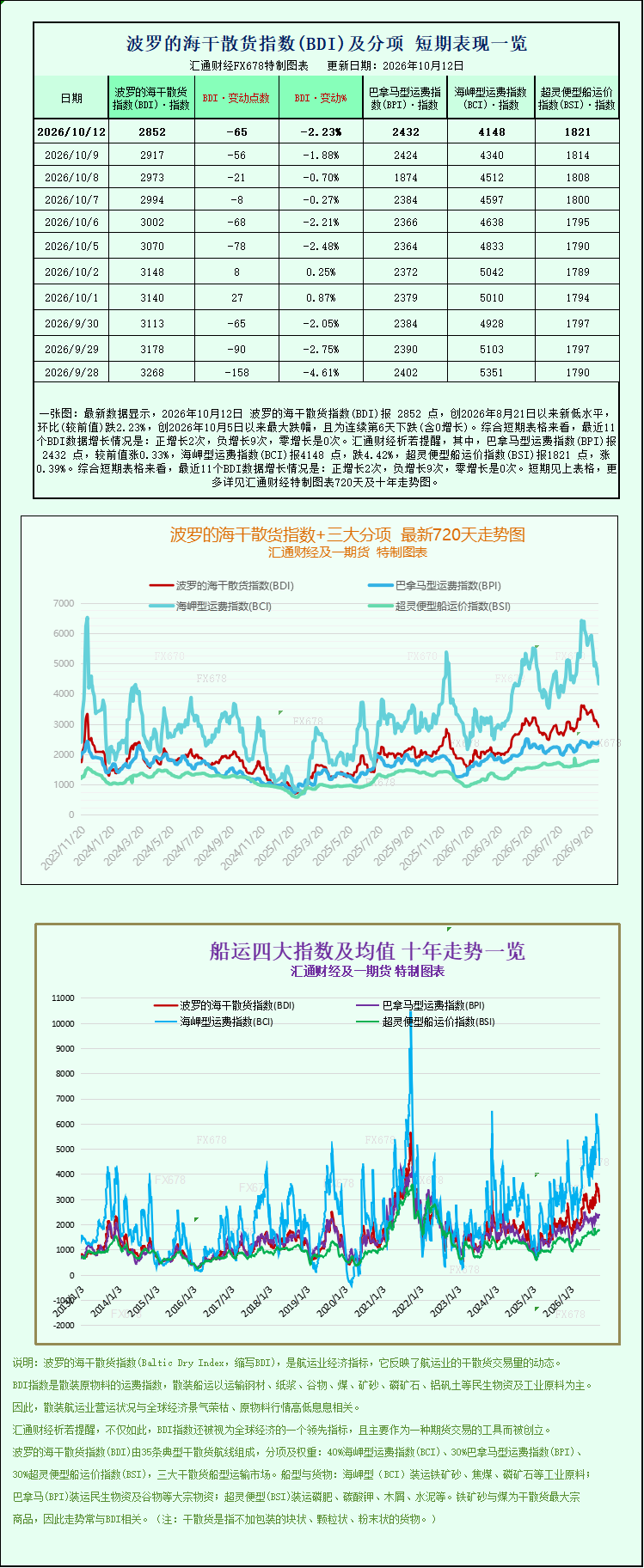 On Monday, the Baltic Dry Index, the main shipping index tracking dry bulk freight rates, continued its decline, falling to its lowest level in more than seven weeks, primarily dragged down by continued weakness in demand for Capesize vessels. Against the backdrop of recent overall pressure on the shipping market and a significant downward shift in freight rates compared to the previous period, this decline further confirms the weakness in the large bulk carrier segment and has led to increased market uncertainty regarding the dry bulk shipping outlook for the fourth quarter. Major Indices Decline Across the Board The Baltic Dry Index (BDI), which tracks freight rates for Capesize, Panamax, and Supramax vessels, fell 65 points, or 2.23%, to close at 2,852 points, its lowest level since August 21. From a weekly perspective, the index has been declining for several consecutive trading days, with a significant cumulative pullback, indicating that this adjustment is not a single day's emotional disturbance, but rather the result of a combination of structural weakness in demand and pressure on shipping capacity. The Capesize index led the decline, hitting a new low since late July. The Capesize Index (BCI) fell 192 points, or 4.42%, to close at 4,148 points, its lowest level since late July, becoming the main factor dragging down the overall index. Capesize vessels are the most sensitive to bulk raw material transportation in the dry bulk market, have the largest single-ship tonnage, and experience the most volatile freight rates. Their freight rate trends are generally considered a leading indicator of demand for commodities such as iron ore and coal. This single-day drop in the index was significantly larger than other vessel types, highlighting the vulnerability of large vessel capacity to demand contraction. The average daily revenue of Capesize vessels carrying 150,000 tons of cargo (including iron ore and coal) fell by $1,745 to $34,115. This average daily revenue level represents a significant pullback from previous highs. Given that Capesize daily charter rates were previously relatively high, if demand fails to recover promptly, shipowners, facing both overcapacity and insufficient cargo volume, may see further declines in rates. Iron Ore Market Volatility: Restocking Expectations and Increased Supply Coexist On Monday, iron ore prices fluctuated sharply. On one hand, the market anticipated that Chinese steel mills would replenish their inventories after a week-long holiday, thus supporting short-term procurement demand; on the other hand, the market also anticipated increased supply, putting downward pressure on prices. This tug-of-war between supply and demand caused iron ore prices to fluctuate repeatedly within a high range, directly impacting the uncertainty of Capesize shipping demand expectations. As the world's largest importer of iron ore and producer of crude steel, China's steel mills' procurement pace has historically been a marginal determinant of Capesize freight rates. Post-holiday restocking often boosts cargo activity in the short term, but if steel mills slow down procurement amid high inventories and weak profits, the upward momentum of freight rates will be significantly limited. Small and medium-sized vessels showed mixed performance: Panamax and Supramax bucked the trend with slight increases In contrast to the sharp decline in Capesize vessels, the index for small and medium-sized vessels remained relatively stable. The Panamax Index (BPI) rose 8 points, or 0.33%, to close at 2,432 points. The average daily earnings of Panamax vessels (.BPWT) (typically carrying 60,000 to 70,000 tons of coal or grain) rose by $75 to $21,888. Among smaller vessels, the Supramax Index (BSI) rose 7 points, or 0.39%, to close at 1,821 points. This divergence between large and small vessel freight rates reflects the current differences in the demand structure of dry bulk shipping: large vessels rely heavily on long-distance transport of heavy cargoes such as iron ore and coal, making them more sensitive to expectations of macroeconomic demand and supply increases; while Panamax and Supramax vessels handle more grains, coal, and other minor bulk cargoes, resulting in relatively stable short-term cargo volumes and less impact from fluctuations in iron ore alone. Market Outlook: A Mixed Bag of Factors In summary, the dry bulk market is currently in a period of mixed factors. On the one hand, the potential restocking demand of Chinese steel mills after the holidays, as well as the pace of subsequent infrastructure and real estate policy implementation, may provide temporary support for iron ore transportation; on the other hand, expectations of increased iron ore supply, overall moderate global macroeconomic demand, and continued capacity deployment all constrain the continued rise in freight rates. Market participants need to pay close attention to Chinese steel production and inventory data, iron ore port arrivals and clearances, and the activity of cargo transactions in the two major shipping areas of the Atlantic and Pacific Oceans to determine whether Capesize freight rates can stabilize at current levels. In the short term, the index may fluctuate around the current level, and a directional choice still awaits a clearer signal from the demand side.
On Monday, the Baltic Dry Index, the main shipping index tracking dry bulk freight rates, continued its decline, falling to its lowest level in more than seven weeks, primarily dragged down by continued weakness in demand for Capesize vessels. Against the backdrop of recent overall pressure on the shipping market and a significant downward shift in freight rates compared to the previous period, this decline further confirms the weakness in the large bulk carrier segment and has led to increased market uncertainty regarding the dry bulk shipping outlook for the fourth quarter. Major Indices Decline Across the Board The Baltic Dry Index (BDI), which tracks freight rates for Capesize, Panamax, and Supramax vessels, fell 65 points, or 2.23%, to close at 2,852 points, its lowest level since August 21. From a weekly perspective, the index has been declining for several consecutive trading days, with a significant cumulative pullback, indicating that this adjustment is not a single day's emotional disturbance, but rather the result of a combination of structural weakness in demand and pressure on shipping capacity. The Capesize index led the decline, hitting a new low since late July. The Capesize Index (BCI) fell 192 points, or 4.42%, to close at 4,148 points, its lowest level since late July, becoming the main factor dragging down the overall index. Capesize vessels are the most sensitive to bulk raw material transportation in the dry bulk market, have the largest single-ship tonnage, and experience the most volatile freight rates. Their freight rate trends are generally considered a leading indicator of demand for commodities such as iron ore and coal. This single-day drop in the index was significantly larger than other vessel types, highlighting the vulnerability of large vessel capacity to demand contraction. The average daily revenue of Capesize vessels carrying 150,000 tons of cargo (including iron ore and coal) fell by $1,745 to $34,115. This average daily revenue level represents a significant pullback from previous highs. Given that Capesize daily charter rates were previously relatively high, if demand fails to recover promptly, shipowners, facing both overcapacity and insufficient cargo volume, may see further declines in rates. Iron Ore Market Volatility: Restocking Expectations and Increased Supply Coexist On Monday, iron ore prices fluctuated sharply. On one hand, the market anticipated that Chinese steel mills would replenish their inventories after a week-long holiday, thus supporting short-term procurement demand; on the other hand, the market also anticipated increased supply, putting downward pressure on prices. This tug-of-war between supply and demand caused iron ore prices to fluctuate repeatedly within a high range, directly impacting the uncertainty of Capesize shipping demand expectations. As the world's largest importer of iron ore and producer of crude steel, China's steel mills' procurement pace has historically been a marginal determinant of Capesize freight rates. Post-holiday restocking often boosts cargo activity in the short term, but if steel mills slow down procurement amid high inventories and weak profits, the upward momentum of freight rates will be significantly limited. Small and medium-sized vessels showed mixed performance: Panamax and Supramax bucked the trend with slight increases In contrast to the sharp decline in Capesize vessels, the index for small and medium-sized vessels remained relatively stable. The Panamax Index (BPI) rose 8 points, or 0.33%, to close at 2,432 points. The average daily earnings of Panamax vessels (.BPWT) (typically carrying 60,000 to 70,000 tons of coal or grain) rose by $75 to $21,888. Among smaller vessels, the Supramax Index (BSI) rose 7 points, or 0.39%, to close at 1,821 points. This divergence between large and small vessel freight rates reflects the current differences in the demand structure of dry bulk shipping: large vessels rely heavily on long-distance transport of heavy cargoes such as iron ore and coal, making them more sensitive to expectations of macroeconomic demand and supply increases; while Panamax and Supramax vessels handle more grains, coal, and other minor bulk cargoes, resulting in relatively stable short-term cargo volumes and less impact from fluctuations in iron ore alone. Market Outlook: A Mixed Bag of Factors In summary, the dry bulk market is currently in a period of mixed factors. On the one hand, the potential restocking demand of Chinese steel mills after the holidays, as well as the pace of subsequent infrastructure and real estate policy implementation, may provide temporary support for iron ore transportation; on the other hand, expectations of increased iron ore supply, overall moderate global macroeconomic demand, and continued capacity deployment all constrain the continued rise in freight rates. Market participants need to pay close attention to Chinese steel production and inventory data, iron ore port arrivals and clearances, and the activity of cargo transactions in the two major shipping areas of the Atlantic and Pacific Oceans to determine whether Capesize freight rates can stabilize at current levels. In the short term, the index may fluctuate around the current level, and a directional choice still awaits a clearer signal from the demand side.- Risk Warning and Disclaimer
- The market involves risk, and trading may not be suitable for all investors. This article is for reference only and does not constitute personal investment advice, nor does it take into account certain users’ specific investment objectives, financial situation, or other needs. Any investment decisions made based on this information are at your own risk.