Gold Trading Alert: A double whammy of a surging dollar and soaring oil prices, coupled with the looming threat of a Fed rate hike, could send gold prices once again targeting the $4,000 mark.
2026-10-13 07:00:18
On Monday (October 12), global gold prices briefly surged before quickly retreating. Spot gold prices fell after hitting a more than one-week high of $4,217.17, reaching a low of around $4,155, and finally closed at $4,171.68 per ounce, down 0.56%. December gold futures fell 0.6% to $4,190.60 per ounce. This was a result of the interplay of a stronger dollar, rising oil prices, and market expectations regarding the Federal Reserve's policies. With the US government and bond markets closed for Columbus Day, investor sentiment was particularly cautious, and gold, as a traditional safe-haven asset, is facing multiple pressures. On Tuesday (October 13) in early Asian trading, spot gold traded in a narrow range, currently hovering around $4,170 per ounce. 
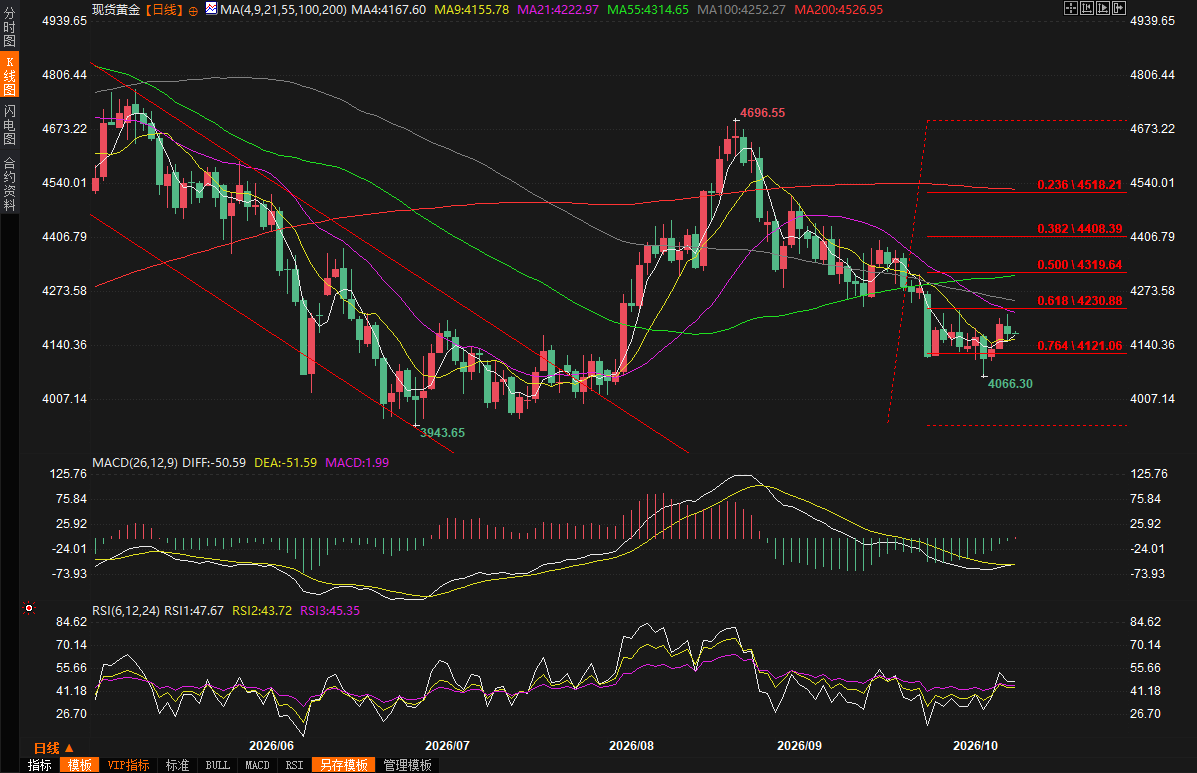 (Spot gold daily chart, source: FX678) At 06:55 Beijing time, spot gold is currently trading at $4070.10 per ounce.
A strong US dollar and rising oil prices were the direct drivers of the decline in gold prices.
The core driving factors behind the recent surge and subsequent decline in gold prices are clearly visible. The US dollar index rose 0.37% on Monday, closing at 102.56, after hitting a new high of 102.60 during the session, the highest since April 2025. The continued strengthening of the dollar directly weakened the attractiveness of dollar-denominated gold, prompting some investors to take profits. Jim Wyckoff, a market analyst at American Gold Exchange, explicitly pointed out that gold is facing significant selling pressure due to the dollar being near a one-and-a-half-year high. Meanwhile, the escalation of the Middle East conflict kept market sentiment tense. While safe-haven demand supported gold to some extent, it failed to completely offset the negative impact of the dollar's appreciation. The simultaneous rise in oil prices further exacerbated the complex market sentiment. Brent crude futures closed up $1.93, or 1.8%, at $106.65 per barrel, a new high since September 15; West Texas Intermediate crude closed at $93.74 per barrel, up $1.89, or 2%. The rise in oil prices was primarily driven by the escalating attacks by Yemen's Houthi rebels on Saudi Arabia—a missile strike on Riyadh's international airport on Saturday killed 13 people and injured more than 300, followed by further attacks on Sunday. These events overshadowed market expectations of a potential increase in supply, despite US President Trump's earlier announcement that Russia would supply large quantities of diesel to the global market and his claim that Ukraine and Russia had reached a ceasefire agreement on energy infrastructure. This ceasefire declaration proved quickly challenged, with Ukrainian President Zelensky clearly stating that Russia continued its airstrikes on Ukrainian energy facilities throughout the night, and the Kremlin emphasizing that negotiations were ongoing and that a short-term ceasefire was not desired. The volatility in oil prices not only fueled inflation expectations but also indirectly strengthened the safe-haven appeal of the US dollar, creating a double drag on gold prices.Inflation data and the Federal Reserve's policy path become key observation windows
Investors' attention has quickly shifted to key data and speeches later this week. Fed Chairman Warsh's speech, Wednesday's Consumer Price Index (CPI) report, and Thursday's Producer Price Index (PPI) and retail sales data will be key clues for judging the future direction of monetary policy. Wyckoff believes these reports are unlikely to show any signs of easing inflation and could instead be bearish for the precious metals market. The CME FedWatch tool shows that the market widely expects the Fed to keep interest rates unchanged later this month, but believes the probability of a rate hike by December is as high as 87.7%. In a high-interest-rate environment, the attractiveness of non-yielding assets like gold naturally decreases. Investors are more inclined to allocate to bonds or other financial assets that provide interest returns, which directly weakens the demand for gold. It is worth noting that the Fed implemented its first rate hike since 2023 last month to combat inflationary pressures. Cleveland Fed President Hammark further stated on Monday that the Fed should "relatively quickly" shift to a tightening policy to control what she believes is a broader trend in inflation. This strengthened policy expectation further limits the potential for a significant short-term rise in gold prices. From a broader perspective, the continued increase in long dollar positions also confirms the market's preference for the dollar. As of the week ending October 7th, long dollar positions increased to approximately $36 billion, a significant rise from $8.4 billion three weeks prior, primarily driven by the euro. The euro's fall to near a 17-month low, coupled with escalating concerns about French fiscal policy and ongoing European political uncertainty, has led to a continued flow of funds into dollar assets. While some strategists believe this round of risk aversion may not translate into a sustained strengthening of the dollar—factors such as cooling economic data, potentially easing inflationary pressures, and the market's saturation of interest rate hike expectations may limit the dollar's upside potential—in the short term, the dollar's strong position still exerts substantial pressure on gold.Long-term impacts of geopolitical risks and energy market volatility
The ongoing conflict in the Middle East and between Russia and Ukraine provides potential support for gold, but also brings more uncertainty. Houthi attacks have not only pushed up oil prices but may also dampen the recovery of Middle Eastern crude oil exports. Reports of tanker attacks near the Strait of Hormuz have further exacerbated market concerns about supply disruptions. Goldman Sachs has raised its December Brent crude oil price forecast to $90 per barrel, expecting a risk premium slightly above $20 per barrel. Meanwhile, energy giants in the Gulf of Mexico are struggling to resume production after the hurricane, but overall supply-side tensions have not dissipated. In the Russia-Ukraine conflict, Trump's announced energy ceasefire was quickly broken by reality, with Russia continuing airstrikes on Ukrainian energy facilities and the EU approving its largest single sanctions action against Russia. These events have driven up global energy prices, especially diesel, which has reached record highs and put pressure on the US government. High energy costs could further push up inflation, reinforcing the Federal Reserve's rationale for maintaining high interest rates, thus indirectly suppressing gold prices. However, long-term geopolitical uncertainty remains a traditional bullish factor for gold. If the conflict escalates further or the safe-haven appeal of the US dollar weakens, gold may still quickly attract capital inflows.summary
In summary, the current decline in gold prices reflects the dominant role of short-term macroeconomic factors—a stronger dollar and rising oil prices are exerting direct pressure, while upcoming inflation data and expectations for Federal Reserve policy will determine the next direction of market sentiment. The investment logic for gold in a high-interest-rate environment is indeed being challenged, but the safe-haven demand stemming from the Middle East and the Russia-Ukraine conflict has not disappeared. Investors need to closely monitor Wednesday's CPI data and the statements from Federal Reserve officials. If inflation data is stronger than expected, the dollar and interest rate expectations may strengthen further, and gold prices may continue to be under pressure, even falling towards the $4,000 level; conversely, if the data shows that inflation has eased, gold may regain upward momentum and break through the resistance zone of $4,200-$4,230. (Spot gold daily chart, source: FX678) At 06:55 Beijing time, spot gold is currently trading at $4070.10 per ounce.
- Risk Warning and Disclaimer
- The market involves risk, and trading may not be suitable for all investors. This article is for reference only and does not constitute personal investment advice, nor does it take into account certain users’ specific investment objectives, financial situation, or other needs. Any investment decisions made based on this information are at your own risk.