Gold prices have retreated from their recent highs towards $4,000, presenting the next major buying opportunity.
2026-10-13 10:12:21
Gold prices have been declining since breaking through the $4,500 per ounce high in September and are currently struggling to find support. A stronger dollar, soaring US Treasury yields, and market expectations of further monetary tightening by the Federal Reserve are all weighing on precious metal prices. However, an intriguing phenomenon is emerging: while speculative funds are gradually withdrawing from the gold market, central banks and gold ETFs are continuously increasing their physical gold holdings. This raises a core question for investors: is gold entering a prolonged correction, or is the recent pullback creating new buying opportunities? Short-term interest rate pressures and long-term safe-haven demand are pulling in opposite directions, leaving gold at a critical juncture.
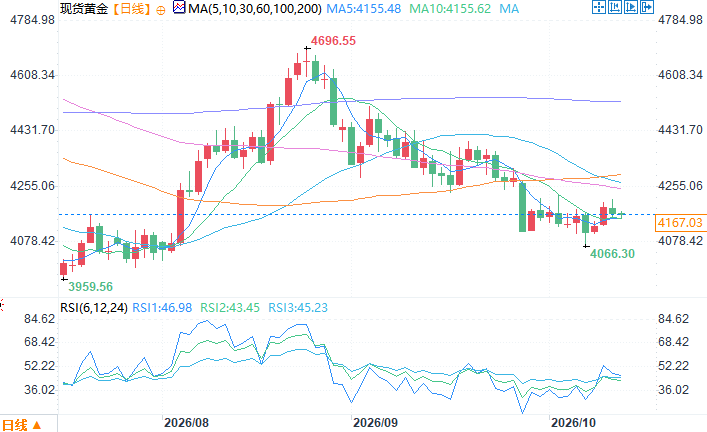 Spot gold daily chart source: FX678. At 10:11 AM Beijing time on October 13th, spot gold was trading at $4168.03 per ounce.
With both bullish and bearish factors at play, gold is under significant short-term pressure.
On Monday (October 12), gold traded between $4,150 and $4,215 per ounce, with December futures falling to around $4,189, as investors awaited the latest US inflation data. Since early September, gold has fallen by approximately 5%, with the dollar index hovering near an 18-month high and the 10-year US Treasury yield above 5%, both factors acting as major downward pressure. This combination is particularly unfavorable for gold, as it does not generate any interest, higher interest rates amplify the attractiveness of government bonds, and a stronger dollar increases the real cost for overseas buyers to purchase gold. However, it is worth noting that the current forces driving bond yields upward may ultimately translate into support for gold. The Federal Reserve is facing an increasingly difficult trade-off between slowing economic growth and persistently high inflation. The September US jobs report showed only 29,000 new jobs added, and the preliminary October consumer confidence reading fell to 46.3. Meanwhile, rising energy costs related to geopolitical conflicts continue to exacerbate uncertainty about the inflation outlook. The yield on 10-year US Treasury bonds recently broke through 5.25%, reaching a new high since 2002. Some bond market analysts believe that if inflation and borrowing pressures continue, the yield may even approach 6%.The dual impact of short-term risks for gold and inflation data
For gold, the short-term risks are clear and direct: if the US September Consumer Price Index (CPI) released this Wednesday again exceeds expectations, it will strengthen market expectations for a December rate hike, further pushing up US Treasury yields and the US dollar, putting new downward pressure on gold prices. However, UBS Global Wealth Management believes that many hawkish policy expectations in the market may already be priced into gold prices. Their analysis on October 12th pointed out that a gradually cooling labor market and stabilizing international oil prices will ultimately weaken market expectations for further monetary tightening, thus creating room for a gold rebound. In other words, every sharp drop in gold prices in the short term does not necessarily represent a deterioration in the trend; rather, it may be digesting the already over-priced interest rate hike expectations.The continued increase in holdings by the central bank and ETFs forms a foundation for a long-term bullish outlook.
A more compelling long-term bullish logic lies hidden beneath recent price fluctuations. Data from the World Gold Council shows that global physical gold ETFs attracted approximately $10 billion in inflows in September, bringing total inflows for the third quarter to a record $31 billion. Notably, even with the decline in gold prices, investors continued to increase their holdings, with gold ETF holdings rising by 67 tons in September, reaching a record high of 4,256 tons. Central banks are providing another important source of demand support. According to the World Gold Council, in the second quarter of 2026, central banks purchased a total of approximately 289 tons of gold, a year-on-year increase of 62%. This continued increase reflects that global monetary authorities are more broadly promoting the diversification of foreign exchange reserves, gradually reducing their reliance on traditional reserve currencies. Amid concerns about global fiscal sustainability, the reshaping of central bank reserve structures, and geopolitical uncertainties, the long-term allocation value of gold is being reassessed. Even though high yields typically make gold less attractive, rising sovereign debt risks may actually drive investors to seek alternative assets beyond bonds.The technical outlook remains weak, with key price levels influencing market direction.
UBS Global Wealth Management believes that the repricing of expectations for Fed rate hikes has likely already been largely priced into gold prices. The institution notes that a sustained bottom for gold prices has not yet been truly established, but cooling job growth and stabilizing oil prices are expected to gradually alleviate pressure on US Treasury yields, opening a window for a gold rebound. Technically, the market remains fragile, with analysts considering the $4,000 to $4,030 per ounce range as a key support area. If gold prices continue to hold above $4,280 to $4,320, it could strengthen the momentum for a new round of rebound. Market analysts in major Asian countries expect gold to likely fluctuate widely between $4,000 and $4,400 in the fourth quarter, with the outcome of the Fed's December interest rate meeting potentially determining the main direction of gold's next move. In the short term, gold is caught between two forces: the Fed's firm determination to curb inflation and investors' deep concerns about the long-term continuation of high interest rates and their impact on government finances and economic growth. This week's US inflation data will be the next key catalyst. Strong data could push gold prices back to around $4,000, while weak data could weaken expectations of an interest rate hike, giving gold bulls a chance to regain the initiative.Conclusion
In summary, gold is currently caught in a tug-of-war between short-term interest rate pressures and long-term safe-haven appeal. The coexistence of speculative selling and central bank/ETF buying reflects a significant increase in market divergence regarding gold's prospects. Short-term direction depends on inflation data and the Federal Reserve's policy path, while the true long-term support for gold prices comes from global fiscal concerns, central bank reserve diversification, and geopolitical uncertainties. For investors, it's crucial to acknowledge the short-term pressures of a high-interest-rate environment while also recognizing gold's long-term value as a structural hedging asset. Awaiting the release of inflation data will allow for a reassessment of how the balance of power between bulls and bears shifts. Spot gold daily chart source: FX678. At 10:11 AM Beijing time on October 13th, spot gold was trading at $4168.03 per ounce.
- Risk Warning and Disclaimer
- The market involves risk, and trading may not be suitable for all investors. This article is for reference only and does not constitute personal investment advice, nor does it take into account certain users’ specific investment objectives, financial situation, or other needs. Any investment decisions made based on this information are at your own risk.