Has the high yield in the 102 range of the US dollar index for decades been sufficient to tighten financial conditions?
2026-10-13 21:00:19
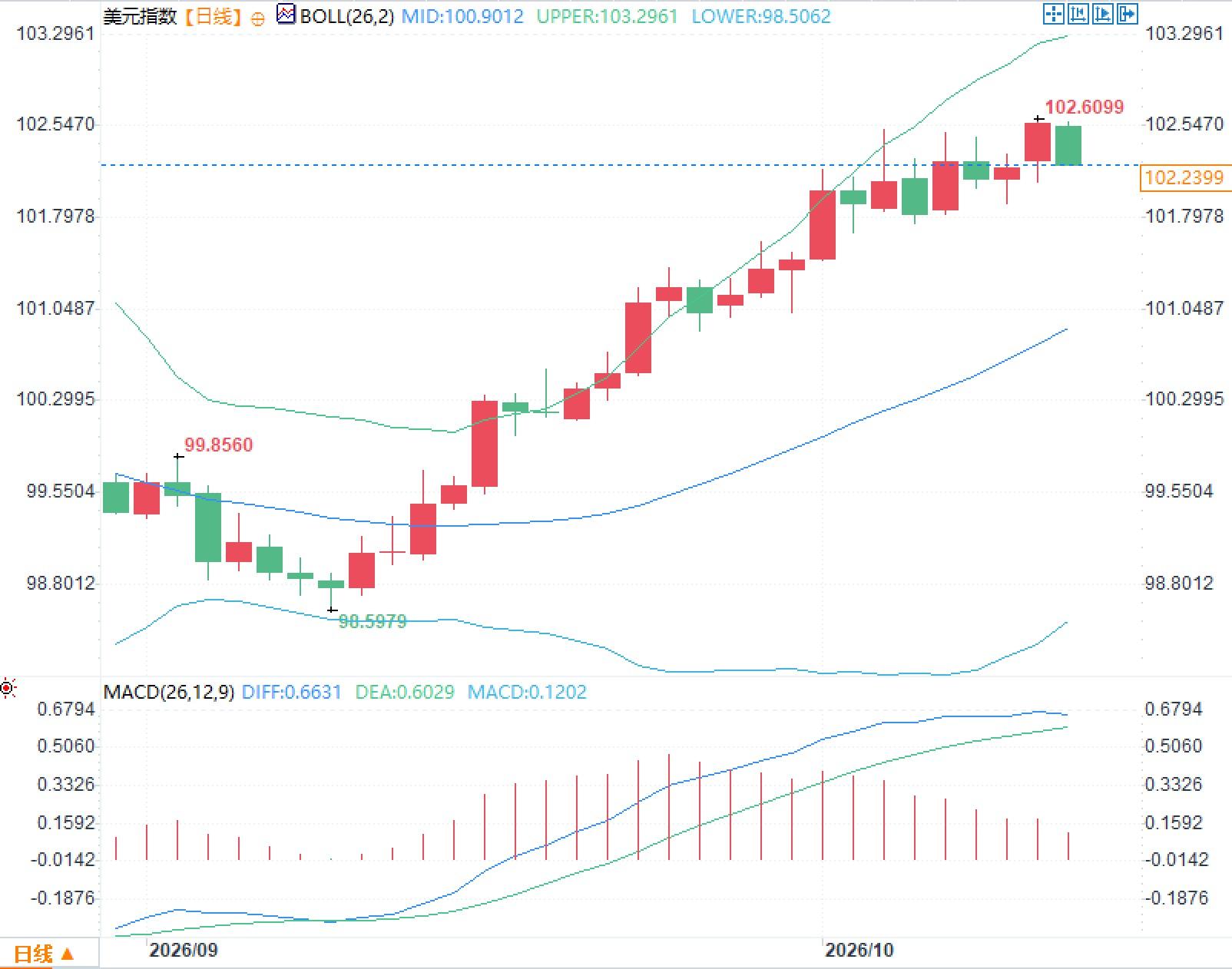
On Tuesday, October 13th, the US dollar index was trading around 102.3, slightly lower than the previous trading day's close, but still within its recent high range. Meanwhile, the yield on the 10-year US Treasury note hovered between 5.18% and 5.20%, near multi-decade highs. Against this backdrop, Federal Reserve Governor Christopher Waller pointed out that rising long-term yields are suppressing demand in interest-rate-sensitive sectors such as housing and automobiles, objectively contributing to tighter monetary conditions. This statement comes after the Fed's unanimous 25 basis point rate hike in September, raising the target range for the federal funds rate to 3.75% to 4.00%, marking the first rate hike since 2023. The market is awaiting the release of US September inflation data on October 14th, while also focusing on policy signals ahead of the Federal Open Market Committee meeting on October 27th and 28th. 
Rising long-term yields and tightening financial conditions
Waller explicitly stated that rising yields inevitably affect housing, automobiles, and other interest-rate-sensitive sectors. This is not the Fed's deliberate intention, but it has already "done some work" in practice. Currently, long-term yields in the US and other developed economies have climbed to multi-decade highs, primarily due to inflation concerns fueled by the Middle East conflict, expectations of widening fiscal deficits, and large-scale investment in artificial intelligence infrastructure. These factors have collectively tightened financial conditions. The market has reacted accordingly; since mid-September, the rate hike priced in by the swap markets of the eight major economies has cumulatively decreased by nearly 200 basis points. After the Fed's rate hike last month, investors were initially highly focused on the possibility of further action at the October meeting, but this focus subsequently cooled as some officials signaled an assessment window. The restraining effect of rising yields on interest-rate-sensitive sectors allows some policy adjustment pressure to be transmitted through price mechanisms, rather than relying entirely on the policy rate itself.Price transmission effect of artificial intelligence infrastructure
Waller points out that the rapid construction of artificial intelligence infrastructure is putting upward pressure on prices. He states that to complete investments worth trillions of dollars, the related demand is almost inelastic, with buyers willing to accept any price, thus driving up the prices of various semiconductor products and spilling over into other sectors that use these products. This phenomenon has already begun to emerge in the United States. He also believes that artificial intelligence may ultimately improve productivity, supporting stronger growth without additionally pushing up inflation, but this benefit may still take several years to fully materialize, and the price pressures driven by artificial intelligence may persist for two to three years. This demand-driven, supply-lagging characteristic makes the current price pressures phased, and combined with the energy cost shock caused by the Middle East conflict, they jointly affect the overall inflation path. Economists expect overall inflation to accelerate in September due to energy costs, while core inflation may moderate.Policy flexibility and market expectation repricing
Last week, Waller stated that further rate hikes are highly likely to be needed to curb inflation, but officials have some flexibility in timing. The September summary of economic projections showed that most participants believed at least one more rate hike was needed this year. However, the spontaneous rise in long-term yields has partially replaced the function of tighter policy, leading traders to lower their expectations for the rate hike path. Waller also emphasized that inflation expectations remain anchored, and the rise in yields reflects more the changes in real growth and debt convenience premiums than simply the inflation premium. He cited research indicating that the status of US Treasuries as a global safe-haven asset has weakened, potentially pushing yields up by an additional 50 to 70 basis points. Under this framework, the transmission of policy rates and long-term rates is not synchronized, and the market has increased its pricing in the Fed maintaining the status quo at its October meeting, focusing more on the December meeting and subsequent data verification.Discussion and Institutional Framework on Central Bank Independence
When asked about the potential impact of the administration on his position, Waller expressed confidence that Congress and the U.S. courts would uphold the central bank's autonomy. He noted that the administration posed a threat to the Fed's independence, but had not yet truly succeeded. Waller himself was appointed by Trump during his first term. Currently, the administration is pushing to remove Governor Lisa Cook from her post, having established a committee this month to investigate allegations related to Cook's mortgage loans, with a White House hearing scheduled for November 5. The Supreme Court had previously blocked the initial removal attempt. Most economists believe that inflation control is generally more effective when central banks can fulfill their responsibilities independently.Frequently Asked Questions
Question 1: How does rising long-term yields partially replace the role of policy interest rates? Answer: Rising yields directly increase financing costs for sectors such as housing and automobiles, suppressing related demand and thus tightening financial conditions to some extent, reducing the necessity for further increases in policy interest rates. Question 2: Why will AI infrastructure development bring temporary price pressure? Answer: Large-scale investment demand is inelastic, pushing up prices of key inputs such as semiconductors and generating spillover effects. Productivity improvements take longer to materialize, so the pressure may last two to three years. Question 3: Why has the market lowered its expectations for Fed rate hikes? Answer: Long-term yields have already spontaneously completed part of the tightening function, and with officials signaling an assessment window, traders have correspondingly reduced their pricing in further near-term rate hikes.- Risk Warning and Disclaimer
- The market involves risk, and trading may not be suitable for all investors. This article is for reference only and does not constitute personal investment advice, nor does it take into account certain users’ specific investment objectives, financial situation, or other needs. Any investment decisions made based on this information are at your own risk.