Houthi target Saudi Aramco, oil prices rebound
2026-10-13 21:48:18
The Houthi rebels in Yemen have designated Saudi Aramco oil facilities as legitimate targets, and the US has simultaneously issued a travel risk warning for Saudi Arabia. Coupled with the ongoing diplomatic stalemate between the US and Iran over the Strait of Hormuz, international oil prices have risen, recovering from their lows. From the core logic of Trump's Republican Party, the underlying logic of the US Middle East strategy revolves around two fundamental pillars: ensuring Israel's security and maintaining the controllability of global energy shipping routes. However, it refuses to repeat the quagmire of decades of deep ground warfare, and all actions must serve domestic public opinion, inflation, and industrial interests, prioritizing the avoidance of the economic backlash from prolonged war. This approach of "limited deterrence, transaction-first, and no unlimited investment" is reflected in the current geopolitical risks surrounding the Strait of Hormuz negotiations, the Red Sea, and Saudi energy facilities. 
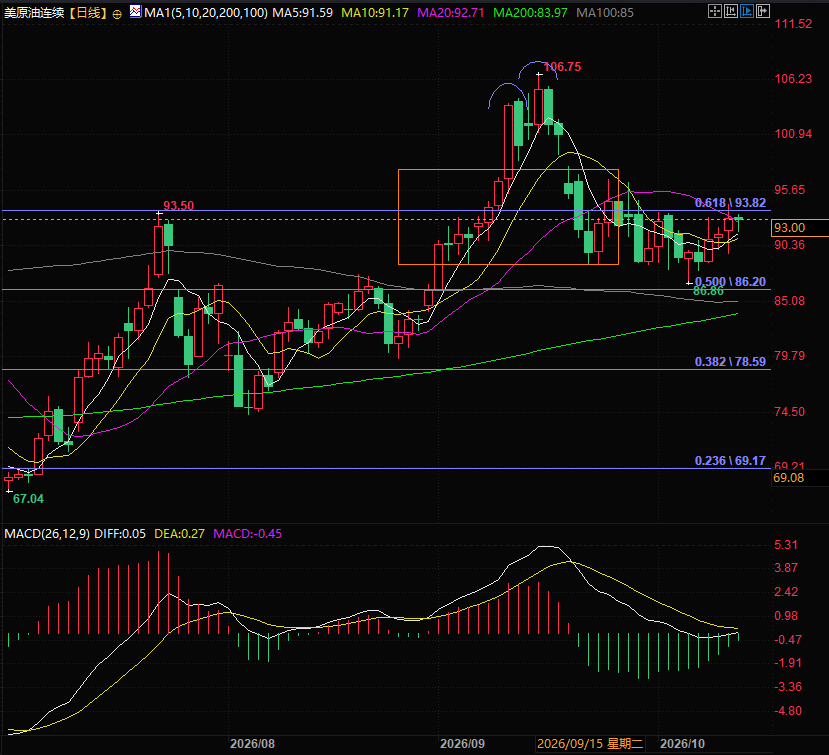 (WTI crude oil futures contract daily chart, source: EasyTrade) At 21:45 Beijing time, WTI crude oil futures contract daily chart is currently trading at $92.99 per barrel.
US-Iran Strait of Hormuz negotiations: Republican bottom line, nuclear issue takes precedence over navigation.
Iran is currently reviewing the US response to its proposal to reopen the Strait of Hormuz and will relay its position through intermediaries such as Qatar and Pakistan. The core conflict in the negotiations lies in the order of negotiation: the US insists that negotiations must begin with the Iranian nuclear issue, while Iran advocates prioritizing the security of navigation through the strait. This aligns perfectly with the Republican Party's consistent strongman stance and its strategy of maximum pressure on Iran: the nuclear issue is a red line, and opening the strait is a bargaining chip; the US will not abandon the nuclear issue simply to restore oil shipping.Houthi threat to Saudi energy facilities: limited support to avoid direct US military involvement.
At the same time, the Houthi rebels in Yemen publicly warned that personnel around Saudi Aramco oil facilities should evacuate and that the energy assets were legitimate targets for attack. The U.S. State Department simultaneously issued a travel advisory, advising the public to reassess their travel plans to Saudi Arabia. From the perspective of the Trump party's decision-making framework, the White House is unlikely to easily deploy large-scale troops directly to protect Saudi oil facilities. The Republican Party tends to provide indirect support to Saudi Arabia, such as intelligence and air defense equipment, binding Riyadh with arms sales and security commitments, but is striving to avoid direct U.S. military involvement in a new large-scale conflict in the Middle East. Their underlying considerations are very pragmatic: direct military intervention would cause oil price spikes, pushing up inflation in the U.S. and directly impacting voter support.Congressional structure constrains strategic choices: replacing total war with controlled competition.
The changes in the congressional landscape following the midterm elections will further constrain the White House's military options. Recent reports indicate that voter dissatisfaction with the economic downturn will force both parties to strengthen market intervention. Republicans will be more inclined to use tools such as tariffs and industrial policy, which in the Middle East will manifest as a strategy of "deterrence first, trade second": on the one hand, maintaining pressure on Iran and upholding the bottom line on the nuclear issue; on the other hand, preserving channels for negotiation and attempting to stabilize shipping across the Strait through diplomatic mediation to prevent a one-off disruption of energy supplies. This strategy is not aimed at achieving lasting regional peace, but rather at controlling the intensity of conflict and limiting geopolitical risks to a manageable range.The ultimate benchmark for geopolitical games: oil prices determine policy gains and losses.
If US-Iran negotiations remain deadlocked for an extended period, coupled with continued warnings from the Houthis against Saudi Aramco oil facilities, the Strait of Hormuz and the Red Sea, two key global oil transport routes, will simultaneously face pressure. The market will continue to price in the risk of oil supply disruptions, pushing oil prices upward and potentially breaking through the current consolidation range. However, the White House is currently trying to avoid stimulating oil prices ahead of the midterm elections, but the election situation is not very optimistic, which may ultimately lead to the Democrats winning the Senate. This would result in a balance of power between the two parties, increasing the frequency of news impacting the market. (WTI crude oil futures contract daily chart, source: EasyTrade) At 21:45 Beijing time, WTI crude oil futures contract daily chart is currently trading at $92.99 per barrel.
- Risk Warning and Disclaimer
- The market involves risk, and trading may not be suitable for all investors. This article is for reference only and does not constitute personal investment advice, nor does it take into account certain users’ specific investment objectives, financial situation, or other needs. Any investment decisions made based on this information are at your own risk.