Gold Trading Alert: Middle East Missiles Strike Saudi Aramco, Gold Prices Under Pressure Awaiting US CPI Data
2026-10-14 07:28:18
On Tuesday (October 13), spot gold prices retreated slightly to around $4,160 per ounce, with December gold futures also closing lower, and overall market trading appearing relatively calm. This apparent tranquility masks an undercurrent of multiple forces at play. The missile attack on Saudi Aramco's headquarters and the surge in international oil prices to a two-week high exacerbated inflation concerns, supporting expectations of at least one more rate hike by the Federal Reserve this year, putting pressure on gold prices. However, the pullback in the US dollar provided some support for gold prices, with investors focusing intently on key US inflation data to be released later this week, as well as the latest statements from Federal Reserve officials. As a traditional safe-haven asset and interest rate sensitive commodity, gold is currently being driven by geopolitical tensions, differing expectations regarding monetary policy, and fluctuations in energy prices. The data and speeches in the coming days are likely to be key variables determining the short-term direction of gold prices. On Wednesday (October 14), spot gold continued to be under pressure during the Asian session, currently trading around $4,155 per ounce. 
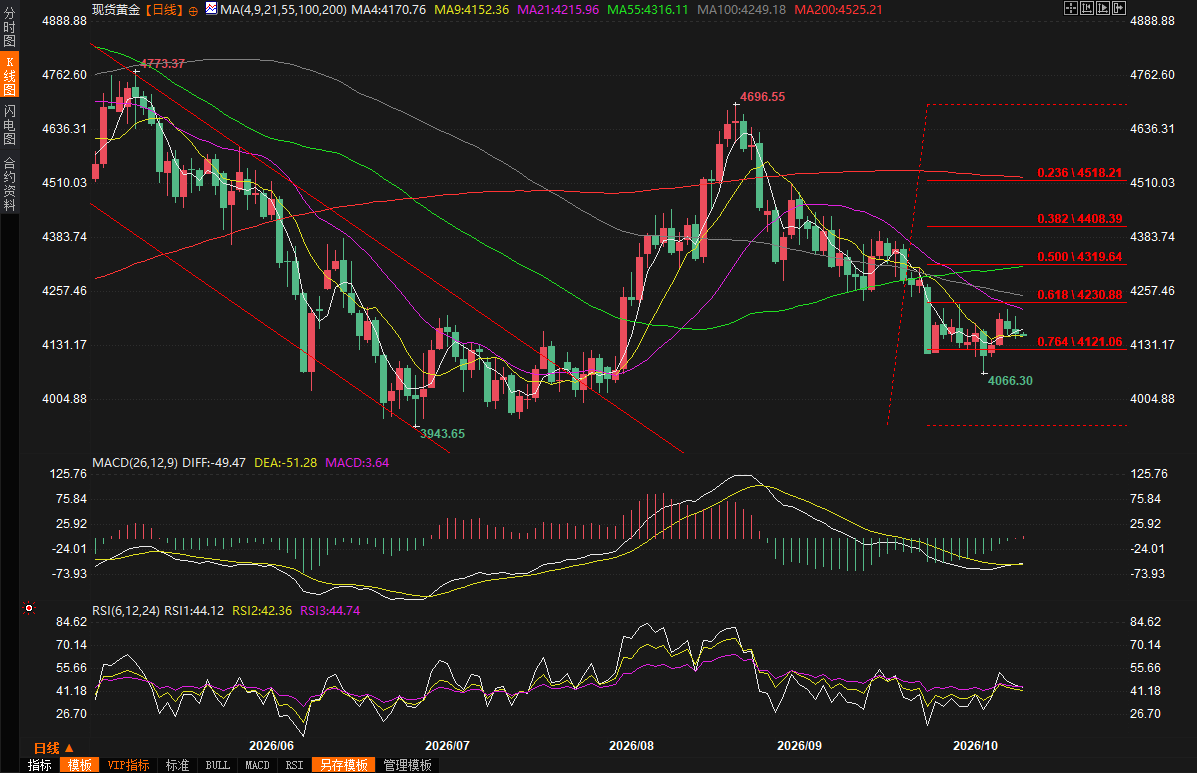 (Spot gold daily chart, source: FX678) At 07:24 Beijing time, spot gold is currently trading at $4155.94 per ounce.
The renewed conflict in the Middle East and the attack on Saudi Aramco headquarters have shaken up the oil market and inflation expectations.
Geopolitical tensions are currently the most difficult factor to quantify yet impossible to ignore in the gold market. The conflict between the Houthi rebels in Yemen and the Saudi-led coalition has escalated significantly, with a ballistic missile directly striking Saudi Aramco's headquarters in Dhahran. The top three floors of the building were damaged and caught fire, and news spread rapidly. As the world's largest oil company, Saudi Aramco's operations center manages a vast onshore and offshore production network; any attack on its core facilities immediately triggers market concerns about the security of crude oil supplies. Previously, the Houthi rebels had repeatedly launched missiles and drones at key Saudi facilities, and Riyadh International Airport had also been attacked multiple times. Simultaneously, the Saudi-led coalition retaliated against targets within Yemen, with the conflict unfolding along the Red Sea coast and near the Bab el-Mandeb Strait. The Bab el-Mandeb Strait, a vital energy route after the Strait of Hormuz's obstruction, directly impacts global oil transportation costs. As a result, international oil prices had previously surged, with both WTI and Brent crude reaching two-week highs. Rising oil prices are being passed down downstream through refined oil products, aviation fuel, and diesel, further exacerbating market concerns about sticky inflation. For gold, this geopolitical shock has a dual effect. On the one hand, the risk of war itself increases safe-haven demand, theoretically supporting gold prices; on the other hand, the inflationary pressure from soaring oil prices reinforces the necessity for the Federal Reserve to maintain or even further tighten monetary policy, thereby pushing up real interest rate expectations and putting downward pressure on gold, which yields no interest. The market currently tends to focus more on the latter, as short-term inflation data has a more direct impact on the Fed's policy path. Analysts at Commerzbank have pointed out that interest rate hikes are increasingly becoming a double-edged sword for gold: rising interest rates increase the opportunity cost of holding gold, but also increase the fiscal burden on many governments, potentially exacerbating concerns about debt sustainability, which in the long run may actually provide support for gold.Divergent statements from Federal Reserve officials have led to market bets on a slower pace of interest rate hikes.
Monetary policy expectations are the core driver of current gold price movements. The Federal Reserve raised its policy rate to the 3.75%-4.00% range in September, and the market had previously anticipated more aggressive actions. However, recent statements from several officials have cooled these expectations. Boston Fed President Collins explicitly stated her support for the September rate hike and believes another small rate hike before the end of the year is appropriate to ensure inflation returns to the 2% target in a timely manner. She also emphasized that the economy and job market are performing well, allowing the Fed to focus more on controlling inflation, but investments in AI infrastructure, tariffs, and energy costs driven by the Middle East conflict could complicate efforts to curb inflation. New York Fed President Williams held a more cautious view. He reiterated that another rate hike may be needed in 2026, but believes there is currently no reason to believe further action is needed in 2027. Williams pointed out that the forces suppressing inflation are working, and he expects overall inflation to fall significantly next year and approach the 2% target. Tariffs will gradually become a thing of the past, and energy prices will not continue to exert downward pressure. He emphasized that the current economy is not overheated and, apart from specific shocks, will not bring additional inflationary pressure. These statements echo the views of Federal Reserve Governor Waller: the recent rise in U.S. Treasury yields reflects stronger economic growth and large-scale investment in artificial intelligence, rather than runaway inflation expectations, which remain "firmly under control." The CME Group's FedWatch tool shows that traders currently see only about a 20% chance of a Fed rate hike this month, while the probability of a December rate hike is as high as 88%. The market as a whole tends to believe that the Fed has no immediate urgency to act before more data is available. This expectation gap has somewhat eased the pressure on gold in a high-interest-rate environment. High interest rates do indeed weaken the relative attractiveness of gold, but if the pace of rate hikes slows and signs of peaking real interest rates emerge, the opportunity cost pressure on gold will also be reduced accordingly.The bond and currency markets move in tandem, and the weakening dollar provides some breathing room for gold prices.
The performance of the US bond market and the dollar also influences gold pricing. On Tuesday, long-term Treasury yields edged lower, following a decline in the European bond market, while the two-year short-term yield rose slightly ahead of inflation data releases. The 10-year US Treasury yield retreated from previous highs but remains relatively high. Volatility in the French bond market acted as a catalyst for declining global interest rates, with some investors turning to government bonds as a safe haven after the sell-off in Asian tech stocks, further depressing long-term yields. The dollar index retreated from an 18-month high. Growing skepticism about the sustainability of valuations for AI-related stocks dampened some capital inflows into the US financial markets. Meanwhile, comments from New York Fed President Williams accelerated the dollar's decline. A weaker dollar typically benefits dollar-denominated gold, providing some support for gold prices. However, the sustainability of this support depends on whether upcoming inflation data can alter market pricing in the Fed's policy path. The International Monetary Fund also cautioned that the risks posed by high public debt and rising bond yields should not be ignored, and inflationary pressures from war could push yields even higher. These macroeconomic concerns mean that gold's value as a long-term hedging tool has not disappeared; it has simply been suppressed in the short term by the anticipation of data releases.Awaiting key data releases, the future direction of gold depends on the interplay between inflation and policy signals.
In summary, the current slight decline in gold prices is more a reflection of market caution ahead of important events than a trend reversal. Oil price volatility and inflation concerns stemming from the Middle East conflict, cautious statements from Federal Reserve officials regarding the pace of interest rate hikes, and the weakening dollar are all contributing factors influencing gold prices. The Consumer Price Index (CPI) and Producer Price Index (PPI) data to be released later this week, along with the Fed Chair's speech, will be crucial in breaking the deadlock. If inflation data continues to show stickiness, especially if it rebounds due to energy cost increases, the market may repric a more prolonged period of high interest rates, thus putting pressure on gold prices. Conversely, if data shows signs of cooling inflation, coupled with continued geopolitical risks, gold's safe-haven and hedging properties are likely to regain importance. (Spot gold daily chart, source: FX678) At 07:24 Beijing time, spot gold is currently trading at $4155.94 per ounce.
- Risk Warning and Disclaimer
- The market involves risk, and trading may not be suitable for all investors. This article is for reference only and does not constitute personal investment advice, nor does it take into account certain users’ specific investment objectives, financial situation, or other needs. Any investment decisions made based on this information are at your own risk.