Why is the ECB preparing to act before the second wave of effects has even materialized?
2026-10-14 12:12:18
The euro edged higher against the dollar in Asian trading on Wednesday (October 14), currently trading around 1.1210, but remains near its lowest levels since the end of May 2025. European Central Bank President Christine Lagarde said on Wednesday (October 14) that the eurozone has not yet seen a second wave of effects from rising energy prices, but hinted that the central bank will not wait until these effects are fully realized before responding. 
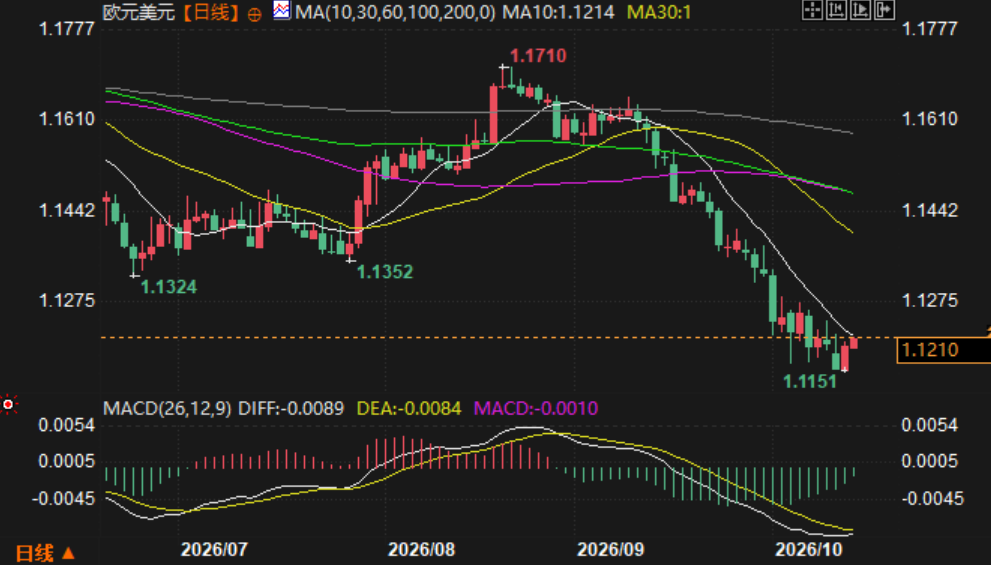 (Euro/USD daily chart, source: FX678) At 12:10 Beijing time, the euro was trading at 1.1210/11 against the US dollar.
Key assessment: Inflation is driven by energy, and there is no second-round effect yet.
Lagarde stated that the rise in inflation is primarily, but not entirely, driven by energy prices. While there are currently no signs that these increases have translated into broader wages and prices, she said policymakers must anticipate and look for early signs. The core of this assessment is that current inflationary pressures are concentrated in the energy sector and have not yet spread to wages and broader service prices. However, Lagarde made it clear that the central bank will not wait for the second-round effects to fully materialize before acting, meaning the ECB may act sooner than the market expects.Early warning signs: Wage expectations in collective bargaining agreements
The European Central Bank (ECB) is paying particular attention to collective bargaining agreements because expectations of future wage increases often first emerge there. The second-round effect refers to the initial price shock prompting workers to seek higher wages and businesses to further raise prices, thus transforming a temporary price spike into more persistent inflation. Lagarde's emphasis on acting before the second-round effect fully manifests indicates the central bank's readiness to preemptively intervene if the wage agreement begins to strengthen. This focus means that the progress of wage negotiations will be a key indicator of the ECB's policy path. If the wage agreement shows accelerating wage growth, it could prompt the ECB to tighten policy sooner rather than later.Stance on French debt: Solutions in French fiscal policy
When asked about French debt, Lagarde stated that the primary and foremost solution lies in French fiscal policy. This statement places the responsibility on Paris, not the European Central Bank. French borrowing costs are under pressure, and the yield spread between French and German government bonds has widened significantly amid budgetary political tensions in France. Goldman Sachs noted in a recent client discussion that this yield spread issue is expected to persist until the French presidential election in the first half of next year. Lagarde's statement implies that investors should not expect the European Central Bank to bail out French yield spreads, which will continue to be exposed to the risks of French budgetary politics.Economic growth assessment: 1.1% is neither outstanding nor bad.
Lagarde stated that economic growth is not outstanding, but the eurozone's 1.1% growth target for 2026 is not bad either. This assessment provides context for the ECB's policy path—growth is neither strong enough to warrant tightening nor weak enough to warrant easing. Lagarde also stated that she will not run for president of France.Market Implications: Energy Prices and Wage Negotiations are Key Indicators
Lagarde's remarks leaned marginally hawkish. A central bank willing to act on early signs rather than waiting for clear evidence of a second-round effect may act sooner than the market expects if the wage agreement strengthens. This supports the relative performance of front-end European yields and the euro. Energy is a key transmission channel—since inflation is primarily driven by energy prices, an escalation of the Gulf situation leading to a further jump in oil or gas prices would increase the likelihood of preemptive tightening, making crude oil and TTF natural gas direct input variables for the ECB's pricing. Her comments on France offered no safety net, thus the Franco-German yield spread remains exposed to the risks of Parisian budget politics.The euro faces a dual constraint against the dollar: a wide interest rate differential and French fiscal risk.
Lagarde's remarks have a marginal positive effect on the euro against the dollar. A central bank willing to act at the first signs of a second wave of effects, rather than waiting for clear evidence, may tighten policy earlier than the market expects if the wage agreement strengthens, supporting eurozone front-end yields and the euro. Currently, the euro is near its lowest level since the end of May 2025. If the market begins to price in the possibility of the ECB acting ahead of schedule, the euro may receive some support. However, this positive momentum is constrained by two factors. First, the interest rate differential between the US and Europe remains significant—the US 10-year Treasury yield remains around 5.30%, and the probability of a Fed rate hike in December remains high, meaning the euro's interest rate disadvantage has not fundamentally changed. Second, Lagarde clearly stated that the solution to French debt lies in French fiscal policy, and the ECB will not bail it out. This means the risk of a widening spread between French and German bond yields will continue to suppress the euro. Furthermore, energy prices are a key transmission channel—if the escalation of the Gulf situation pushes up oil and TTF natural gas prices, the probability of the ECB tightening earlier increases, but at the same time, the eurozone's growth prospects may be damaged, with the two having opposite effects on the euro. In summary, Lagarde's hawkish stance has provided some bottom support for the euro, but the interest rate differential between the US and Europe and the fiscal risks in France still limit its rebound potential. The euro is likely to remain in a low-level fluctuation against the US dollar in the short term.Summarize
Lagarde's core message is that while there is no second-round effect in the Eurozone, the ECB will not wait until it fully manifests before acting. Inflation is primarily driven by energy prices, and the central bank is watching wage expectations in the collective bargaining agreement as an early warning sign. If the wage agreement strengthens, the ECB may tighten policy sooner than the market expects, supporting front-end European yields and the euro. She attributed the solution to French debt to French fiscal policy, indicating that the ECB will not bail out French interest rate differentials, which will continue to be exposed to budgetary politics risks. Energy prices and wage negotiations are key indicators of the ECB's next move—a further jump in oil or gas prices, or an early strengthening of wage demand, will increase pressure on the central bank to act before inflation becomes deeply entrenched. For the market, crude oil and TTF natural gas have become direct input variables for the ECB's pricing, while French interest rate differentials continue to be constrained by Paris's fiscal politics. (Euro/USD daily chart, source: FX678) At 12:10 Beijing time, the euro was trading at 1.1210/11 against the US dollar.
- Risk Warning and Disclaimer
- The market involves risk, and trading may not be suitable for all investors. This article is for reference only and does not constitute personal investment advice, nor does it take into account certain users’ specific investment objectives, financial situation, or other needs. Any investment decisions made based on this information are at your own risk.