A chart shows the Baltic Dry Index falling to a more than two-month low, with freight rates for large vessels weakening.
2026-10-14 23:06:18
Latest data shows that on October 14, 2026, the Baltic Dry Index (BDI) stood at 2667 points, a new low since July 29, 2026, down 4.78% month-on-month, the largest drop since March 10, 2026, and marking the eighth consecutive day of decline (including zero growth). Looking at the short-term charts, the recent 11 BDI data points show: 2 positive increases, 9 negative increases, and 0 zero increases. Specifically, the Panamax Freight Index (BPI) was at 2409 points, down 0.95% from the previous value; the Capesize Freight Index (BCI) was at 3630 points, down 9.11%; and the Supramax Freight Index (BSI) was at 1845 points, up 0.65%. For detailed 720-day and 10-year trend charts of the Baltic Dry Index and its three main sub-indices, please refer to the charts specially created by FX678. 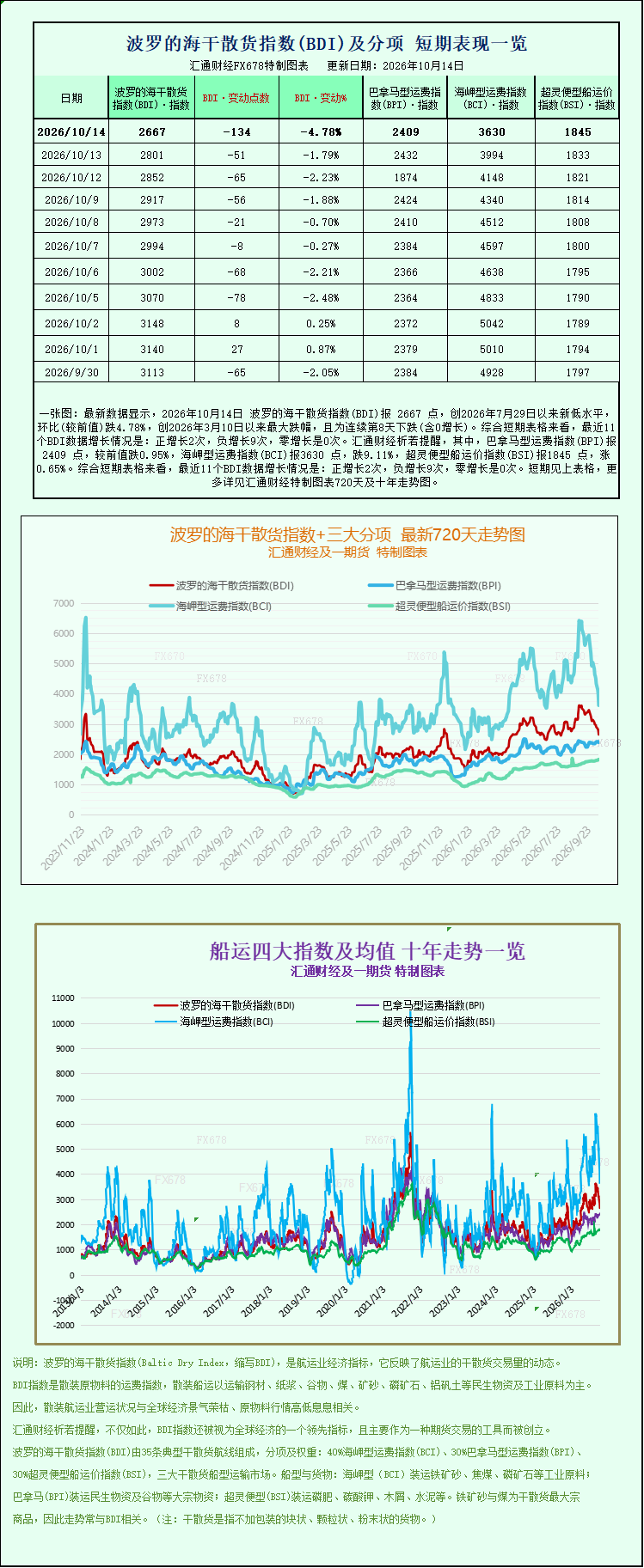 On Wednesday, the Baltic Dry Index, which tracks dry bulk shipping prices, fell for the eighth consecutive trading day, reaching its lowest level in more than two months since July 29. This decline was mainly driven by a sharp drop in Capesize vessel freight rates, while Panamax rates also weakened. Only the Supramax index saw a slight rebound. I. Key Market Trends: Eight Consecutive Declines, Hitting a New Low Since July 29 The Baltic Dry Index fell 134 points, or 4.78%, to close at 2,667 points, its lowest level since July 29, marking its eighth consecutive day of decline. This index comprehensively reflects freight rates for the three main vessel types: Capesize, Panamax, and Supramax. Its continued decline indicates a downward shift in the overall freight rate center of the dry bulk shipping market. II. Capesize: Leading the Decline, Average Daily Revenue Falls Below $30,000 The Capesize vessel index fell 364 points, a drop of 9.11%, closing at 3,630 points, the lowest level since late June. As the absolute main driver of this decline, Capesize freight rates fell by nearly 10% in a single day, significantly more than other vessel types. The average daily revenue of Capesize vessels carrying approximately 150,000 tons of cargo (mainly iron ore and coal) declined by $3,302 to $29,417 per day. The average daily revenue falling below the $30,000 mark reflects significant pressure on spot market charter rates for large bulk carriers. III . Drivers of the Decline: Blast Furnace Maintenance in China Coupled with High Port Inventories From the demand side, iron ore futures prices on the Dalian Commodity Exchange (DCE) fell in tandem with the market on Wednesday, directly dampening expectations for Capesize vessel transportation demand. Market sources indicate that increased blast furnace maintenance at Chinese steel mills has suppressed demand for iron ore procurement and transportation. Meanwhile, rising port inventories in Australia and Brazil suggest ample iron ore supply. This combination of contracting demand and ample supply has exerted downward pressure on freight rates for large bulk carriers. Since Capesize vessels are the primary carriers for bulk dry bulk cargoes such as iron ore and coal, their freight rates are highly sensitive to the health of China's steel industry and global mineral trade flows. This round of decline is interpreted by the market as a reflection of a temporary easing of supply and demand. IV. Panamax: Following the decline, but with a relatively narrower drop The Panamax index fell 23 points, or 0.95%, to close at 2,409 points, a significantly smaller drop than that of Capesize. Average daily earnings for Panamax vessels decreased by $206 to $21,680 per day. These types of vessels typically carry 60,000 to 70,000 tons of coal or grain. Their freight rates are mainly affected by the trading rhythm of commodities such as thermal coal and grain, showing relatively strong resilience overall, but still following the overall market decline. V. Supramax: Slight Increase Against the Trend Among smaller vessels, the Supramax index rose slightly by 12 points, or 0.65%, to 1,845 points, becoming the only one of the three major vessel types to close higher. This is related to the cargo structure and capacity distribution of small and medium-sized vessels; their freight rates have not fallen in tandem with larger vessels in the short term. VI . Market Observation: Structural Signals and Outlook Structurally, this round of decline shows a clear "large vessels weak, small vessels strong" divergence: Capesize vessels fell by nearly 9% in a single day, while Supramax vessels rose slightly against the trend, indicating that the current pressure is mainly concentrated on large bulk carriers most affected by iron ore trade, rather than a systemic collapse in overall shipping demand. It should be noted that the Baltic Dry Index (BDI) is inherently highly volatile in the short term, influenced by multiple variables such as the pace of steel maintenance in China, changes in port inventories, mine shipment arrangements, and seasonal factors. A single day's decline or a continuous downward trend should not be simply extrapolated to a long-term trend. Subsequent movements will depend on the pace of blast furnace restarts in China, the speed of iron ore arrivals and clearances at ports, and actual changes in mine shipments. Objectively speaking, current market signals point more to a marginal easing of supply and demand in the short term than a fundamental reversal in demand.
On Wednesday, the Baltic Dry Index, which tracks dry bulk shipping prices, fell for the eighth consecutive trading day, reaching its lowest level in more than two months since July 29. This decline was mainly driven by a sharp drop in Capesize vessel freight rates, while Panamax rates also weakened. Only the Supramax index saw a slight rebound. I. Key Market Trends: Eight Consecutive Declines, Hitting a New Low Since July 29 The Baltic Dry Index fell 134 points, or 4.78%, to close at 2,667 points, its lowest level since July 29, marking its eighth consecutive day of decline. This index comprehensively reflects freight rates for the three main vessel types: Capesize, Panamax, and Supramax. Its continued decline indicates a downward shift in the overall freight rate center of the dry bulk shipping market. II. Capesize: Leading the Decline, Average Daily Revenue Falls Below $30,000 The Capesize vessel index fell 364 points, a drop of 9.11%, closing at 3,630 points, the lowest level since late June. As the absolute main driver of this decline, Capesize freight rates fell by nearly 10% in a single day, significantly more than other vessel types. The average daily revenue of Capesize vessels carrying approximately 150,000 tons of cargo (mainly iron ore and coal) declined by $3,302 to $29,417 per day. The average daily revenue falling below the $30,000 mark reflects significant pressure on spot market charter rates for large bulk carriers. III . Drivers of the Decline: Blast Furnace Maintenance in China Coupled with High Port Inventories From the demand side, iron ore futures prices on the Dalian Commodity Exchange (DCE) fell in tandem with the market on Wednesday, directly dampening expectations for Capesize vessel transportation demand. Market sources indicate that increased blast furnace maintenance at Chinese steel mills has suppressed demand for iron ore procurement and transportation. Meanwhile, rising port inventories in Australia and Brazil suggest ample iron ore supply. This combination of contracting demand and ample supply has exerted downward pressure on freight rates for large bulk carriers. Since Capesize vessels are the primary carriers for bulk dry bulk cargoes such as iron ore and coal, their freight rates are highly sensitive to the health of China's steel industry and global mineral trade flows. This round of decline is interpreted by the market as a reflection of a temporary easing of supply and demand. IV. Panamax: Following the decline, but with a relatively narrower drop The Panamax index fell 23 points, or 0.95%, to close at 2,409 points, a significantly smaller drop than that of Capesize. Average daily earnings for Panamax vessels decreased by $206 to $21,680 per day. These types of vessels typically carry 60,000 to 70,000 tons of coal or grain. Their freight rates are mainly affected by the trading rhythm of commodities such as thermal coal and grain, showing relatively strong resilience overall, but still following the overall market decline. V. Supramax: Slight Increase Against the Trend Among smaller vessels, the Supramax index rose slightly by 12 points, or 0.65%, to 1,845 points, becoming the only one of the three major vessel types to close higher. This is related to the cargo structure and capacity distribution of small and medium-sized vessels; their freight rates have not fallen in tandem with larger vessels in the short term. VI . Market Observation: Structural Signals and Outlook Structurally, this round of decline shows a clear "large vessels weak, small vessels strong" divergence: Capesize vessels fell by nearly 9% in a single day, while Supramax vessels rose slightly against the trend, indicating that the current pressure is mainly concentrated on large bulk carriers most affected by iron ore trade, rather than a systemic collapse in overall shipping demand. It should be noted that the Baltic Dry Index (BDI) is inherently highly volatile in the short term, influenced by multiple variables such as the pace of steel maintenance in China, changes in port inventories, mine shipment arrangements, and seasonal factors. A single day's decline or a continuous downward trend should not be simply extrapolated to a long-term trend. Subsequent movements will depend on the pace of blast furnace restarts in China, the speed of iron ore arrivals and clearances at ports, and actual changes in mine shipments. Objectively speaking, current market signals point more to a marginal easing of supply and demand in the short term than a fundamental reversal in demand.
- Risk Warning and Disclaimer
- The market involves risk, and trading may not be suitable for all investors. This article is for reference only and does not constitute personal investment advice, nor does it take into account certain users’ specific investment objectives, financial situation, or other needs. Any investment decisions made based on this information are at your own risk.