Gold and silver prices fell as better-than-expected CPI data renewed pressure on the Federal Reserve to raise interest rates.
2026-10-14 21:40:18
Gold and silver prices fell sharply during the early U.S. trading session on Wednesday (October 14). Higher-than-expected U.S. inflation data reignited concerns that energy-driven inflationary pressures would force the Federal Reserve to continue its tightening policy path until the end of the year. Spot gold traded around $4,097.24 per ounce, down 1.53% on the day; spot silver traded around $56.97, down 3.68% on the day.  The U.S. Consumer Price Index (CPI) rose 3.7% year-on-year in September, higher than the market consensus of 3.6%, and up from 3.4% in August. Core CPI rose 0.3% month-on-month and 2.6% year-on-year; gasoline prices surged 9.1% month-on-month, and the energy index climbed 5.2%, indicating that the impact of oil price fluctuations directly translated into overall inflation data. While this inflation report did not yet consider an October rate hike as the market benchmark, it further strengthened market expectations for a December rate hike. Previously, the Fed meeting minutes showed that most officials still expected one more rate hike this year, which the market had already fully priced in. The 10-year Treasury yield traded around 5.2%; the dollar index, although retreating from Monday's 18-month high, remained strong, putting pressure on precious metals. The market will focus on: the Producer Price Index (PPI), retail sales data, initial jobless claims, and the Philadelphia Fed survey released on Thursday; import and export price data will be released on Friday, and Fed Chairman Kevin Warsh will also attend an event related to the International Monetary Fund (IMF). Weak producer prices and sluggish consumer data would lower real interest rates, benefiting gold; conversely, strong PPI or retail sales data would continue to pressure the dollar and US Treasury yields on precious metals. The situation in the Strait of Hormuz and the US-Iran conflict pose direct risks to oil prices and will indirectly pressure the precious metals market through inflation, US Treasury yields, and the dollar. An attack occurred at a Saudi Aramco building in Dhahran, and a container ship sank after hitting a mine in the southern Strait of Hormuz. Another oil tanker and container ship were attacked inside the strait. Iranian officials stated they are using new tactics to attack shipping vessels; the Houthi rebels, allied with Iran, continue to launch missiles and drones at Saudi Arabia. Brent crude oil prices are near $105.82 per barrel, while West Texas Intermediate (WTI) crude is around $95.48, with tight diesel supplies further amplifying inflation risks. From a purely geopolitical perspective, this should have been bullish for gold, but Wednesday's market response was bearish for precious metals: rising crude oil prices reinforced expectations of persistently high inflation, pushing up interest rate hike expectations, while concerns about industrial demand amplified the sell-off in silver. Global risk sentiment was mixed before the US stock market opened. Dow Jones and S&P 500 futures rose slightly; Nasdaq futures fell, chip stocks continued their decline, and investors weighed the earnings reports of major banks. Asian markets were mixed, with mainland China and Hong Kong stocks rising, while markets with a high semiconductor weighting were under pressure. European stocks strengthened slightly, but against the backdrop of higher-than-expected CPI, market focus remained on US Treasury yields, the dollar, and whether inflation data would lead the market to price in more rate hikes in 2027. Other major external markets: New York WTI crude oil rose to $95.48 per barrel; Brent crude oil was around $105.82 per barrel; the benchmark 10-year US Treasury yield was close to 5.308%; the dollar index remained strong after retreating from its previous high. Technical Analysis
 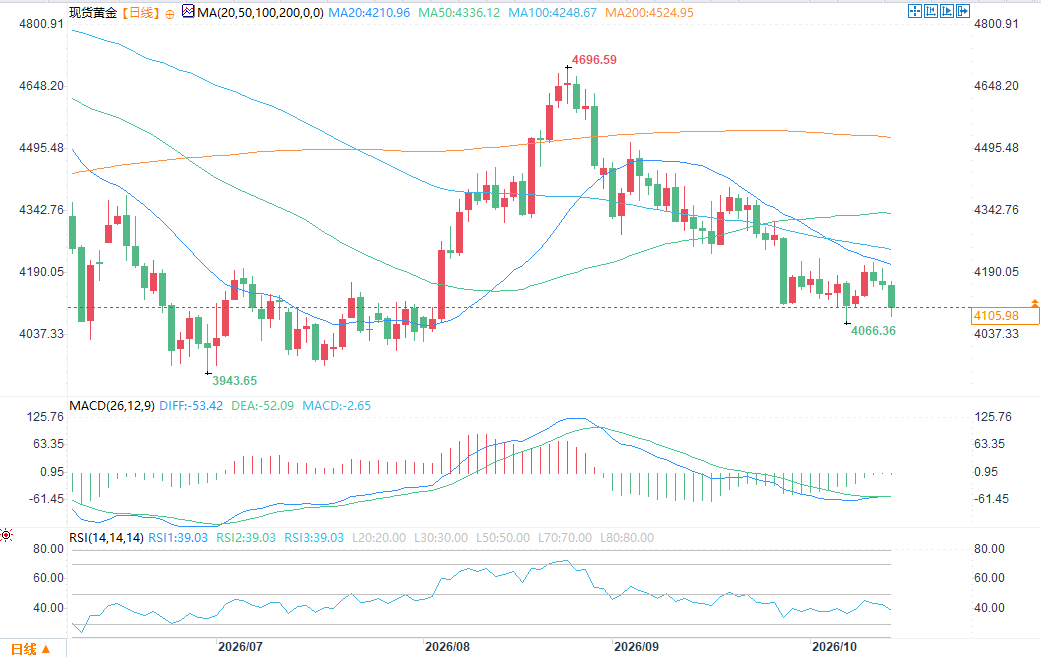 The next upside target for spot gold bulls is to push the price above the $4181.44-$4217.40 resistance zone. A decisive break above this level would target $4253.15, with a further target of $4296.57. The short-term downside target for bears is a break below $4066.54, with deeper support at $4000 and then $3900. First resistance is at $4134.62, followed by $4167.62; first support is at $4100, followed by $4066.54.
 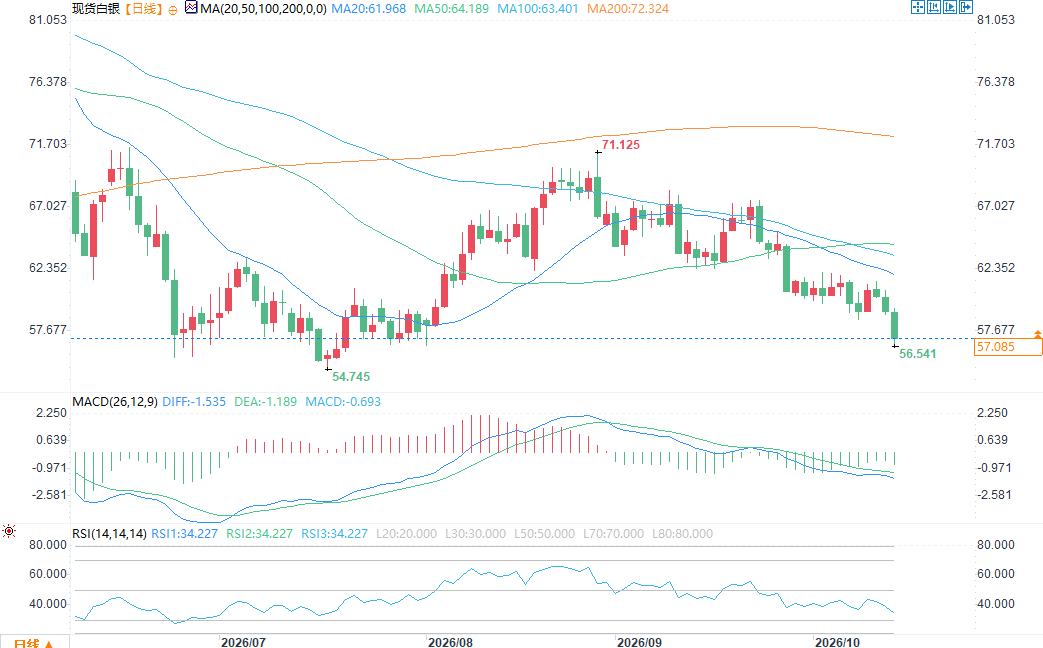 The next upside target for spot silver bulls is to push the price above the $59.830-$61.720 range, with a further target of $62.600 and then $64.090. The downside target for bears is a break below $57.800, with a deeper target of $57.640 and then $56.550. First resistance is at $58.343, followed by $59.541; first support is at $57.800, followed by $57.640.
The U.S. Consumer Price Index (CPI) rose 3.7% year-on-year in September, higher than the market consensus of 3.6%, and up from 3.4% in August. Core CPI rose 0.3% month-on-month and 2.6% year-on-year; gasoline prices surged 9.1% month-on-month, and the energy index climbed 5.2%, indicating that the impact of oil price fluctuations directly translated into overall inflation data. While this inflation report did not yet consider an October rate hike as the market benchmark, it further strengthened market expectations for a December rate hike. Previously, the Fed meeting minutes showed that most officials still expected one more rate hike this year, which the market had already fully priced in. The 10-year Treasury yield traded around 5.2%; the dollar index, although retreating from Monday's 18-month high, remained strong, putting pressure on precious metals. The market will focus on: the Producer Price Index (PPI), retail sales data, initial jobless claims, and the Philadelphia Fed survey released on Thursday; import and export price data will be released on Friday, and Fed Chairman Kevin Warsh will also attend an event related to the International Monetary Fund (IMF). Weak producer prices and sluggish consumer data would lower real interest rates, benefiting gold; conversely, strong PPI or retail sales data would continue to pressure the dollar and US Treasury yields on precious metals. The situation in the Strait of Hormuz and the US-Iran conflict pose direct risks to oil prices and will indirectly pressure the precious metals market through inflation, US Treasury yields, and the dollar. An attack occurred at a Saudi Aramco building in Dhahran, and a container ship sank after hitting a mine in the southern Strait of Hormuz. Another oil tanker and container ship were attacked inside the strait. Iranian officials stated they are using new tactics to attack shipping vessels; the Houthi rebels, allied with Iran, continue to launch missiles and drones at Saudi Arabia. Brent crude oil prices are near $105.82 per barrel, while West Texas Intermediate (WTI) crude is around $95.48, with tight diesel supplies further amplifying inflation risks. From a purely geopolitical perspective, this should have been bullish for gold, but Wednesday's market response was bearish for precious metals: rising crude oil prices reinforced expectations of persistently high inflation, pushing up interest rate hike expectations, while concerns about industrial demand amplified the sell-off in silver. Global risk sentiment was mixed before the US stock market opened. Dow Jones and S&P 500 futures rose slightly; Nasdaq futures fell, chip stocks continued their decline, and investors weighed the earnings reports of major banks. Asian markets were mixed, with mainland China and Hong Kong stocks rising, while markets with a high semiconductor weighting were under pressure. European stocks strengthened slightly, but against the backdrop of higher-than-expected CPI, market focus remained on US Treasury yields, the dollar, and whether inflation data would lead the market to price in more rate hikes in 2027. Other major external markets: New York WTI crude oil rose to $95.48 per barrel; Brent crude oil was around $105.82 per barrel; the benchmark 10-year US Treasury yield was close to 5.308%; the dollar index remained strong after retreating from its previous high. Technical Analysis The next upside target for spot gold bulls is to push the price above the $4181.44-$4217.40 resistance zone. A decisive break above this level would target $4253.15, with a further target of $4296.57. The short-term downside target for bears is a break below $4066.54, with deeper support at $4000 and then $3900. First resistance is at $4134.62, followed by $4167.62; first support is at $4100, followed by $4066.54. The next upside target for spot silver bulls is to push the price above the $59.830-$61.720 range, with a further target of $62.600 and then $64.090. The downside target for bears is a break below $57.800, with a deeper target of $57.640 and then $56.550. First resistance is at $58.343, followed by $59.541; first support is at $57.800, followed by $57.640.
- Risk Warning and Disclaimer
- The market involves risk, and trading may not be suitable for all investors. This article is for reference only and does not constitute personal investment advice, nor does it take into account certain users’ specific investment objectives, financial situation, or other needs. Any investment decisions made based on this information are at your own risk.