Gold Trading Alert: Overheated Inflation Strengthens Interest Rate Hike Expectations, Gold Prices Fall for Three Consecutive Days, Once Again Aiming for the $4,000 Mark?
2026-10-15 07:16:18
Gold prices came under renewed pressure on Wednesday (October 14). Spot gold fell more than 1% in a single day, closing near $4,105 per ounce, marking its third consecutive day of decline. During the session, it briefly dipped to its lowest level since October 7, at $4,073.29 per ounce. This was a confluence of factors: unexpectedly high US inflation data, a rapid shift in Federal Reserve policy expectations, and the coordinated movement of the US dollar and US Treasury yields. Gold, as a traditional safe-haven and inflation-hedging asset, has temporarily lost ground in this round of competition, and its pricing logic is being re-examined. On Thursday (October 15) in early Asian trading, spot gold traded in a narrow range, currently around $4,101.38 per ounce. 
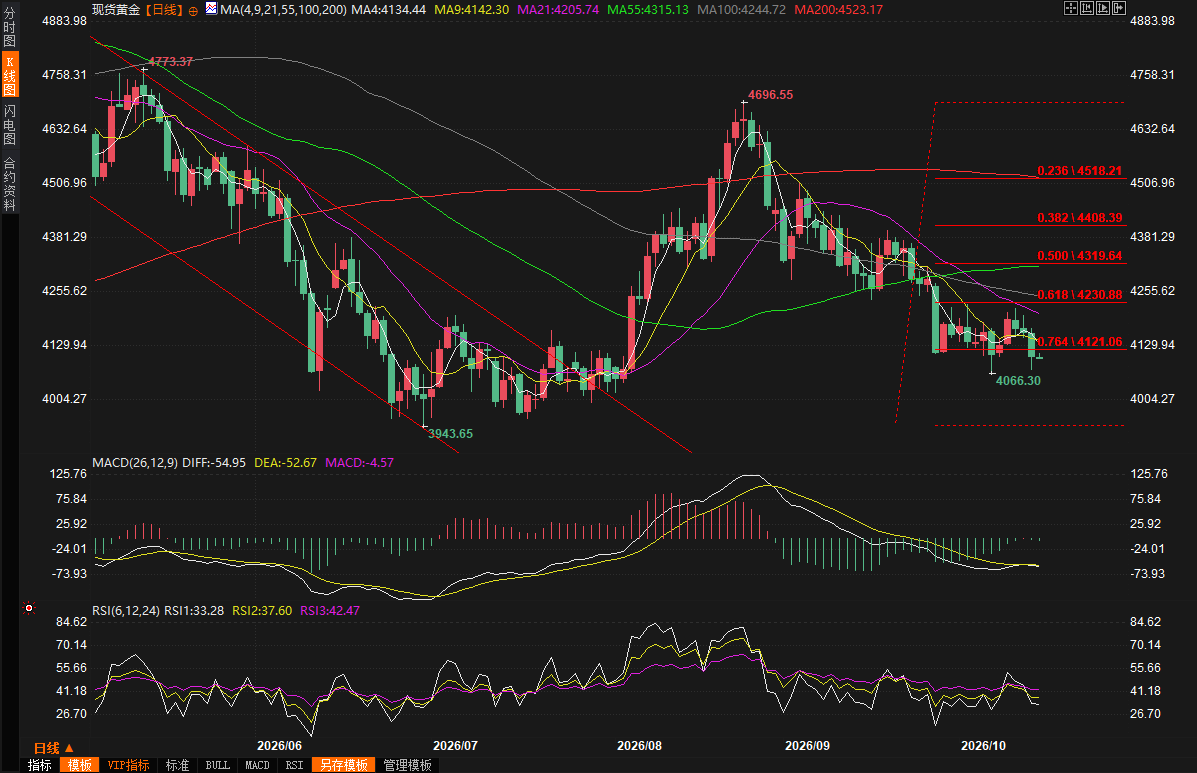 (Spot gold daily chart, source: EasyTrade) At 07:12 Beijing time, spot gold is currently trading at $4101.65 per ounce.
Inflation data exceeded expectations, prompting the market to instantly reassess the Federal Reserve's course of action.
The release of the September U.S. Consumer Price Index (CPI) directly triggered the drop in gold prices that day. Data showed that the CPI rose 0.6% month-on-month, significantly higher than August's 0.4%; the year-on-year increase reached 3.7%, exceeding market expectations of 3.6%. A significant rise in gasoline prices was one of the main drivers, and the overall inflation trajectory once again deviated from the Federal Reserve's long-term target of 2%, showing signs of acceleration rather than cooling. This result quickly changed market pricing in monetary policy. According to the CME FedWatch tool, traders' probability of a Fed rate hike in October rose from about 22% before the data release to around 42%, and although it subsequently fell, it remained significantly higher than before; the probability of a December rate hike was even priced in at around 93%. The market logic is straightforward: if inflation remains stubborn, the Fed will find it difficult to remain inactive, increasing the necessity for further tightening of policy. Gold is extremely sensitive to interest rates—rising real interest rates increase the opportunity cost of holding gold, suppressing its attractiveness. Therefore, when expectations of a rate hike intensify, gold prices naturally come under pressure. Meanwhile, the US dollar index surged to 102.94, a 19-month high, before settling around 102.49, a gain of about 0.3% for the day. The stronger dollar directly increased the cost of dollar-denominated gold for investors in non-US currencies, creating additional selling pressure. The 10-year US Treasury yield also retreated after a rapid rise in the morning, but the overall interest rate environment still posed a resistance to gold. Market participants pointed out that there is a clear tension between current inflation data and the recent "patient" signals from Federal Reserve officials: on one hand, the data suggests continued tightening, while on the other hand, officials emphasize the need to observe the effects of the previous rate hikes. This divergence causes market sentiment to fluctuate repeatedly, with gold becoming the direct carrier of these sentiment swings.The tug-of-war between internal signals from the Federal Reserve and market expectations
The statements from Federal Reserve officials became a key variable in the market sentiment reversal that day. Vice Chairman for Supervision Bowman explicitly stated that the Fed had time to observe the evolution of financial markets and the economy after the September rate hike before deciding whether to take further action. Officials from the New York Fed and other institutions had previously released dovish signals, suggesting that an October rate hike was not inevitable. These comments partially offset the impact of the CPI data, causing a sharp rebound in US Treasury yields in the afternoon. The 10-year yield eventually fell back to around 5.19%, and the 2-year yield also retreated from its intraday high. This "hawkish data, dovish officials" pattern caused a brief period of confusion in the market. On the one hand, inflation remained far above the target and the trend was unfavorable, reinforcing expectations of further rate hikes before the end of the year; on the other hand, officials emphasized policy lags and patience, suggesting that the probability of maintaining the current interest rate in October remained dominant. The gold market therefore exhibited typical "expectation-driven" characteristics: short-term prices were highly sensitive to interest rate expectations; once the probability of a rate hike increased, funds quickly withdrew; while when official signals softened, the decline narrowed. Analysts believe that current gold pricing is highly dependent on the interplay between the Federal Reserve's communication and data; changes in either direction could trigger significant volatility. Notably, the Fed's recent Beige Book indicates that the US labor market remains in a stalemate of "fewer hiring, fewer layoffs," while inflationary pressures have rebounded in some regions. This inherent contradiction of the "dual mandate"—the trade-off between price stability and maximum employment—is the root cause of the market's difficulty in forming a consensus. In this environment, gold cannot fully enjoy its safe-haven premium, nor can it gain sustained support through its anti-inflationary properties; short-term pressure is a natural consequence.Geopolitical and oil price disturbances: Gold's safe-haven properties are partially masked.
In contrast to the decline in gold prices, international oil prices rose on Wednesday. Brent crude futures rose above $106 a barrel, while US crude hit a three-week high. The main driving factor was escalating geopolitical tensions in the Middle East: Houthi attacks on Saudi Aramco headquarters and continued attacks on targets within Saudi Arabia, while Iran announced new tactics for attacking ships, with some vessels already sunk near the Strait of Hormuz. Supply concerns rapidly intensified, providing significant support for oil prices. Rising oil prices typically strengthen inflation expectations through cost increases, theoretically indirectly benefiting gold. However, in the current environment, this logic is suppressed by a stronger dollar and interest rate expectations. The market is more focused on the Federal Reserve's direct response to inflation than on the transmission of commodity prices. While geopolitical risks have escalated, they have not fully translated into safe-haven buying of gold, indicating that the current driving force behind gold prices has shifted from traditional safe-haven demand to expectations of monetary policy. This structural change makes gold more of an "interest rate-sensitive asset" in short-term trading than a pure "safe haven." In the longer term, gold still faces a complex interplay of support and resistance. On the one hand, global geopolitical uncertainties, balance sheet adjustments by major central banks, and concerns about a potential upward shift in the long-term inflation center continue to provide a fundamental support for gold. On the other hand, if the Federal Reserve ultimately chooses to continue raising interest rates in a high-inflation environment, rising real interest rates will continue to suppress the upside potential of gold prices. Investors need to closely monitor subsequent retail sales, initial jobless claims, producer price index, and further statements from Federal Reserve officials, as these data will determine the market pricing direction before and after the October interest rate meeting.Short-term pressure is unlikely to change the long-term logic; the key factor remains policy maneuvering.
In summary, Wednesday's gold price decline was not an isolated event, but a direct result of better-than-expected US inflation data, rapidly rising expectations of interest rate hikes, and a strengthening of the US dollar and US Treasury yields. Spot gold fell to around $4,100 per ounce, hitting a low of $4,073 during the session, reflecting the market's repricing of the short-term interest rate path. Meanwhile, dovish signals from Fed officials and the afternoon decline in US Treasury yields also suggest that the market has not completely abandoned the assessment that the Fed will remain patient. Gold's short-term movement will continue to fluctuate around Fed policy expectations. If subsequent data continues to show persistent inflation and a further increase in the probability of an interest rate hike, gold prices may still face downward pressure, and may even further test the $4,000 support level. Conversely, if officials continue to emphasize policy lags and economic resilience, and the market strengthens its pricing of maintaining interest rates unchanged in October, gold is expected to see a technical rebound, with resistance in the $4,200-$4,230 area to watch. In the long term, gold, as a core asset for hedging currency credit risk and geopolitical uncertainty, has not lost its strategic allocation value due to a single day or a few days of adjustment. The real test lies in whether the Federal Reserve can find a balance between controlling inflation and avoiding excessive tightening. This search for balance will continue to dominate the medium-term rhythm of the gold market. For investors, the focus now should be on the difference between expectations and actual data rather than individual figures. Any misalignment between inflation, employment, official statements, and geopolitical events could alter the pricing weight of gold in the short term. In an environment of continued policy uncertainty, maintaining a sensitive track of interest rate paths may be more important than simply betting on the direction of gold prices. (Spot gold daily chart, source: EasyTrade) At 07:12 Beijing time, spot gold is currently trading at $4101.65 per ounce.
- Risk Warning and Disclaimer
- The market involves risk, and trading may not be suitable for all investors. This article is for reference only and does not constitute personal investment advice, nor does it take into account certain users’ specific investment objectives, financial situation, or other needs. Any investment decisions made based on this information are at your own risk.