Houthi attacks and new Iranian tactics: How geopolitical risk premiums outweigh supply recovery
2026-10-15 07:36:18
On Thursday (October 15) during Asian trading hours, US crude oil futures saw a slight pullback, currently trading below $95 per barrel. Crude oil prices rose on Wednesday after Houthi rebels attacked Saudi Aramco's headquarters in Dhah, and Iran indicated it was deploying new tactics targeting shipping to maintain high oil prices. US crude oil futures briefly rose to $96 per barrel, a three-week high. 
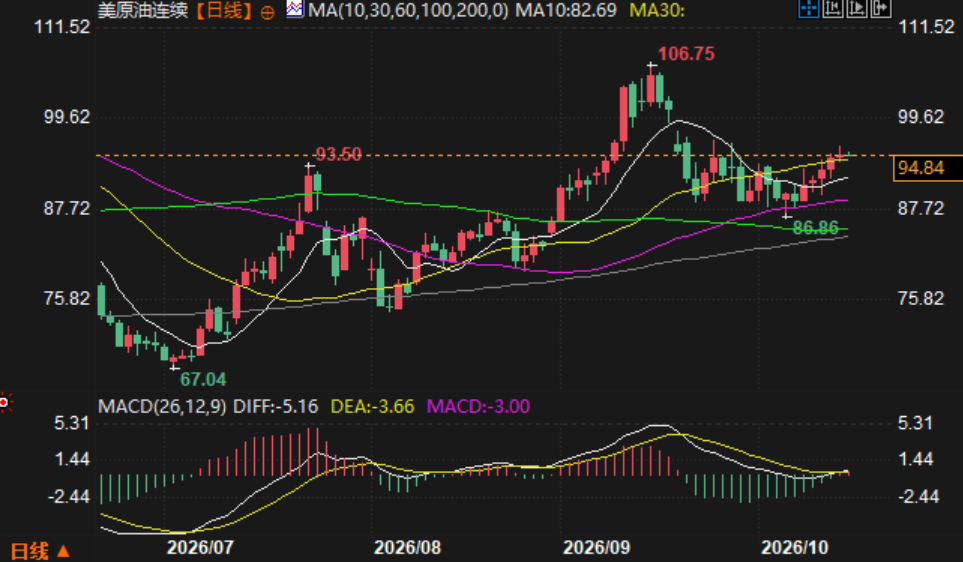 (US crude oil futures daily chart, source: FX678) At 7:29 Beijing time, US crude oil futures were trading at $94.84 per barrel.
Houthi attacks on Aramco offices, Saudi airports attacked four times
The Saudi Energy Ministry stated that Houthi rebels attacked Aramco's administrative building in Dhahran, causing a limited fire. The group has launched ballistic missiles and drones at Saudi Arabia over the past week, claiming it was retaliation for Riyadh's support of the Yemeni government forces. Riyadh International Airport has been attacked four times, with one attack on Saturday killing 13 people. A Yemeni military spokesman said operations against Saudi airports and oil facilities would continue in the coming days and warned shipping companies, civilians, and workers to evacuate these locations. At the heart of this incident is the expansion of the conflict's targets from military facilities to energy infrastructure and civilian aviation facilities. Dhahran is the center of Saudi Arabia's oil industry, and the attack on Aramco's offices signifies that the conflict has reached a core node of Saudi Arabia's energy system. Although the actual damage from this attack was limited, its symbolic significance and the risk of escalation provided direct support for oil prices.Iran's new tactics and attacks on ships in the Strait of Hormuz
At sea, the Iranian Revolutionary Guard Navy stated that a cargo ship carrying 2,500 containers sank south of the Strait of Hormuz after striking a mine and catching fire. The previous day, the UK's Maritime Trade Operations Office reported that a container ship and an oil tanker were hit by unidentified projectiles in the strait. Iran stated it has begun using new tactics against ships, aiming to maintain high oil prices. At the heart of this series of events is the deteriorating shipping security in the Strait of Hormuz, and Iran's new tactics indicate its intention to extend the conflict into the shipping sector. Despite a recovery in Gulf exports, the increasing frequency and severity of ship attacks have kept the market wary of tail risks of supply disruptions. Risk premiums therefore persist, even if actual supply losses are limited.Supply data: Gulf exports have recovered to 75% of pre-war levels, but demand forecasts have been revised downwards.
Supply data provided some hedging. The International Energy Agency (IEA) stated in its October oil market report that crude oil exports from Gulf oil-producing countries increased by approximately 4.4 million barrels per day in September, reaching about 75% of pre-war levels. Separate tracking data showed that Gulf flows, excluding Iran, recovered to over 81% of pre-war levels, led by Saudi Arabia, while Iranian exports plummeted to zero due to US sanctions. Analysts cautioned that more crude reaching the international market does not necessarily mean more crude is being produced, as the partial recovery reflects barrels being moved from regional refineries. The IEA now projects a decline in global oil demand of approximately 2.6 million barrels per day in 2026, slightly deeper than its previous forecast of a 2.5 million barrel decline, due to conflict disruptions and higher prices suppressing consumption. The agency expects global supply to average about 101 million barrels per day this year, a decline of nearly 6 million barrels per day annually. Russian crude oil production rose slightly in September by about 65,000 barrels per day to about 8.4 million barrels per day, but remained nearly 900,000 barrels per day lower than a year ago.Russian diesel may limit price volatility
Russian diesel could also limit price volatility. Last Friday, Trump announced that Russia had agreed to supply diesel to the global market, and his government temporarily lifted US sanctions on Russian diesel. Analysts say the anticipated increase in Russian diesel exports could limit sharp price fluctuations in either direction. This means that the potential improvement in diesel supply could partially offset the risk premium for crude oil, especially if tensions in the refined product market ease.Market focus: US inventory data
Market attention is now focused on U.S. inventory data. Both the American Petroleum Institute's industry data and the Energy Information Administration's official data were delayed by a day due to Monday's federal holiday. The inventory data will provide the market with the latest clues about the domestic supply and demand situation in the U.S. and could influence short-term price direction. A significant drop in inventories could further support oil prices; an increase could partially offset geopolitical risk premiums.Summarize
Houthi rebels attacked Amedaran's offices, Saudi airports were attacked four times, Iran signaled new tactical actions against ships, and a cargo ship sank after striking a mine south of the Strait of Hormuz. International Energy Agency data showed Gulf exports had recovered to about 75% of pre-war levels, but the agency simultaneously lowered its 2026 global oil demand forecast to a decline of approximately 2.6 million barrels per day. Expectations of increased Russian diesel exports may limit price volatility. The core contradiction in the market is that while Gulf exports are recovering, threats to infrastructure and shipping are perpetuating a risk premium. Analysts described Wednesday's trading as primarily driven by fear rather than actual supply losses. The delayed release of US inventory data due to the holiday will provide new clues for short-term direction. For the market, persistently high oil prices keep central banks under inflationary pressure, limiting room for interest rate cuts and putting pressure on the currencies of fuel-importing countries. (US crude oil futures daily chart, source: FX678) At 7:29 Beijing time, US crude oil futures were trading at $94.84 per barrel.
- Risk Warning and Disclaimer
- The market involves risk, and trading may not be suitable for all investors. This article is for reference only and does not constitute personal investment advice, nor does it take into account certain users’ specific investment objectives, financial situation, or other needs. Any investment decisions made based on this information are at your own risk.