US data exceeded expectations across the board, yet the dollar and US Treasury yields declined; strong retail sales figures conceal underlying concerns about consumer spending.
2026-10-15 20:58:18
Multiple US economic data sets were released, collectively exceeding expectations. However, the asset market reaction deviated significantly from the traditional logic of "strong data = rising US dollar and Treasury yields": the US dollar index briefly surged about 12 points to 102.23 before quickly retreating; spot gold briefly fell $13 from $4150 to $4137 before the bulls rallied again; and US Treasury yields declined in tandem. The market did not simply interpret the better-than-expected retail sales, PPI, and CPI figures as "overheating economy, forcing the Fed to aggressively raise interest rates," but rather sought to uncover hidden recession signals behind the data—this is the most crucial characteristic of this market movement. 
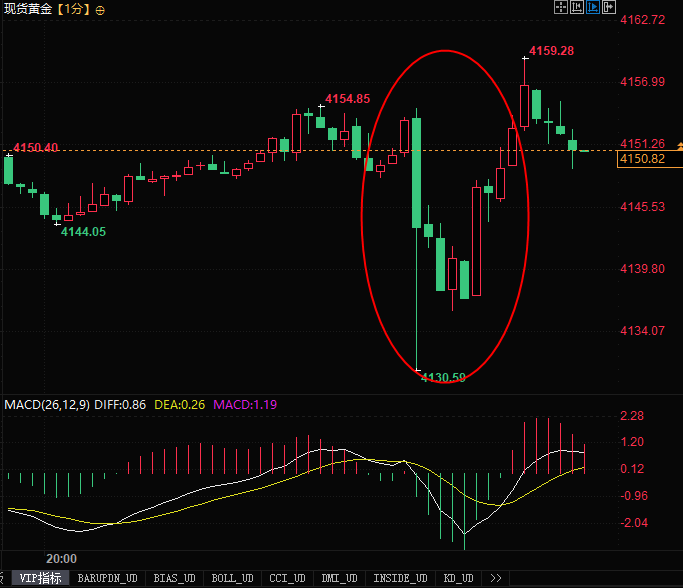 (1-minute chart of spot gold, source: EasyForex)
 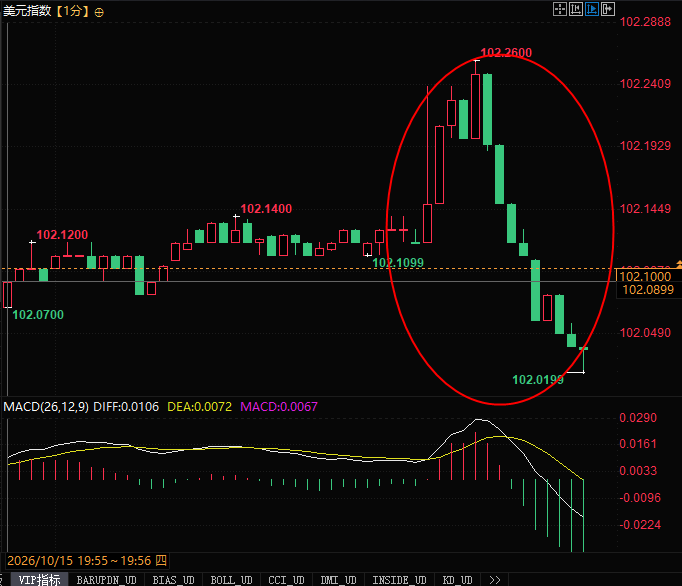 (US Dollar Index 1-minute chart, source: FX678)
Retail sales appeared to exceed expectations, but underlying concerns remain.
US retail sales rose 0.8% month-over-month in August, exceeding the expected 0.3%; core retail sales rose 0.9% month-over-month, also exceeding the expected 0.5%, while remaining unchanged year-over-year at 6.01%, significantly exceeding market expectations. However, many institutions argue that this retail data is not very meaningful: a large part of the nominal retail sales increase is due to the price effect of inflation, not an increase in actual purchase volume. The actual consumption growth rate, after adjusting for inflation, is significantly lower than the nominal growth rate, indicating weak growth in real household consumption. The previous figure was revised downwards, coupled with significantly weak wage data (weekly wages -0.5% month-over-month and -0.1% year-over-year), indicating that income has turned negative. The growth in household spending relies on depleting savings and increasing borrowing, not on income growth. Energy and fuel consumption drive total retail sales; excluding energy, demand in the discretionary consumption sector is weak. In short: nominal retail sales are impressive, but actual consumption is weak, and this resilience is not sustainable in the long term. What the market sees is not a strong economy, but rather residents borrowing money and spending savings to cope with price increases, indicating that the underlying driving force of consumption is weakening. While the data collectively exceeded expectations, the asset reactions deviated significantly from the traditional logic of "strong data = rising US dollar and US Treasury yields": the US dollar index briefly surged about 12 points to reach 102.23 before quickly falling back; spot gold briefly fell $13 from $4150 to $4137 before the bulls rallied again; and US Treasury yields declined in tandem. (1-minute chart of spot gold, source: EasyForex) (US Dollar Index 1-minute chart, source: FX678)PPI shows that inflation in both upstream and downstream sectors rebounded simultaneously: energy was the main driver, while core inflation remained sticky.
The simultaneously released PPI data also significantly exceeded expectations, with PPI rising 6.3% year-on-year, compared to an expected 5.3% and a previous value of 5.4%; core PPI rose 5.0% year-on-year, compared to an expected 4.4% and a previous value of 4.6%. The rebound in upstream industrial product inflation suggests a risk of transmission of downward pressure on downstream consumer goods prices. Combined with the September overall CPI of 3.7% year-on-year (expected 3.6%, previous value 3.4%) and core CPI of 2.6% year-on-year (expected 2.5%, previous value 2.4%), the energy CPI surged to 20.4% year-on-year (previous value 16.9%), becoming the primary driver of overall CPI growth; the housing sub-item CPI, with the highest weighting, remained resilient, continuing to support core inflation, indicating that service sector inflation has not completely subsided. Key point: the source of rising inflation is energy prices (external geopolitical factors), not overheated domestic consumption and labor wages. This energy-driven inflation is unlikely to be effectively curbed by the Fed's interest rate hikes. IV. Signs of Cooling in the Labor Market: Rising Prices and Negative Nominal Income. A clear cooling signal has emerged on the labor market income side: US weekly wages fell 0.5% month-on-month, down from 0.2% previously; year-on-year weekly wages fell to -0.1%, down from 0.3% previously, with both month-on-month and year-on-year wage growth turning negative. Prices are rising, but nominal income is contracting, eroding residents' real purchasing power. This is the most crucial dovish evidence in this data combination. The market believes that declining wages indicate weakening endogenous service inflation momentum. Even if the CPI surges in the short term due to oil prices, the risk of a wage-price spiral has decreased.Data reshapes expectations for Federal Reserve policy, explaining why the dollar and Treasury yields fell instead of rising.
Traditional logic: CPI, PPI, and retail sales all exceed expectations → the Fed must continue aggressive interest rate hikes → the dollar and Treasury yields surge. However, the market's interpretation this time is slightly different. First, the inflation is caused by external energy shocks, not by overheated domestic demand; second, retail sales are artificially inflated due to nominal price increases, while real consumption is weakening; third, wage data has clearly declined, and the risk of a wage spiral has subsided, which is the inflation risk the Fed is most concerned about; finally, San Francisco Fed President Daly stated that further interest rate hikes may be necessary, but there is no need to act immediately in October, indicating a cautious overall stance. Traders judge that the one-off oil price-driven inflation is unlikely to force the Fed to raise interest rates continuously. Domestic demand is gradually weakening, and the risk of a subsequent economic slowdown is more worthy of attention than a short-term inflation rebound. Therefore, after the strong data release, funds traded on the expectation of a "weakening economy," causing Treasury yields to fall, the dollar to rise and then fall, and gold to quickly recover its losses.In summary, the economy is in a complex equilibrium, with data showing a pattern of "superficial strength but underlying weakness."
In summary, the current US economy presents a set of contradictory signals: nominal retail sales, CPI, and PPI figures are impressive, but consumption growth is supported by price increases, savings, and credit, while household wages are declining, indicating insufficient real domestic demand. In the short term, energy prices are pushing up inflation, but the core source of endogenous inflation—wages—has begun to cool. Asset pricing has shifted its focus from "whether inflation will surge" to "when domestic demand will be dragged down by high interest rates and declining incomes." Key areas to watch going forward include: the rate of savings depletion, credit card delinquencies, and whether consumption shows a significant decline in the fourth quarter.- Risk Warning and Disclaimer
- The market involves risk, and trading may not be suitable for all investors. This article is for reference only and does not constitute personal investment advice, nor does it take into account certain users’ specific investment objectives, financial situation, or other needs. Any investment decisions made based on this information are at your own risk.