Bank of England governor says second-round effects are subdued; pound hits two-week high.
2026-10-16 12:04:20
On Friday (October 16) during Asian trading hours, the British pound rose against the US dollar, climbing as much as 0.22% to 1.3304 by 12:00, reaching its highest level since September 30. Behind the currency's rise, the latest remarks from Bank of England Governor Bailey provided new policy clues to the market. Governor Bailey stated on Friday that the second-round effect of rising energy prices appears to have been suppressed so far, but it is too early to judge. He called the above-target UK inflation "extremely frustrating" and stated that Middle East news was the biggest driver of UK government bond yields. These comments were more balanced than Bailey's warnings at the end of September, potentially slightly reducing the market's high pricing of a November rate hike, but not ruling out the possibility. 
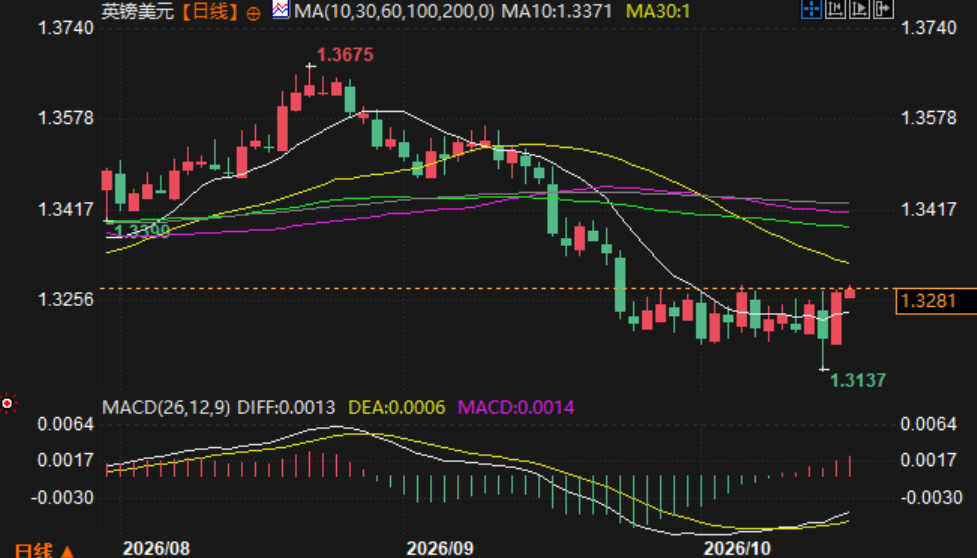 At 12:02 Beijing time, the British pound was trading at 1.3297/98 against the US dollar.
Key takeaway: The second-round effect has been suppressed so far, but it is too early to conclude.
Speaking at the Institute of International Finance's annual meeting in Bangkok, Bailey said evidence regarding the so-called second-round effect has been rather subdued so far. The second-round effect refers to the transmission of higher energy costs to wages and the prices of other goods and services. He added that businesses are emphasizing cost-cutting rather than passing on costs. Meanwhile, Bailey described above-target UK inflation as "extremely frustrating." He stated that the economy has proven more resilient than the central bank expected, but not strong enough, with Middle East news being the biggest driver of UK gilt yields. At the heart of this assessment is that Bailey is not yet convinced that the energy shock is embedded in wage and price settings. This is a key test for a majority of the Monetary Policy Committee members. His frustration with inflation suggests he has little tolerance for prolonged inflation overshooting, and therefore these comments do not explicitly oppose a November rate hike.Market pricing: Bets on a November rate hike are highly concentrated; Bailey's speech was slightly more balanced.
These statements are crucial because market bets on a November 5th rate hike by the Bank of England were quite concentrated. The current interest rate is 3.75%. At its September meeting, the Monetary Policy Committee voted 6-3 to keep rates unchanged, with three members favoring an immediate rate hike, and Bailey voting in the majority. However, at the end of September, he warned that persistently high energy prices would make maintaining the current rate more difficult, a shift in tone that briefly increased expectations of a rate hike. In contrast, Friday's comments were more balanced. Describing the second-round effect as subdued, consistent with the Bank's September assessment, suggests that Bailey is not yet convinced that the energy shock is embedded in wage and price settings. However, this statement did not explicitly oppose a November rate hike.Government Bond Yields and the Middle East: Oil and Gas Prices at the Forefront of UK Interest Rate Outlook
Bailey's views on government bond yields highlight the extent to which UK interest rates now depend on oil and gas prices related to the conflict with Iran. Further increases in energy costs will strengthen the case for tightening, while easing tensions in the Middle East will weaken it. This transmission channel means that developments in the Middle East will directly impact UK government bond yields and interest rate hike expectations via energy prices, thus affecting the pound.Follow-up focus: September inflation data, budget proposal and November policy decisions
The next key events are next week's UK September inflation data, the budget on October 28, and the Bank of England's November policy decision, which will include new forecasts. These events will provide crucial clues to the Bank of England's policy path. Stronger inflation data could reinforce expectations of a November rate hike; weaker data could support Bailey's balanced stance.Summarize
Bailey stated that the effects of the second round of inflation in the UK have been subdued so far, but it is too early to judge. He described above-target inflation as extremely frustrating and indicated that Middle East news is the biggest driver of UK gilt yields. These comments are more balanced than his warnings at the end of September and may slightly reduce the market's high pricing of a November rate hike, but do not rule out the possibility. Bailey's description of the second round of inflation as subdued suggests that he is not yet convinced that the energy shock is embedded in wage and price settings, a key test for a majority of the Monetary Policy Committee. His frustration with inflation indicates that he has little tolerance for inflation exceeding the target over a longer period, so these comments do not explicitly oppose a November rate hike. The situation in the Middle East is directly transmitted to UK gilt yields and rate hike expectations through oil and gas prices, and further increases in energy costs will strengthen the tightening case. Next week's September inflation data, the October 28th budget, and the November policy decision are the next catalysts. At 12:02 Beijing time, the British pound was trading at 1.3297/98 against the US dollar.- Risk Warning and Disclaimer
- The market involves risk, and trading may not be suitable for all investors. This article is for reference only and does not constitute personal investment advice, nor does it take into account certain users’ specific investment objectives, financial situation, or other needs. Any investment decisions made based on this information are at your own risk.