Gold Trading Alert: Gold prices are under slight pressure due to the dual pressures of the US dollar and yields; is the next target $4100?
2026-10-20 07:50:20
On Monday (October 19), spot gold edged lower, closing at $4,140.45 per ounce, a drop of about 0.57%; December gold futures also fell by about 0.5%, closing at $4,160.10. On the surface, this is a direct result of a stronger dollar and rising US Treasury yields, but a deeper logic lies in the fact that geopolitical tensions in the Middle East and Eastern Europe are pushing up oil prices, strengthening expectations of sticky inflation, and thus supporting expectations of further interest rate hikes by the Federal Reserve, while simultaneously increasing the safe-haven appeal of the dollar, ultimately putting multiple pressures on gold, a non-interest-bearing asset. On Tuesday (October 20) in early Asian trading, spot gold continued its weakness, currently trading around $4,135 per ounce, a drop of about 0.12%. Today's trading will continue to focus on geopolitical developments and the performance of US housing market data. 
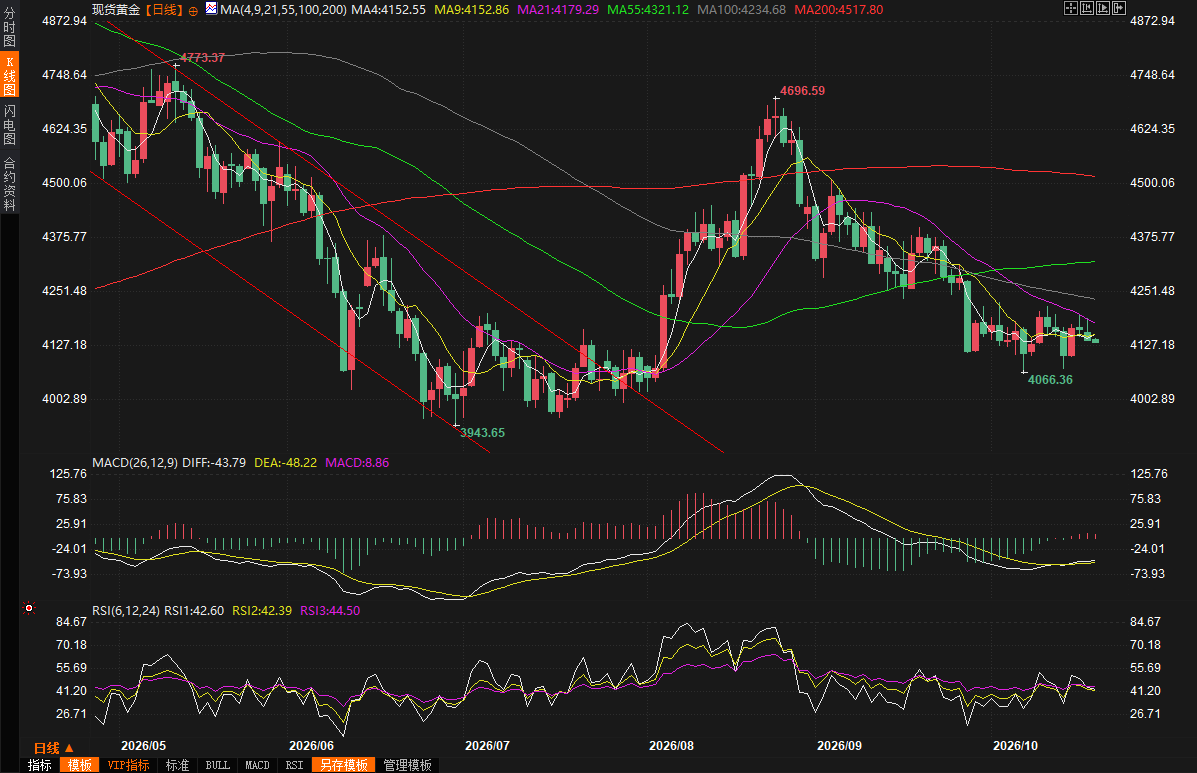 (Spot gold daily chart, source: EasyTrade) At 07:45 Beijing time, spot gold is currently trading at $4135.12 per ounce.
The logic behind the pressure on gold prices is clear: the US dollar is strengthening in tandem with yields.
The US dollar index rose about 0.22% on Monday, approaching the 102 mark. The yield on the 10-year US Treasury note rebounded to around 5.14%, and the yield on the 30-year note rose to around 5.477%. Safe-haven funds that had flowed into US Treasuries due to a sharp sell-off in AI-related stocks returned on Monday after the rebound in AI stocks, causing yields to recover quickly from last week's significant decline. A stronger dollar directly increases the cost of dollar-denominated gold for holders of non-US currencies, while persistently high real yields weaken the relative attractiveness of gold as a non-yielding asset. Market analyst Fawad Razakzada pointed out that market concerns that central banks may have to further tighten policies to control inflation are providing new upward momentum for yields. When yields remain high, investors will reassess whether holding bonds is wiser than holding gold. The Federal Reserve completed its first rate hike of the year in September, raising rates by 25 basis points. The CME FedWatch tool shows that traders believe there is an approximately 82.8% probability of keeping rates unchanged next week, but the probability of a rate hike in December remains close to 90%. The tone of policy guidance is therefore crucial – if next week's decision sends a hawkish signal, gold prices could weaken further in the short term. Ole Hansen, head of commodity strategy at Saxo Bank, points out from a technical perspective that key resistance remains around $4235, while support continues to form below $4100. Currently, prices are trading within this range, and the market is digesting the impact of high interest rates and policy uncertainty. Investors are also awaiting next week's Personal Consumption Expenditures (PCE) data, the Fed's most closely watched inflation indicator, whose results will directly influence the pricing of expectations for a December rate hike.Geopolitical tensions are driving up oil prices and inflation expectations, which in turn reinforces the logic of interest rate hikes and the US dollar.
Contrary to the market's usual narrative that "geopolitical conflicts are good for gold," the current escalation of the situation in the Middle East and Ukraine is indirectly suppressing gold prices through energy price channels. Iran is reportedly intensifying attacks on merchant ships in the Strait of Hormuz, aiming to push up energy prices before the US midterm elections and thus exert political pressure on the Trump administration. Regional officials and diplomats have revealed that Tehran sees the pre-election window as a crucial opportunity to weaken its political position by leveraging rising energy costs. Although the US military is maintaining shipping traffic through fighter jets, drones, and special operations forces, and Hormuz oil exports have at times approached pre-war levels, transportation risks and costs remain high. Analysts estimate that geopolitical premiums are still keeping oil prices about $30 per barrel higher. Oil prices are currently hovering near five-month highs, directly exacerbating concerns about sticky global inflation. Higher energy prices mean it will be more difficult for the Federal Reserve to quickly shift to easing, thus supporting market expectations for further policy tightening. Meanwhile, Russia's large-scale airstrikes on Ukrainian energy facilities have resulted in power outages for over 500,000 households and the implementation of rotating power rationing in many parts of the country, further intensifying energy supply uncertainty. These combined events not only pushed up oil prices but also enhanced the attractiveness of the US dollar as a major global safe-haven currency. When risk sentiment intensifies, funds tend to flow into both US Treasury bonds and the dollar, rather than simply into gold. Francesco Pesole, a foreign exchange strategist at ING, observed that the market has developed a reaction pattern: even if inflation remains high, stock market volatility is enough to weaken expectations of further tightening by the Federal Reserve; however, when geopolitical risks are transmitted to inflation expectations through energy prices, the dollar strengthens due to the dual support of safe-haven demand and expectations of interest rate hikes. This logic puts gold in a dilemma between its traditional safe-haven attributes and the suppression of interest rates and the dollar, making it more susceptible to the latter's dominance in the short term.With the policy window approaching, gold prices may continue to fluctuate amid high interest rates and a strong dollar.
In summary, the current slight pullback in gold prices is not a simple technical adjustment, but rather the result of the combined effects of geopolitical tensions through four channels: oil prices, inflation expectations, the path of interest rate hikes, and the safe-haven demand for the US dollar. The focus of the Fed's meeting next week is not only on whether to raise interest rates, but also on the guidance provided by the statement and dot plot for the subsequent path. If officials adopt a hawkish stance, emphasizing inflation risks and data dependence, gold may test the support level near $4,000. Even if interest rates remain unchanged, if the guidance suggests an increased probability of a December rate hike, gold prices are unlikely to see a significant rebound. Looking at a longer timeframe, gold still benefits from global central bank gold purchases and the long-term inflation hedging logic. However, in the short term, if oil prices remain high due to geopolitical tensions and the safe-haven appeal of the US dollar is strengthened, gold prices will struggle to escape the pressure of yields and exchange rates. Investors need to closely monitor the trend of US Treasury yields, fluctuations in the US dollar index, the shipping safety situation in the Hormuz, and next week's PCE data. These variables will collectively determine the direction of gold prices in the next stage. (Spot gold daily chart, source: EasyTrade) At 07:45 Beijing time, spot gold is currently trading at $4135.12 per ounce.- Risk Warning and Disclaimer
- The market involves risk, and trading may not be suitable for all investors. This article is for reference only and does not constitute personal investment advice, nor does it take into account certain users’ specific investment objectives, financial situation, or other needs. Any investment decisions made based on this information are at your own risk.