Crude oil trading alert: Geopolitical risk premiums and policy-driven price suppression coexist; US crude oil remains range-bound.
2026-10-20 09:22:20
WTI crude oil fell to $96.72 per barrel in Asian trading on Monday, down about 2.3% from Friday's close of $99.04, before stabilizing in the $97-$98 range. It rebounded slightly after the Asian market opened on Tuesday, trading around $98.80 per barrel, while Brent crude also rebounded above $109. Oil prices exhibited a tug-of-war pattern of "rising in overnight trading and falling in Asian trading," with the core contradiction lying in the ongoing struggle between geopolitical risk premiums and policy-driven price suppression.  Geopolitically, shipping risks in the Strait of Hormuz continue to escalate. Iran's Islamic Revolutionary Guard Corps reported that an oil tanker caught fire and exploded in the southern part of the strait last week, and at least 10 attacks on merchant ships have been confirmed since October. Kpler data shows that the average daily crude oil flow in the Gulf region plummeted to approximately 8.5 million barrels last week, far below the previous week's level of over 20 million barrels. However, overall supply resilience remains—US Energy Secretary Wright stated that Persian Gulf oil transportation has recovered to about 80% of pre-war levels, and Saudi Arabia and other countries are maintaining exports through pipelines and alternative routes, meaning there has been no substantial disruption to the overall supply of Middle Eastern crude oil. On the policy front, the Trump administration signed an executive order on Friday exempting key sanctions and tariffs imposed on Russia under the Graham Act, leading to market expectations of potentially increased Russian diesel exports and triggering profit-taking at higher levels. Simultaneously, the US Department of Energy initiated a crude oil swap program, planning to release up to 17 million barrels from strategic reserves between November and January, further calming market sentiment. However, institutions such as DBS Bank and Philip Nova have pointed out that these measures are short-term remedies and cannot fundamentally eliminate the core supply risks in the Middle East. On the fundamental side, global crude oil supply and demand remain in a tight balance. The EIA projects a global crude oil supply deficit of approximately 1.34 million barrels per day in 2026, and the US Strategic Petroleum Reserve has fallen to its lowest level since 1982. This weak inventory buffer amplifies the impact of geopolitical news on prices. On the demand side, China's refinery crude oil processing volume rose slightly for the third consecutive month in September, with strong fuel exports supporting demand. However, the three major institutions continued to lower their 2026 global demand growth forecasts, limiting the directional impact of demand on oil prices. From a technical perspective, WTI crude oil is trading below the $100 mark on the daily chart, with the recent high of $99.34 acting as immediate resistance. Last week, oil prices surged from a low of $89.61 to $99.34, a gain of nearly 10%, before falling back under policy pressure, forming a wide-range, high-level consolidation pattern. Resistance levels are at $99.04, $99.34, and $100. Support levels are at $96.72, $95, and $93-94. If oil prices break through the $100 mark, they could potentially challenge the $102-$105 range; if they fall below $96.72, they could retest the $95 or even $93 level.
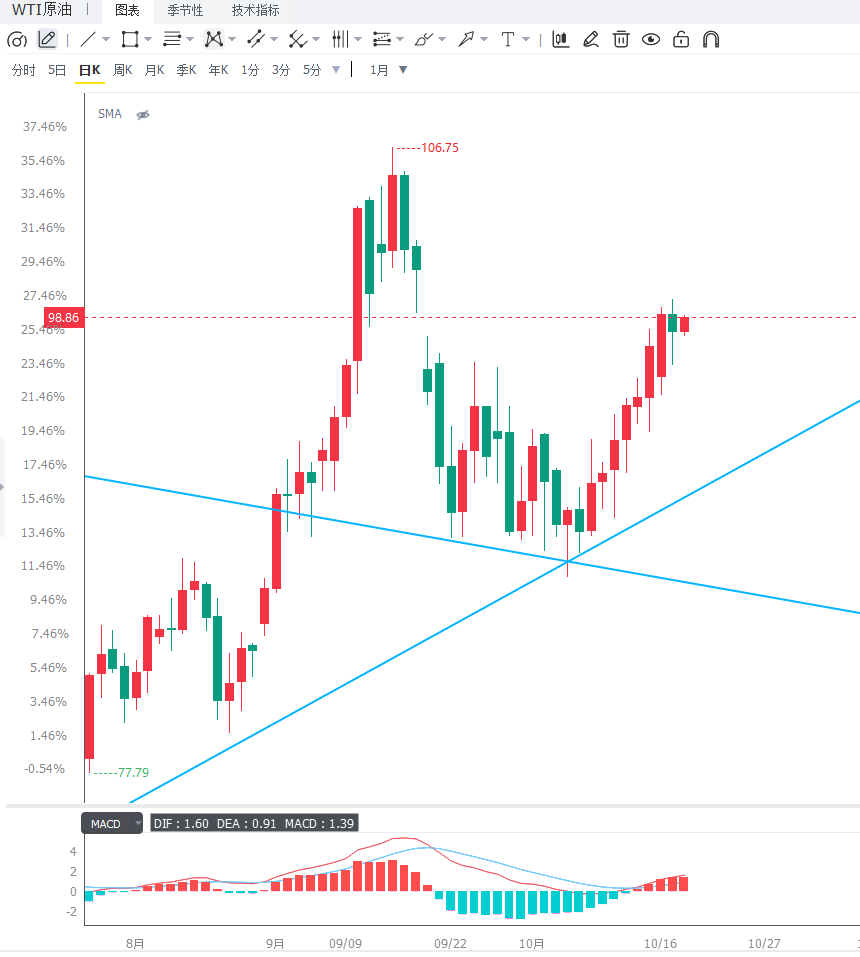 In summary, WTI crude oil is currently caught in a tug-of-war between "geopolitical risk premium" and "policy-driven price suppression." Shipping risks in the Strait of Hormuz continue to provide bottom support, but a combination of US policy measures, including waiving sanctions against Russia and releasing strategic reserves, has effectively suppressed upside potential. Going forward, key factors to watch include the resumption of traffic in the Strait of Hormuz, changes in Russian actual export data, policy signals ahead of the US midterm elections, and EIA inventory data.
Geopolitically, shipping risks in the Strait of Hormuz continue to escalate. Iran's Islamic Revolutionary Guard Corps reported that an oil tanker caught fire and exploded in the southern part of the strait last week, and at least 10 attacks on merchant ships have been confirmed since October. Kpler data shows that the average daily crude oil flow in the Gulf region plummeted to approximately 8.5 million barrels last week, far below the previous week's level of over 20 million barrels. However, overall supply resilience remains—US Energy Secretary Wright stated that Persian Gulf oil transportation has recovered to about 80% of pre-war levels, and Saudi Arabia and other countries are maintaining exports through pipelines and alternative routes, meaning there has been no substantial disruption to the overall supply of Middle Eastern crude oil. On the policy front, the Trump administration signed an executive order on Friday exempting key sanctions and tariffs imposed on Russia under the Graham Act, leading to market expectations of potentially increased Russian diesel exports and triggering profit-taking at higher levels. Simultaneously, the US Department of Energy initiated a crude oil swap program, planning to release up to 17 million barrels from strategic reserves between November and January, further calming market sentiment. However, institutions such as DBS Bank and Philip Nova have pointed out that these measures are short-term remedies and cannot fundamentally eliminate the core supply risks in the Middle East. On the fundamental side, global crude oil supply and demand remain in a tight balance. The EIA projects a global crude oil supply deficit of approximately 1.34 million barrels per day in 2026, and the US Strategic Petroleum Reserve has fallen to its lowest level since 1982. This weak inventory buffer amplifies the impact of geopolitical news on prices. On the demand side, China's refinery crude oil processing volume rose slightly for the third consecutive month in September, with strong fuel exports supporting demand. However, the three major institutions continued to lower their 2026 global demand growth forecasts, limiting the directional impact of demand on oil prices. From a technical perspective, WTI crude oil is trading below the $100 mark on the daily chart, with the recent high of $99.34 acting as immediate resistance. Last week, oil prices surged from a low of $89.61 to $99.34, a gain of nearly 10%, before falling back under policy pressure, forming a wide-range, high-level consolidation pattern. Resistance levels are at $99.04, $99.34, and $100. Support levels are at $96.72, $95, and $93-94. If oil prices break through the $100 mark, they could potentially challenge the $102-$105 range; if they fall below $96.72, they could retest the $95 or even $93 level. In summary, WTI crude oil is currently caught in a tug-of-war between "geopolitical risk premium" and "policy-driven price suppression." Shipping risks in the Strait of Hormuz continue to provide bottom support, but a combination of US policy measures, including waiving sanctions against Russia and releasing strategic reserves, has effectively suppressed upside potential. Going forward, key factors to watch include the resumption of traffic in the Strait of Hormuz, changes in Russian actual export data, policy signals ahead of the US midterm elections, and EIA inventory data.
- Risk Warning and Disclaimer
- The market involves risk, and trading may not be suitable for all investors. This article is for reference only and does not constitute personal investment advice, nor does it take into account certain users’ specific investment objectives, financial situation, or other needs. Any investment decisions made based on this information are at your own risk.