Middle East geopolitical events have significantly boosted risk premiums, pushing US crude oil prices above $100.
2026-10-20 19:02:20
On Tuesday (October 20), during the European trading session, international crude oil futures prices rose, with West Texas Intermediate (WTI) crude oil rising above $100 per barrel to $100.74 per barrel, while Brent crude oil hit a five-month high of $111.52 per barrel.  Last night, Israeli Prime Minister Benjamin Netanyahu announced that he had issued orders to the Israel Defense Forces, Mossad (Israel's intelligence and secret service), and the IDF to overthrow the Iranian regime. Netanyahu mentioned US President Trump's public support, stating that Trump's position was very clear: the primary task is to completely eliminate the existential threat posed by Iran to Israel. This geopolitical event significantly increased the risk premium in the Middle East, coupled with continued attacks on shipping in the Red Sea and the Persian Gulf, drastically escalating the risk of oil supply disruptions. In the past two weeks, at least 18 ships have been attacked, and the security risks of Persian Gulf shipping continue to be a core driver of oil prices. The Houthi rebels in Yemen claimed responsibility for a new round of attacks on Saudi energy facilities, airports, and military targets, including the Yanbu Aramco oil field and Riyadh International Airport. These successive attacks have exacerbated regional instability concerns, and the significant geopolitical uncertainty brought about by Israel's order to overthrow the Iranian regime continues to support oil prices above $100. Market expectations of a decline in US crude oil inventories last week may further support oil prices. Meanwhile, the Trump administration's energy-related sanctions and tariffs against Russia remain uncertain, and the rules governing penalties for purchasing Russian crude oil are subject to change, adding uncertainty to the global oil supply outlook. US Secretary of State Rubio stated that officials need more time to assess the situation before a final decision can be made. Theoretically, the possibility of increased Russian oil supply could alleviate market pressure, but at this stage, the market's primary focus remains on the broader Persian Gulf region and the potential risk of further supply disruptions following Israel's hardline stance on Iran. Technical Analysis
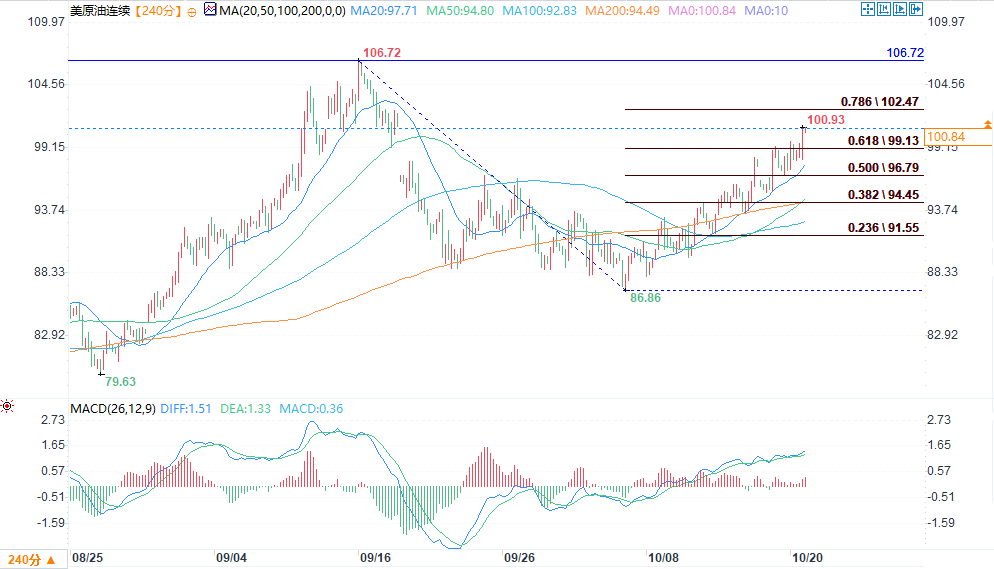 (WTI Crude Oil 4-Hour Chart Source: EasyForex) WTI crude oil is currently in a strong upward trend on the 4-hour chart, rebounding from a low of 86.86 and steadily rising along multiple moving averages. The current price of 100.84 is above the MA20, MA50, MA100, and MA200, with short-term moving averages in a bullish alignment, forming strong support. The price touched 100.93, approaching the 0.618 Fibonacci resistance level of 99.13. The next key resistance is at the 0.786 level of 102.47, with strong resistance at the previous high of 106.72. The Fibonacci support zones for this upward move are 0.500 (96.79) and 0.382 (94.45). In terms of indicators, the MACD DIFF remains above the DEA, with the red bars continuing, indicating continued bullish momentum. However, the narrowing gap between the DIFF and DEA suggests a potential weakening of short-term bullish strength. The 4-hour chart shows a continued price increase, but indicators have not expanded significantly in tandem, suggesting a slight potential top divergence and a possible short-term pullback during the upward surge. If a pullback occurs, the area around 96.79 will be a crucial support/resistance level, coinciding with moving average support. Overall, oil prices are slightly bullish in the short term due to geopolitical news, but face significant resistance above. A sustained move above 102.47 would allow bulls to challenge the previous high of 106.72; however, failure to break through this level would likely result in a pullback to test support around 96.79. Chasing the price higher is not advisable; it's better to wait for a pullback to support before considering long positions. A break below 94.45 would invalidate the current rebound structure and weaken the trend.
Last night, Israeli Prime Minister Benjamin Netanyahu announced that he had issued orders to the Israel Defense Forces, Mossad (Israel's intelligence and secret service), and the IDF to overthrow the Iranian regime. Netanyahu mentioned US President Trump's public support, stating that Trump's position was very clear: the primary task is to completely eliminate the existential threat posed by Iran to Israel. This geopolitical event significantly increased the risk premium in the Middle East, coupled with continued attacks on shipping in the Red Sea and the Persian Gulf, drastically escalating the risk of oil supply disruptions. In the past two weeks, at least 18 ships have been attacked, and the security risks of Persian Gulf shipping continue to be a core driver of oil prices. The Houthi rebels in Yemen claimed responsibility for a new round of attacks on Saudi energy facilities, airports, and military targets, including the Yanbu Aramco oil field and Riyadh International Airport. These successive attacks have exacerbated regional instability concerns, and the significant geopolitical uncertainty brought about by Israel's order to overthrow the Iranian regime continues to support oil prices above $100. Market expectations of a decline in US crude oil inventories last week may further support oil prices. Meanwhile, the Trump administration's energy-related sanctions and tariffs against Russia remain uncertain, and the rules governing penalties for purchasing Russian crude oil are subject to change, adding uncertainty to the global oil supply outlook. US Secretary of State Rubio stated that officials need more time to assess the situation before a final decision can be made. Theoretically, the possibility of increased Russian oil supply could alleviate market pressure, but at this stage, the market's primary focus remains on the broader Persian Gulf region and the potential risk of further supply disruptions following Israel's hardline stance on Iran. Technical Analysis (WTI Crude Oil 4-Hour Chart Source: EasyForex) WTI crude oil is currently in a strong upward trend on the 4-hour chart, rebounding from a low of 86.86 and steadily rising along multiple moving averages. The current price of 100.84 is above the MA20, MA50, MA100, and MA200, with short-term moving averages in a bullish alignment, forming strong support. The price touched 100.93, approaching the 0.618 Fibonacci resistance level of 99.13. The next key resistance is at the 0.786 level of 102.47, with strong resistance at the previous high of 106.72. The Fibonacci support zones for this upward move are 0.500 (96.79) and 0.382 (94.45). In terms of indicators, the MACD DIFF remains above the DEA, with the red bars continuing, indicating continued bullish momentum. However, the narrowing gap between the DIFF and DEA suggests a potential weakening of short-term bullish strength. The 4-hour chart shows a continued price increase, but indicators have not expanded significantly in tandem, suggesting a slight potential top divergence and a possible short-term pullback during the upward surge. If a pullback occurs, the area around 96.79 will be a crucial support/resistance level, coinciding with moving average support. Overall, oil prices are slightly bullish in the short term due to geopolitical news, but face significant resistance above. A sustained move above 102.47 would allow bulls to challenge the previous high of 106.72; however, failure to break through this level would likely result in a pullback to test support around 96.79. Chasing the price higher is not advisable; it's better to wait for a pullback to support before considering long positions. A break below 94.45 would invalidate the current rebound structure and weaken the trend.
- Risk Warning and Disclaimer
- The market involves risk, and trading may not be suitable for all investors. This article is for reference only and does not constitute personal investment advice, nor does it take into account certain users’ specific investment objectives, financial situation, or other needs. Any investment decisions made based on this information are at your own risk.