With the 21 basis point interest rate hike now priced in, can the Canadian dollar maintain its rebound?
2026-10-20 20:32:27
On Tuesday, October 20th, the USD/CAD exchange rate fell back to around 1.405, continuing the Canadian dollar's rebound. It had previously reached a high of around 1.4300 on October 14th. The Bank of Canada's interest rate expectations have been significantly repriced, with the market pricing in a rate hike of approximately 21 basis points at the October 28th policy meeting, a significant increase from 9 basis points at the end of last week. This change was driven by revised forecasts from the three major Canadian banks and the latest business and consumer outlook survey showing rising long-term household inflation expectations. Although Canadian employment data showed a sharp decline for the second consecutive month in September, with a loss of 68,000 jobs and the unemployment rate rising to 6.5%, forward-looking inflation risks continue to dominate market pricing. The September consumer price index rose to 3.1% year-on-year, with core indicators showing some easing. 
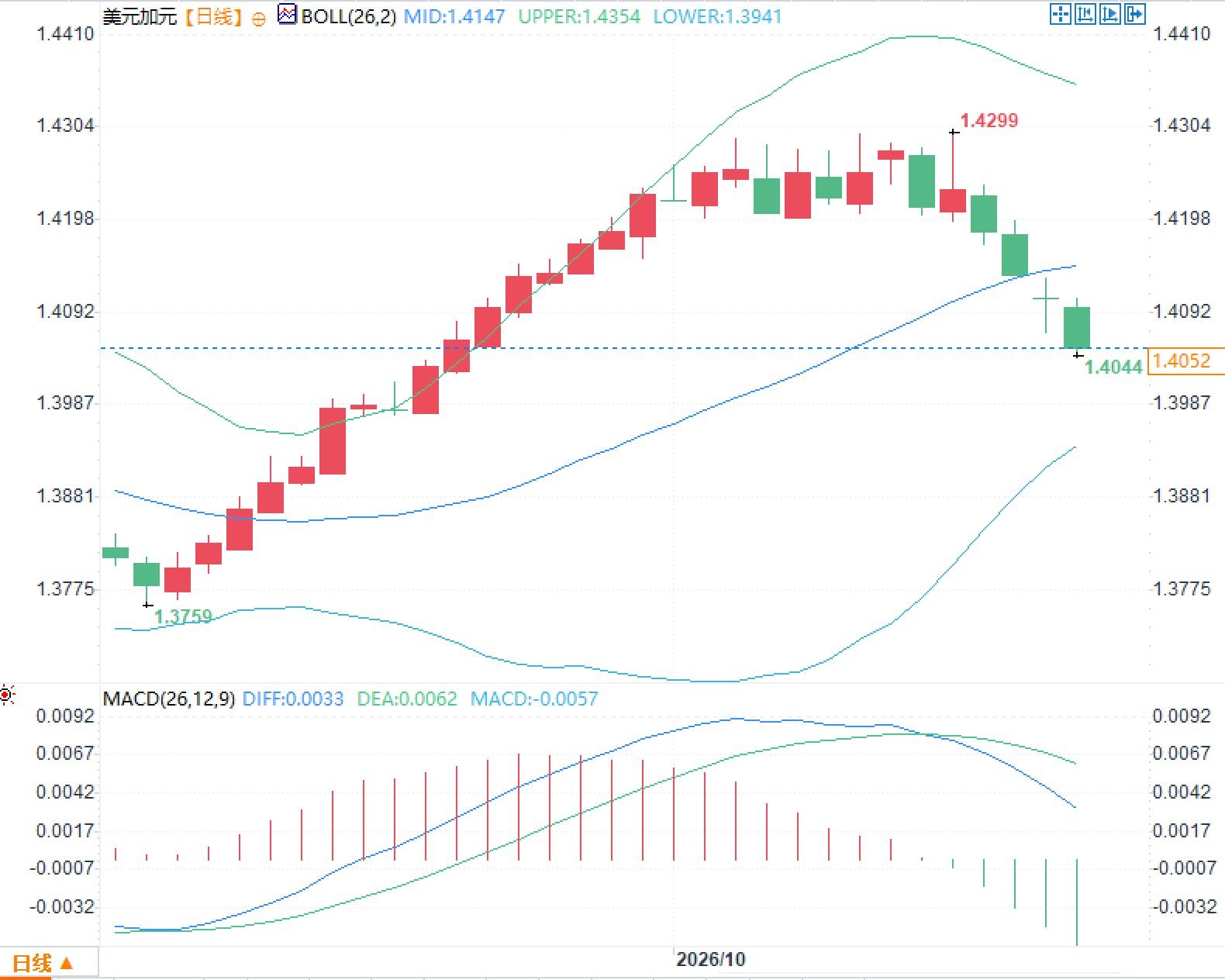 Regarding the USD/CAD exchange rate, the daily chart shows that the price is below the middle Bollinger Band (approximately 1.4147). In the MACD indicator, DIFF and DEA are still positive, but the histogram has turned negative.
Bank of Canada policy expectation repricing
The Bank of Canada's overnight target rate remains unchanged at 2.25%, having held steady for several consecutive periods since the October 2025 rate cut. The market's pricing in next week's meeting is close to a full 25 basis point rate hike. Three major Canadian banks have adjusted their interest rate forecasts this week, now anticipating a rate hike next week. This shift is supported by the Bank of Canada's latest Business and Consumer Outlook Survey. The survey shows that long-term household inflation expectations have risen and are converging with short-term expectations. Consumers cite trade tensions and energy prices as major sources of inflation. The Business Outlook Survey also shows that business inflation expectations have increased, and more businesses plan to pass on higher input costs to customers. The Bank of Canada has recently signaled a closer approach to a rate hike. If policymakers focus more on forward-looking inflation risk indicators, and the market maintains a high probability of a rate hike, the likelihood of policy tightening increases. A rate hike could further fuel discussions about a December rate hike.The tradeoff between inflation data and the job market
Canada's Consumer Price Index (CPI) rose 3.1% year-on-year in September, up from 3.0% in August, primarily driven by energy prices, with gasoline prices rising 27.8% year-on-year. Excluding gasoline, the increase slowed to 2.2%. The Bank of Canada's preferred core indicators (trimmed mean and weighted median) averaged around 1.85%, a slight decrease from the previous period. This indicates that overall inflation was significantly impacted by energy shocks, but core pressures were relatively mild. On the other hand, the labor market continued to weaken. Job losses reached 68,000 in September, following 42,000 in August, and the unemployment rate rose to 6.5%. Losses were concentrated in the public sector, education services, and healthcare, with a particularly pronounced decline in youth employment. Private sector employment remained relatively stable. This trade-off between growth and inflation risks leaves the policy path uncertain. If the Bank of Canada prioritizes rising long-term inflation expectations, it may prioritize addressing its price stability target; if it focuses more on recent weak employment and growth, it may continue to observe the market. Market pricing has already reflected higher expectations for interest rate hikes, but the data stream has not yet formed a one-sided conclusion.The linkage between exchange rate and interest rate markets
The USD/CAD pair has retreated from its high near 1.4300 and is currently trading around 1.405. The strengthening of the Canadian dollar is directly related to the repricing in the Canadian interest rate market. Short-term interest rate futures are pricing in a 25 basis point rate hike next week, rising from about 9 basis points last week to about 21 basis points, reflecting a reassessment of the policy path. Canadian government bond yields have adjusted accordingly, with changes in term spreads reflecting a rebalancing of inflation and growth prospects. Regarding the USD/CAD exchange rate, the daily chart shows that the price is below the middle Bollinger Band (approximately 1.4147). In the MACD indicator, DIFF and DEA are still positive, but the histogram has turned negative.Multiple Policy Paths and Market Pricing
The market is currently pricing in a near-full rate hike at the October 28 meeting, but the Bank of Canada still faces data discrepancies. If policymakers determine that rising long-term inflation expectations pose a risk and believe that energy price shocks may transmit to broader prices, the probability of a rate hike increases. After a rate hike, the market may further discuss the possibility of another move in December, which would provide additional support for the Canadian dollar. Conversely, if continued job losses and growth uncertainty are given greater weight, the scenario of keeping rates unchanged remains valid. A decline in core inflation indicators provides some room for the latter. Regardless of the final decision, the descriptions of the inflation path and output gap in the policy statement and economic outlook report will determine subsequent market pricing. The Canadian dollar exchange rate has already partially reflected the repricing of rate hike expectations; subsequent volatility will depend on whether the actual decision and statement wording are consistent with current market pricing. Changes in global energy prices and the trade environment remain key external variables affecting the Canadian inflation outlook.Frequently Asked Questions
Question 1: Why might the Bank of Canada consider raising interest rates given the weak employment situation? Answer: Although employment declined for the second consecutive month in September, the latest surveys show rising long-term household inflation expectations, and businesses are also planning to pass on costs. If policymakers prioritize forward-looking inflation risks over current employment data, a rate hike may still be discussed. Question 2: What impact will Canada's September inflation data have on the policy path? Answer: Overall CPI rose to 3.1%, mainly driven by energy, while core indicators declined. This indicates that the energy shock dominates overall inflation, but core pressures are relatively mild, providing room for policy trade-offs. Question 3: How are current market pricing and major bank forecasts reflected? Answer: The interest rate market is pricing in a rate hike of about 21 basis points next week, and the three major Canadian banks have adjusted their forecasts to anticipate a rate hike. This reflects that surveys and changes in signals have driven a repricing of expectations, but ultimately it still depends on the actual decision.- Risk Warning and Disclaimer
- The market involves risk, and trading may not be suitable for all investors. This article is for reference only and does not constitute personal investment advice, nor does it take into account certain users’ specific investment objectives, financial situation, or other needs. Any investment decisions made based on this information are at your own risk.