French bond yields hit 24-year high! Euro hangs in the balance with French budget.
2026-10-21 20:40:20
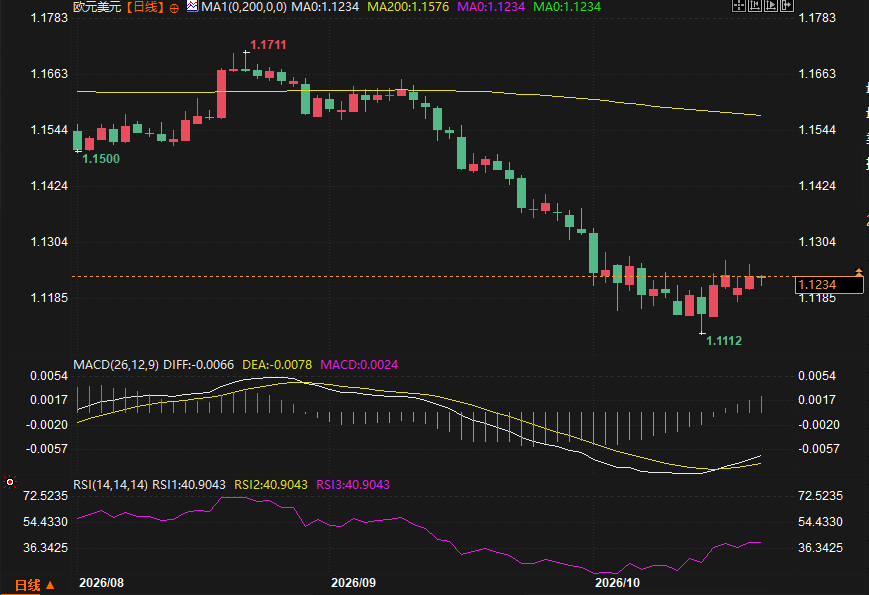
On Wednesday (October 21), the euro traded around 1.1234 against the US dollar, having dipped as low as 1.1112 before recovering slightly. The real driver of the day's market movement came from the French bond market: the yield on 10-year French government bonds briefly rose above 5% in the morning, the first time since 2002; the Franco-German 10-year yield spread approached 160 basis points , returning to levels seen during the Eurozone debt crisis. The pricing logic in the bond market is straightforward—the weekend's social unrest, Moody's review of France's Aa3 rating later this week, and the deadlock on the 2027 budget—these three factors combined are causing the market to reprice French sovereign risk. As the common currency of 18 member states, the euro naturally carries this risk premium, directly reflected in the repeated breaches of the 1.12 level on the daily chart. 
Fundamental Analysis: From French Bond Yield Spreads to Euro Risk Reassessment
The chain of events deserves careful analysis. First, Interior Minister Núñez admitted that police had briefly lost control in some major urban areas, forcing the Macron government to reject his resignation and significantly increasing political costs. Second, the fiscal situation continues to deteriorate: France's deficit ratio has risen to 5.4% of GDP this year, and public debt has reached 119% , the highest since 1946, and the country has not achieved budget balance since 1974. Third, the rating review is approaching, and Moody's outlook is already negative; any downgrade could trigger a sell-off. According to the assessment framework of Ruimi, a senior economist at a major German investment bank, France is the most vulnerable economy among the eighteen Eurozone countries in terms of public finance, external balance, private debt, bank resilience, and the labor market; Ireland, Greece, and Portugal have shown significant improvement since 2010, while France, Belgium, and Finland have declined. Strategist Sil, from another major US bank, bluntly stated that the OAT-Bund spread has entered uncharted territory , the weekend riots have further complicated budget negotiations, and foreign investors are withdrawing from French government bonds. Based on this analysis, the conclusion is not complicated: if France fails to implement fiscal consolidation, the epicenter of the second Eurozone crisis will most likely fall in Paris, and the risk premium of the euro will systematically increase.Technical Analysis: The Tug-of-War Between Trend Resistance and Oversold Correction
Turning to the chart. Reference contract: EUR/USD daily chart, August to October 2026. Range logic: Since the high of 1.1711 in mid-September, the price has been trading below the 200-day moving average (MA200) (1.1576) for over a month, indicating a complete medium-term downtrend. The 1.1112 level forms the October low, and in the short term, the price has shown signs of flattening after three tests of the 1.1185-1.1234 range. Regarding the MACD, the DIFF is at -0.0066, the DEA is at -0.0078, and the histogram is at 0.0024. The green bars are narrowing and approaching the zero line, indicating weakening downward momentum. The RSI is at 40.9 , having moved away from oversold conditions but far from strengthening, a typical weak consolidation reading. Key points to watch during the session: First, whether the 1.1185 level can be held; if it is breached, the next target is the previous low of 1.1112. Second, the 1.1304 level is a dense area of short-term moving averages; whether it can be recovered will determine the level of the rebound. Third, if the spread between French and French bonds widens again around the time Moody's review results are announced this week, intraday volatility will increase significantly, and long lower shadows and gap patterns should be watched out for.Market Outlook
In the short term, exchange rate pricing power remains in the hands of French bond yield spreads. If the budget makes procedural progress this week and the rating review is finalized as "maintained but reiterated negative," the euro may recover to the 1.1304-1.1440 range; conversely, if the unrest continues and yield spreads break through previous highs, a test of the previous low of 1.1112 will be unavoidable. Until the French fiscal path becomes clear, any rebound should be viewed as a technical correction within a weak market environment.Further Reading
Q: Why is the French 10-year bond yield an anchor for the euro? A: It serves as a pricing benchmark for sovereign risk in the Eurozone. A rise in yields means an increase in the implied credit cost of the common currency, and capital outflows directly suppress the euro. Q: What does a 160 basis point Franco-German interest rate differential mean? A: This level was last seen during the Eurozone debt crisis, indicating that the market demands additional sovereign risk compensation for France's solvency. Q: Why is the Moody's review crucial? A: France already has a negative outlook; a downward revision would increase government financing costs and could trigger passive selling by agencies tracking the rating. Q: How does social unrest affect exchange rates? A: Unrest weakens the government's political space to implement spending cuts, and the expectation of fiscal consolidation fails to materialize. The risk premium is transmitted to the euro through the bond market.- Risk Warning and Disclaimer
- The market involves risk, and trading may not be suitable for all investors. This article is for reference only and does not constitute personal investment advice, nor does it take into account certain users’ specific investment objectives, financial situation, or other needs. Any investment decisions made based on this information are at your own risk.