The US dollar fell slightly against the Japanese yen, with a December rate hike by the Bank of Japan becoming an overwhelming consensus.
2026-10-22 12:14:21
The US dollar edged lower against the Japanese yen during Asian trading hours on Thursday (October 22), currently trading around 157.65. The latest consensus in a Bank of Japan survey regarding a December rate hike is providing new policy clues for the yen's medium-term trajectory. A survey by a prominent media outlet shows that over 80% of Bank of Japan observers expect the next rate hike to occur in December, with no one predicting action at the meeting ending on October 30. 
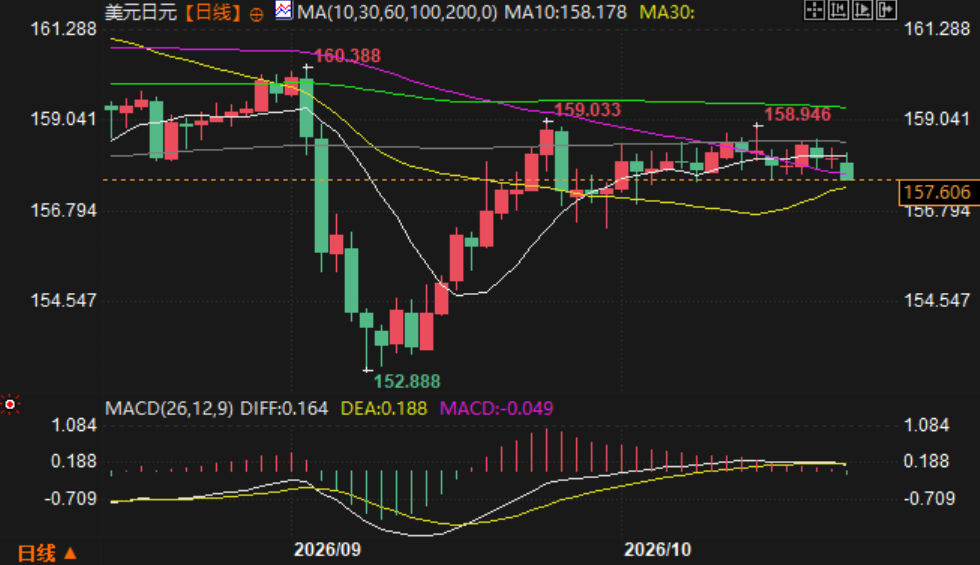 (USD/JPY daily chart, source: EasyForex) At 12:13 Beijing time, USD/JPY was trading at 157.64/65.
Key survey findings: 83% expect a rate hike in December, no one expects one in October.
Approximately 83% of economists expect the Bank of Japan (BOJ) to raise borrowing costs from 1.25% at its meeting ending December 18, a significant increase from 35% in the previous month's survey, when January was the most popular option. No one predicts action at the meeting ending October 30. Two-thirds of respondents also expect the BOJ to raise interest rates every three months, up from 46% previously. The key to this finding is that December has become the most likely window for the BOJ's next move, with no one expecting action in October. Market consensus has become significantly more concentrated, shifting from a dispersed state a month ago to a clear expectation in December. The median peak interest rate forecast remains at 1.75%, indicating that economists' assessment of the end of the tightening cycle remains stable.October meeting focus: Whether to announce potential inflation reaching 2%
Many economists say the main focus of this month's meeting will be whether the Bank of Japan concludes that underlying inflation has reached its 2% target—a conclusion it hasn't made since setting the target in 2013. Economists from prominent institutions expect the Bank of Japan to signal underlying inflation is around 2% and adopt a hawkish stance to maintain interest rates. Economists anticipate the quarterly outlook report, to be released alongside the decision, will largely maintain its inflation forecast, with only a slight upward revision for the next fiscal year. While the October meeting is likely to remain on hold, it could release a historic signal by announcing that underlying inflation has met its target, which would strengthen expectations of a December rate hike and support the yen, pushing up Japanese government bond yields.Policy Background: September interest rate hikes bring interest rates into the neutral range
The September rate hike brought the policy rate into the Bank of Japan's estimated neutral range of 1.1% to 2.5% for the first time, increasing market interest in how high rates will ultimately rise. The Bank of Japan's policy rate has entered the neutral range, meaning that policy is no longer explicitly easing, but is still some distance from restrictive levels. Market focus has increased on the terminal interest rate, with the median peak rate forecast of 1.75% becoming a key indicator for gauging the scope for tightening.Political factors: The government's stance has softened somewhat, but the committee vote remains the focus.
Political factors remain significant. Prime Minister Sanae Takaichi is known for her support of monetary easing, but after US Treasury Secretary Bessenter urged Japan to abandon its reflation policy, Takaichi and her cabinet members stated they were not pursuing reflation. Approximately two-thirds of surveyed economists now believe the government's stance on central bank interest rate hikes has softened. Strategists at prominent institutions suggest the Prime Minister's office may not welcome further rate hikes but may temporarily acquiesce, primarily due to relations with the US. Committee votes are also under scrutiny. The September rate hike was opposed by two Takaichi-appointed members, weakening the yen. Some economists believe hawkish member Hajime Takada may push for consecutive rate hikes at this month's meeting.Market Implications: The direction of the yen depends on the tone of the statement and the voting differences.
With all surveyed economists ruling out action on October 30, the yen's direction will depend more on the tone of the Bank of Japan's statement and outlook report. An announcement that underlying inflation has reached 2% would mark a historic shift and strengthen expectations of a December rate hike, potentially supporting the yen and pushing up Japanese government bond yields. The committee vote is another swing factor: further dissent from appointed committee members could weigh on the yen, while calls for a rate hike from hawkish members would have the opposite effect. Oil prices remain a key factor influencing Japan's inflation outlook. As a major energy importer, any escalation in the Middle East pushing up oil prices would strengthen the case for a stable quarterly rate hike, while also weighing on Japan's trade balance and the yen.Institutional Views
Goldman Sachs has significantly lowered its 12-month target for USD/JPY to 150 (around October 2027), with a 3-month target of 158 and a 6-month target of 155. The bank recently shifted to a structurally bullish stance on the yen, believing that domestic policies that have suppressed the yen over the past 10-15 years are becoming more supportive. The Bank of Japan has accelerated its pace of interest rate hikes, and the government is also encouraging domestic investors to repatriate funds to domestic assets. Goldman Sachs points out that higher Japanese interest rates enhance the attractiveness of domestic assets, and coupled with potential capital repatriation and intervention risks, the yen has a basis for appreciation. However, Japanese investors are still purchasing large amounts of overseas assets, which may slow the yen's recovery. Westpac expects USD/JPY to fall back to 156 in December 2026 and further to 151 in December 2027, implying a steady appreciation of the yen over the next year. The bank believes that Japanese inflation data will continue to test the rationale for further interest rate hikes by the central bank, while the expectation that US interest rates will remain unchanged throughout 2027 means that the yen's appreciation path is not entirely dependent on significant easing by the Federal Reserve. Westpac points out that at the current exchange rate level, the yen's recovery is more due to the normalization of domestic policies in Japan than simply a shift in US policy.Summarize
A survey shows that 83% of economists expect the Bank of Japan (BOJ) to raise interest rates in December, a significant increase from 35% last month, with no one expecting action at the October 30 meeting. Two-thirds of respondents expect the BOJ to raise rates every three months, with the median peak rate forecast remaining at 1.75%. The main focus of the October meeting is whether the BOJ will announce that underlying inflation has reached its 2% target—something it hasn't done since 2013. Leading institutions expect the BOJ to signal that underlying inflation is around 2% and adopt a hawkish stance to maintain interest rates. The September rate hike brought the policy rate into the neutral range for the first time, increasing market attention to the final interest rate. On the political front, about two-thirds of economists believe the government's stance on rate hikes has softened, but the committee vote remains a key factor—two dissenters in September weakened the yen, and hawkish members may push for consecutive rate hikes. With action in October ruled out, the yen's direction will depend on the tone of the statement, signals of inflation reaching the target, and voting disagreements. Oil prices remain a key factor influencing Japan's inflation outlook. (USD/JPY daily chart, source: EasyForex) At 12:13 Beijing time, USD/JPY was trading at 157.64/65.
- Risk Warning and Disclaimer
- The market involves risk, and trading may not be suitable for all investors. This article is for reference only and does not constitute personal investment advice, nor does it take into account certain users’ specific investment objectives, financial situation, or other needs. Any investment decisions made based on this information are at your own risk.