Gold Trading Alert: Middle East conflict drives up oil prices, inflation looms large over precious metals, gold prices hit a two-month low and plunge nearly 3%!
2026-10-23 07:08:22
On Thursday (October 22), the global gold market experienced a sudden and sharp decline. Spot gold fell 2.8% to close at $4,025.23 per ounce, after hitting a low of $4,020.95 during the session, its lowest level since August 3. US December gold futures also closed down 2.2% at $4,060.40. In just one trading day, gold prices plummeted from relatively high levels to a more than two-month low, with market sentiment clearly shifting towards caution. The core driver of this decline was not the waning of traditional safe-haven demand, but rather the resurgence of inflation concerns due to soaring oil prices, which reinforced expectations that interest rates may remain high for an extended period. Meanwhile, the sharp correction in the artificial intelligence sector, the rare plunge in US Treasury yields, and further geopolitical tensions in the Middle East have collectively shaped the current complex tug-of-war between bulls and bears in the gold market. Investors' attention is now firmly focused on next week's Federal Reserve interest rate meeting and the subsequent release of personal consumption expenditure data. On Friday (October 22) in early Asian trading, spot gold hovered at low levels, currently trading around $4,025 per ounce. 
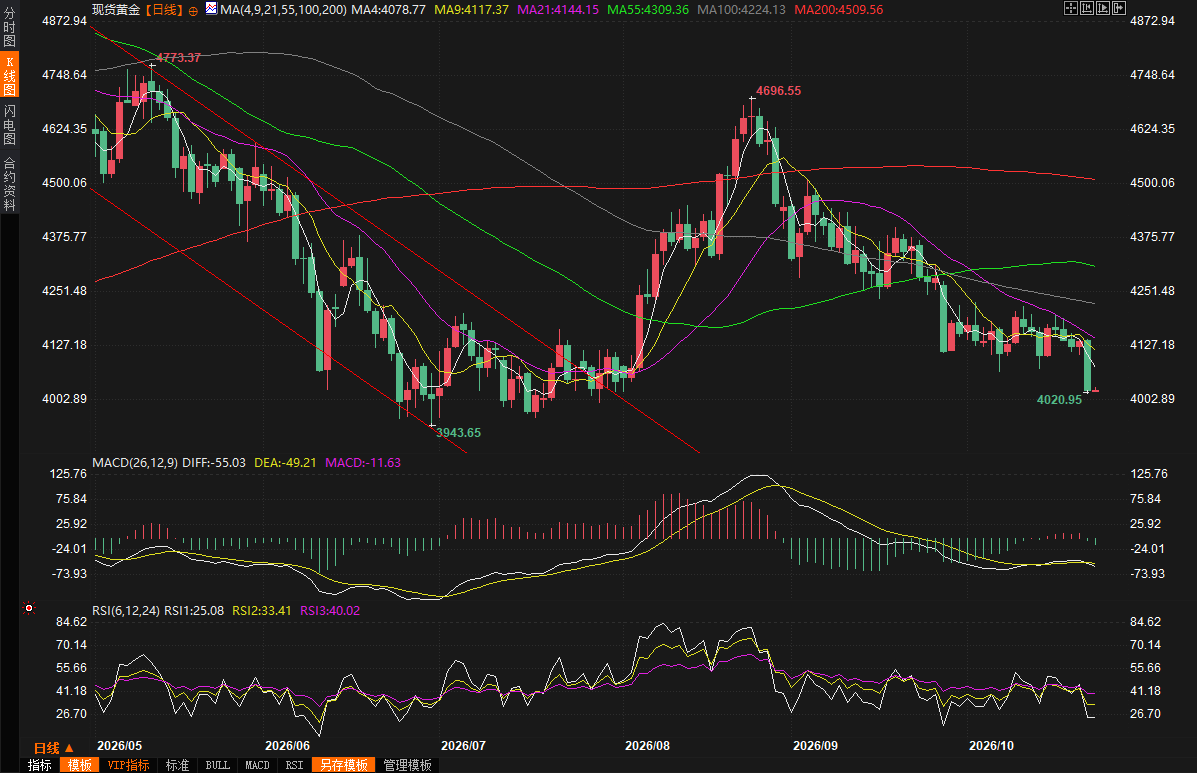 (Spot gold daily chart, source: EasyTrade) At 07:05 Beijing time, spot gold is currently trading at $4023.98 per ounce.
Soaring oil prices fuel inflation expectations, putting interest rate path back in focus.
Following a new round of attacks by Houthi rebels on Saudi Arabia, market concerns about supply disruptions in this key Middle Eastern energy export region intensified rapidly. Brent crude futures surged 4.0% to settle at $113.17 a barrel, the highest closing price since May 4; U.S. crude futures also rose 2.4% to $99.47. Oil prices not only hit a five-month high but also entered technically overbought territory for the third time in a week. The overnight jump in energy prices directly impacted inflation expectations. David Meger, director of precious metals trading at High Ridge Futures, pointed out that rising energy prices are exacerbating market concerns about inflationary pressures, and as inflationary pressures rise, the market is beginning to clearly worry that the Federal Reserve will continue to raise interest rates. Last week's U.S. consumer and producer inflation data both exceeded expectations, further justifying a tightening of monetary policy. Although the market still widely expects the Federal Reserve to hold rates steady at its October 27-28 meeting, the CME FedWatch tool shows that traders now see a 78% probability of a rate hike in December. The US Personal Consumption Expenditures (PCE) data, scheduled for release on October 29, will be the next key window to watch. If the data continues to show sticky inflation, the market's pricing in a "higher and longer" interest rate path may be further strengthened, thus putting downward pressure on gold. As a zero-yield asset, gold tends to be under pressure when real interest rate expectations rise, a point clearly reflected in Thursday's trading.The tug-of-war between safe-haven demand and risk appetite: AI concerns drove a sharp drop in US Treasury yields, but failed to support gold prices.
In stark contrast to concerns about rising oil prices and inflation, US stocks, particularly tech stocks, suffered a sharp decline on Thursday. The Nasdaq fell 2.60%, its biggest single-day drop since early June, while the S&P 500 fell 1.21%. Meta's stock price subsequently plummeted nearly 8% after it disclosed in its earnings report that it experienced its first cash outflow in over a decade due to AI-related spending and announced the issuance of non-voting shares to finance its AI expansion. Tesla also fell 3.1% after lowering its capital expenditure forecast. The Philadelphia Semiconductor Index plunged 6.7%. Renewed market concerns about the sustainability of AI spending and related investment returns triggered a sell-off in risk assets, with funds rapidly flowing into safe-haven assets such as US Treasuries. The 10-year Treasury yield fell 19.3 basis points to 4.953%, its biggest single-day drop since March 2023; the 30-year yield fell 15 basis points, and the two-year yield fell 18.5 basis points. Thomas Urano, co-chief investment officer at Sage Advisory, stated that investors had already priced in inflation and the possibility of further interest rate hikes by the Federal Reserve, but changes in risk asset performance and financial conditions are driving funds towards US Treasuries. Safe-haven trading has clearly dominated the US Treasury market over the past week. It's worth noting that a sharp decline in US Treasury yields usually supports gold, as lower real interest rates reduce the opportunity cost of holding gold. However, gold prices fell simultaneously on Thursday, indicating that concerns about oil-driven inflation and the resulting strengthened expectations of interest rate hikes have temporarily outweighed the positive impact of declining yields. In the battle between "energy inflation" and "safe-haven buying," the former has temporarily gained the upper hand.Geopolitical risks continue to escalate, but gold's safe-haven appeal has not yet been fully realized.
Tensions in the Middle East have not eased despite rising oil prices. Saudi Aramco has ordered its employees to evacuate its headquarters in Dhahran, near Bahrain, on the Persian Gulf coast, as clashes between the Houthi rebels and the Saudi-led coalition continue to escalate. Analysts point out that although reports indicate Middle Eastern crude oil exports have exceeded pre-conflict levels, attacks on ships in the Strait of Hormuz and Houthi attacks on Saudi oil infrastructure are enough to offset the impact of increased exports. Morgan Stanley estimates that Middle Eastern crude oil exports last week were approximately 17 million barrels per day, still slightly below the pre-conflict average of about 18 million barrels per day. Against this backdrop, gold, as a traditional safe-haven asset, should theoretically receive support. However, the current market pricing logic leans more towards the chain of "inflation → interest rates → opportunity cost" rather than simple geopolitical safe-haven demand. As long as the expectation of the Federal Reserve maintaining high interest rates remains unproven, the upward momentum of gold will be suppressed. Meanwhile, India, the world's largest consumer of silver, has issued permits to import approximately 6,500 metric tons of silver over the next six months to meet demand during the festive season. This reflects the resilience of physical demand to some extent, but has a limited direct impact on gold prices.With a key date approaching next week, gold prices may be poised for a directional move.
In summary, Thursday's sharp pullback in gold prices was a result of a combination of factors: rising oil prices fueling inflation concerns, strengthened expectations of interest rate hikes, and market sentiment volatility triggered by adjustments in the AI sector. While the plunge in US Treasury yields signaled safe-haven demand, it failed to reverse the downward trend in gold, demonstrating the continued strong influence of current interest rate expectations on gold prices. Looking ahead to next week, the Federal Reserve's interest rate meeting and PCE data will be key variables determining the short-term direction of gold prices. If the Fed releases a more hawkish signal regarding inflation in its statement or dot plot, or if PCE data continues to exceed expectations, gold prices may face further pressure, testing the $4,000 support level or even lower. Conversely, if data or policy statements alleviate market concerns about "higher and longer" interest rates, coupled with the continued existence of geopolitical risks in the Middle East, gold may stabilize at its current level and seek a rebound. Currently, gold prices have fallen to a more than two-month low, and technical oversold signs are emerging. However, with mixed fundamental factors, the direction will depend on the key events next week. Investors should pay close attention to the interest rate path while also closely monitoring the evolution of the Middle East situation and changes in global risk appetite. The gold market is currently in an environment shaped by inflation, interest rates, and geopolitics, and short-term volatility may intensify. Pay attention to the support level at 4,000. (Spot gold daily chart, source: EasyTrade) At 07:05 Beijing time, spot gold is currently trading at $4023.98 per ounce.
- Risk Warning and Disclaimer
- The market involves risk, and trading may not be suitable for all investors. This article is for reference only and does not constitute personal investment advice, nor does it take into account certain users’ specific investment objectives, financial situation, or other needs. Any investment decisions made based on this information are at your own risk.