French fiscal risk becomes a key variable; this article analyzes four scenarios for the euro against the US dollar.
2026-10-23 07:42:21
On Friday (October 23) during the Asian session, the euro fluctuated slightly higher against the US dollar, currently trading around 1.1220. The European Central Bank's policy path and French fiscal risks remain the core variables determining the euro's medium-term direction. MUFG expects the ECB to keep interest rates unchanged at next week's policy meeting, but believes the tightening cycle is not yet over, although rising bond yields and French fiscal pressures have already done some of the work for policymakers. 
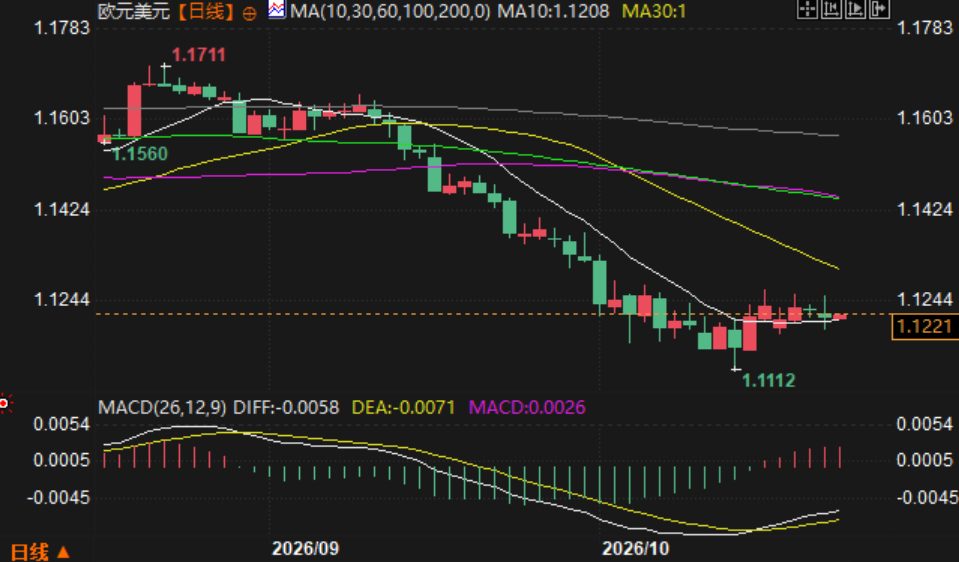 (Euro/USD daily chart, source: FX678) At 7:37 Beijing time, the euro was trading at 1.1220/21 against the US dollar.
Key prediction: Hold off in October, add interest rates once each in December and the first quarter of 2027.
MUFG states that the bond market sell-off and growing fiscal risks in France have ruled out an October rate hike. ECB officials are increasingly pointing to the impact of tighter financial conditions on the outlook, while underlying inflationary pressures remain under control. Nevertheless, the bank's strategists believe that resilient economic activity and higher gas prices since September still provide justification for moving into a slightly more restrictive zone on risk management grounds. MUFG expects the ECB to raise rates by 25 basis points in December, followed by another rate hike in the first quarter of 2027, bringing the policy rate to 3.00%, before lowering it back to 2.75% in the third quarter of 2027. The core of this assessment is that the October pause was a pace adjustment rather than a reversal of direction; the ECB's tightening cycle is not over, but tighter financial conditions and fiscal risks in France have, to some extent, substituted for policy action.France is the core risk: the baseline scenario for fiscal drift.
France is at the center of the outlook. MUFG points out that a divided parliament has led successive governments to repeatedly miss fiscal targets, and despite several consolidation programs, the deficit remains close to 6% of GDP. With public debt at approximately 120% of GDP, the bank states that France has little room to fall further and is highly vulnerable to weak growth or rising borrowing costs. The latest forecast from the IMF already shows France as a notable exception among major European economies, with growth projected at only 0.4% this year. Pressure in the bond market is evident: the spread between French and German 10-year bond yields has widened to levels not seen since the Eurozone debt crisis, while France's annual interest payments have climbed to record highs. MUFG believes that the high and increasing proportion of French debt held by foreign investors may have amplified the sell-off. So far, contagion has been limited, and Italian yield spreads have been relatively controlled.Four scenarios: The baseline scenario is continued fiscal drift, with the euro/dollar exchange rate expected to trade between 1.08 and 1.14.
MUFG presented four scenarios ahead of the French presidential election, identifying Le Pen as the frontrunner. Their baseline scenario (45% probability) involves continued drift: the government relies on procedural mechanisms to function, measures are diluted or postponed, and the deficit remains between 5.6% and 6.0% of GDP. In this scenario, MUFG projects a French-German interest rate differential of approximately 170 basis points, with the euro trading between 1.08 and 1.14 against the dollar. This would not force an immediate response from the ECB, but quantitative tightening could face scrutiny. A deeper credibility crisis (15% probability) would lead to severe political instability, a recession, and a deficit well above 6% by 2027. This would push interest rate differentials above 200 basis points and lower the euro against the dollar to between 1.02 and 1.10, with investors focusing on the ECB's transmission protection tools as a potential backstop. On the more positive side, limited consolidation (35% probability) will keep the spread around 110 basis points, while faster consolidation (5% probability) will narrow it to about 90 basis points and support the euro against the dollar in the 1.12 to 1.18 range.Euro forecast: 1.12 by year-end, rebounding to 1.18 in the third quarter of 2027.
Regarding the euro, MUFG stated that the reduced expectations of ECB rate hikes have already helped weaken the euro, which is closely linked to the short-term interest rate differential between the US and Europe. The bank expects the US dollar to remain strong for a longer period. It forecasts the euro to be at 1.12 against the dollar by the end of this year, then gradually recover to 1.14 in the first quarter of 2027, 1.16 in the second quarter, and 1.18 in the third quarter. The core of this forecast is: in the short term, the reduced expectations of ECB rate hikes and the strength of the dollar will continue to suppress the euro; in the medium term, as the ECB resumes rate hikes and the dollar's strength diminishes, the euro will gradually recover.Market Focus: The Tone of the Statement and Press Conference
With policymakers in a quiet period, next week's statement and press conference will be closely watched to gauge the weight the ECB places on tightening financial conditions and French fiscal risks, and whether it remains open to action in December. At the heart of this focus is the market's search for signals of a December rate hike in the ECB's rhetoric. Concerns about tightening financial conditions could weaken expectations of a December rate hike, while an emphasis on inflation risks could strengthen them.Summarize
MUFG expects the ECB to keep interest rates unchanged next week, but the tightening cycle is not yet over. They anticipate a 25 basis point rate hike to 3.00% in December and Q1 2027, followed by a drop back to 2.75% in Q3 2027. The October pause was a pace adjustment rather than a directional shift; tightening financial conditions and French fiscal risks have, to some extent, substituted for policy action. France is the core risk; the baseline scenario (45% probability) involves continued fiscal drift, with the deficit remaining at 5.6% to 6.0% of GDP, a French-German interest rate differential of approximately 170 basis points, and the euro/dollar exchange rate in the range of 1.08 to 1.14. A deeper credit crisis (15% probability) would push the interest rate differential beyond 200 basis points, with the euro/dollar exchange rate falling to 1.02 to 1.10. MUFG forecasts the euro/dollar exchange rate at 1.12 by the end of the year, recovering to 1.18 in Q3 2027. Markets will be watching next week’s statement and press conference to gauge the ECB’s weighting of tighter financial conditions and French fiscal risks, as well as its openness to action in December. (Euro/USD daily chart, source: FX678) At 7:37 Beijing time, the euro was trading at 1.1220/21 against the US dollar.- Risk Warning and Disclaimer
- The market involves risk, and trading may not be suitable for all investors. This article is for reference only and does not constitute personal investment advice, nor does it take into account certain users’ specific investment objectives, financial situation, or other needs. Any investment decisions made based on this information are at your own risk.